




























Oliver Lovat: The legacy of Steve Wynn in Las Vegas
Oliver Lovat, Global Gaming Insider contributor and Denstone Group CEO, highlights the legacy of Steve Wynn. Disgraced in his personal life, his impact on Las Vegas’ architecture remains undeniable

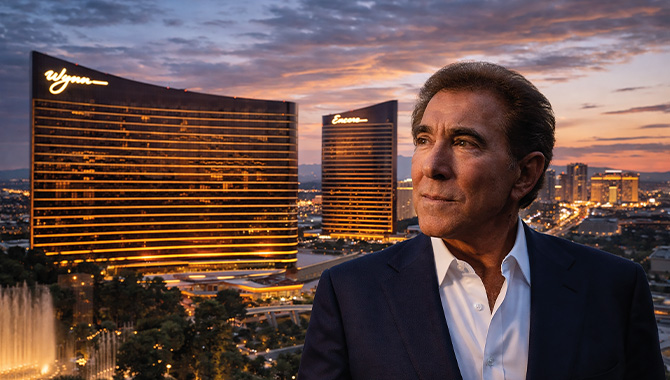
The most eagerly anticipated event in the global gaming calendar is the opening of Wynn Al Marjan, the 1,500-room casino resort in Ras Al Khaimah in the UAE.
Sometime in early 2027, the resort will join the portfolio of Wynn and Encore in Las Vegas, Encore in Boston Harbor, Wynn and Encore in Macau, Wynn Palace in Cotai, and Wynn Mayfair, the private gaming club at the former home of Aspinall’s in London. What makes this particular resort so fascinating is that it is the first casino resort in the Middle East and the first conceived by the company since the departure of its Founder, the most impactful casino developer in history.
In the 2025 Global Gaming Awards, Wynn Resorts was voted winner of the Land-Based Gaming Operator Of The Year, as it has done in four of the past five years. With Elaine Wynn passing in April 2025, this was the first time the company had won this acclaim without a Wynn directly involved.
The Founder as the brand
“I’m Steve Wynn and this is my new hotel, the only one I’ve ever signed my name to.”
Steve Wynn and his team had always struggled with brand names. The Golden Nugget was inherited from the casino he purchased on Fremont Street. It was transferred to Atlantic City, exported to Laughlin and The Golden Nugget Strip was the working name for The Mirage. The aborted Victoria Bay was inspired by the South African cove. Treasure Island owes more to Scottish literature than Southern Nevada, Beau Rivage was the intended name for Bellagio, and Wynn itself was announced as Le Rêve, inspired by Picasso’s masterpiece.
Using the “Founder as The Brand” was not new to either hospitality or gaming companies, most notably in markets where the “Founders” were active in running the business.
Whether it be the McDonald brothers’ efficiency, Melinda Lou “Wendy” Thomas’ pigtails or Harland Sanders’ 11 spices and distinctive appearance, founders as brands have proved a highly effective strategy.
In Nevada’s casinos, founders Bill Harrah, Sam Boyd and Jack Binion all built eponymously named casinos across the nation, promising the “personal touch” in a non-differentiated environment, but it hadn’t been done in Las Vegas for decades, and not on The Strip.Hotel founders Conrad Hilton, John and Alice Marriott, and Hyatt Robert von Dehn lend their names to today’s global hospitality companies; which are far removed from their initial operations, but throughout the portfolio, are still relaying many of their hospitality values.
When selecting the founder as the brand, as we note, there are three primary rationales: recognition of brand via a person, use of a personal brand for pure differentiation purposes, or relaying the personal values of the founder to align with customer experience. Steve Wynn wasn’t just the best-known casino operator in the world, with a track record of creating groundbreaking resorts, his identity was infused into the buildings, the brand, the operations, the interactions and the culture of the entire company.
The clarity of vision Wynn possessed was evident on April 28, 2005, opening night, when Wynn Las Vegas was the newest beneficiary of learnings and practices, some imported, but many developed primarily by leadership over decades. To this day, in Las Vegas, one cannot name a resort that has been built, opened and operated by anyone as successfully as Steve Wynn has done, on many occasions in a range of locations.
Understanding brand Wynn
Before Steve Wynn became Steve Wynn, there was Frank Sinatra.
From his first appearance at the Desert Inn in 1951 to his final appearance in 1994, Frank Sinatra and Las Vegas are timelessly aligned across all mediums. Live albums were recorded at The Sands, concerts from Caesars Palace were beamed to televisions across the nation, in cinemas, Ocean’s 11 built the mythology of the Rat Pack, and when Sinatra played live, his name was in bigger letters than the hotel brand that was the host.
It is no surprise that Wynn coaxed Sinatra from one of his multiple retirements to perform and advertise for The Golden Nugget in Atlantic City. Famously, Sinatra and Wynn showcased the property – with class and dignity, and towels! Sinatra personified the elegance that Wynn wanted to portray and project, even if, in truth, The Nuggets were a long way off from the real luxury that Wynn aspired to and would create in future projects.
Rather, his messaging was about aspiration. By hiring key people across the business, he would fill the gaps where he could translate from what, to why and finally how, and inculcate those values throughout the organization. At the start was the hospitality mission; whether guests were worth a million dollars, or not, all were made to feel that they were. Employees were valued like family and career progress was based on ability rather than qualifications.
Even today’s longstanding corporate executives at Wynn will share how they started at the front desk or at valet. The Management Associate Program for training future executives was established at The Mirage and is now a key part of MGM’s training schedule, churning out dozens, if not hundreds of executives that dominate the industry. This was a culture-first enterprise that reinvented hospitality for Las Vegas, and subsequently the gaming industry in its entirety.
These initial graduates found homes in The Mirage, Golden Nugget, Treasure Island and Bellagio. Many left their well-paid jobs at the merged MGM-Mirage to join Wynn in opening his new resort.
Across employees, there were shared stories, experiences, rituals and values. One of the remarks made after the MGM-Mirage merger was that Mirage-trained employees would ask, “what would Steve want?” when faced with a challenge, rather than revert to the handbook that was provided.
The top-down approach was illustrated in perhaps the final commercial voiced by Steve Wynn before his departure; “There has to be the best place in the world to stay, why can’t it be here?” It was that pursuit of doing it better, more elegantly, that aligned the founder brand to the resort experience had by customers, not just in Las Vegas, but in Macau as well.
Each of his properties were unique. I have written in the past on the intricacies found in the placemaking, whether it be in Downtown, The Strip or Macau, however each of Steve Wynn’s iterations have generated millions of memories from generations of customers. By the time of his departure, the Wynn brand had garnered as much resonance as the Sinatra name held a generation before, absorbing many of the same qualities that Wynn had sought to acquire and interpret across the business.
A Founder problem
Having a founder so aligned intimately with a brand holds problems as well as benefits.
When Steve Wynn was faced with allegations of personal misconduct, as the focal point of all verticals, the Founder’s image was intrinsically linked to the company he built. In theory, the more inseparable the founder is from the brand’s identity, the more vulnerable the brand becomes. In a textbook case of corporate crisis management, Wynn Resorts actively dissociated from Steve Wynn, who became shunned and punished by the industry, and in effect chased out of town.
Wynn Boston was hastily renamed Encore Boston Harbor, fearing the likely response of damaged brand credibility and distrust. It remains the only one without his name on it. There was anticipation of customers feeling anger, wanting to distance from the resort which had tried so hard to capture loyalty from a core demographic.
Not since Charlie Chaplin was forced out of Hollywood, and then the US entirely in 1952, has such a high-profile, successful figure been so traduced by an industry that they were so responsible for shaping.
Now, several years on, we can assess the outcomes.
Other than considering the feelings of Massachusetts’ regulators, the departure of the founder has had little – or indeed no – perceived damage to either the company, the brand, or indeed the reputation of Steve Wynn in the eyes of the customers.
This shouldn’t be a surprise. Research by Warwick Business School shows that the effects of scandals rarely impact a company’s long-term reputation, unless directly showing a failure of the core product.
Matt Maddox, who replaced Wynn as CEO, said to NBC in 2018, “This company is not about a man. Steve Wynn is not Wynn Resorts. Wynn Resorts is about the 25,000 employees that grow this company every day.”
This is true, to a point, but the company exists in a workscape that is a reflection of the Founder, and one that continues very much in the direction that was set out 50 years ago at The Golden Nugget. In every corner at Wynn Resorts, Steve Wynn’s shadow is evident, even if his image is no longer seen.
Wynnless Resorts
It was said to me that when selecting a potential operator to be the first casino resort in the UAE, the rulers wanted Wynn, first and foremost. This is because of the brand positioning as set out by Steve Wynn 20 years ago, and that the leadership team is best placed to bring decades of hospitality planning, learning and culture to a new market with little record of success at this scale.
Undoubtedly, the company has not been damaged since Wynn’s departure, as financial success and accolades show, however a well-known property President shared with me that “It is easy to win Casino Operator of the Year when you are managing resorts designed by Steve Wynn.”
The most interesting aspect for us industry observers (and for investors), is what will a Wynn Resort be like without a Wynn involved? With many of the team that worked on development for decades now gone, will Wynn Al Marjan be able to deliver on the promises that were so intuitive to the Founder’s psychology, with the intimacy, excitement, discovery, warmth, awe and engagement found in other Wynn properties? Or will this next iteration of the brand be positioned in the category of global luxury, which is nearly indistinguishable across brands?
This is a huge test for the company’s future.
Founders’ legacy
There have been several creditable histories written about Las Vegas in recent years by those from outside the industry and a series of documentaries on the evolution of the city have aired. All concur that Las Vegas could – and probably would – have slid into irrelevance or shared the fate of Reno, Laughlin or even Atlantic City, if not for Steve Wynn.
At time of writing, Las Vegas is heading towards 40 million visitors, again, with near-record revenues across the verticals. A total of 150,000 hotel rooms, Allegiant Stadium, F1, The Raiders, The Golden Knights, The Sphere… all part of the new narrative envisioned by Wynn 40 years ago.
But that is not all.
More recently, as casinos have gone global, hospitality development has reached a new scale; there is a greater and growing interest in the business understanding of this industry, the impact of placemaking and appreciation of culture heavy management philosophies. At the core of these fundamental developments was Steve Wynn.
For a generation, after visiting one of Wynn’s properties, it changed the way of thinking about what was possible and encouraged many of us to work in this industry. We are all part of Steve Wynn’s legacy. As are the thousands of independent business operators inspired to create elevated hospitality projects across the globe. But, most importantly, millions of customers revered the experiences Wynn created. And they want more of it.
While some seek expedience in minimizing the impact Steve Wynn had to this city and industry, he remains “The Founder,” not just to the company that bears his name; his work remains the benchmark for the delivery of emotionally resonant experiences. This city and industry should be celebrating Steve Wynn far more than it does. I am frequently told, “it’s complicated”, yet more complicated cases do not face the same opprobrium.
In 1972, Charles Chaplin returned to America after 20 years of exile to receive an honorary Academy Award. Upon appearing on stage, the standing ovation he received remains the longest in The Oscars’ history.
Soon we will know if the company Steve Wynn created will use the Founder’s legacy bequeathed to shape the future of global hospitality development. What remains to be seen is, as Chaplin and Sinatra delivered a parting salute, will the audience get to see one final encore from Steve Wynn, one that isn’t in Boston? It is my view that it is again time to talk about Steve Wynn.
Oliver Lovat is the CEO of the Denstone Group. He advises on development and the strategic positioning of casino resorts.