




























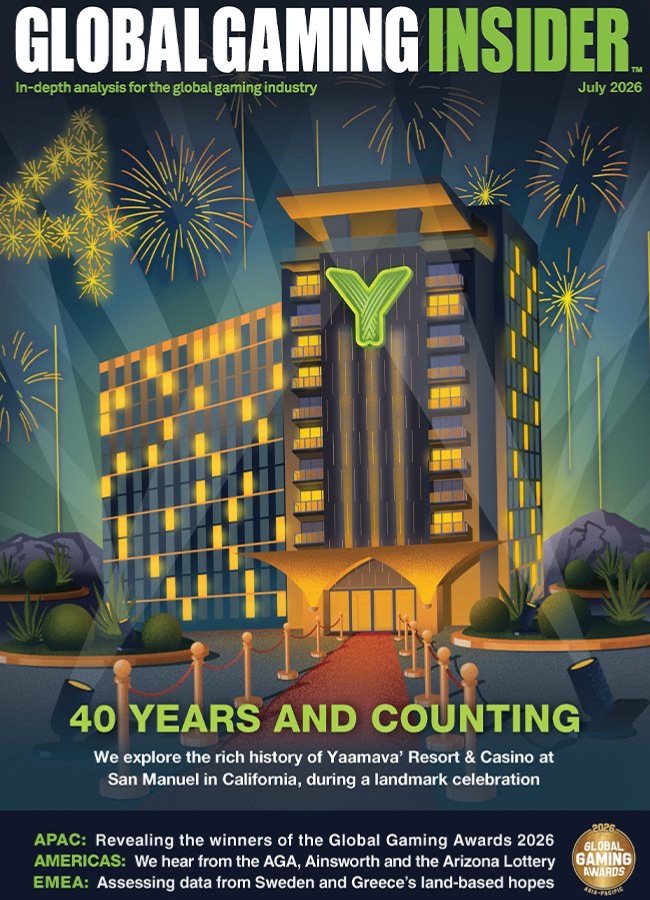
Yaamava' Resort & Casino at San Manuel: Celebrating 40 years and counting
With Kirk Geller on location in California, Global Gaming Insider explores the rich history of Yaamava’ Resort & Casino at San Manuel, as the property celebrates a special landmark this year.

In 1986, the Yuhaaviatam of San Manuel Nation – then known as the San Manuel Band of Mission Indians – launched its first foray into commercial gambling as a means to develop economic self-sufficiency across its
Tribal community. Two centuries of surviving various attempts on its existence and culture had led the Tribe to Highland, California, and the surrounding mountains of San Bernardino. Looking to pique the interest of local residents, the Yuhaaviatam of San Manuel Nation introduced the San Manuel Indian Bingo Hall on July 24, which focused exclusively on bingo games.
Bingo bliss
While more legal framework would be provided in 1988 with the Indian Gaming Regulatory Act (IGRA), the Tribe felt it was necessary to establish economic independence after expanding the right to self-govern just over a decade prior. Described as a “landmark” era for the Yuhaaviatam of San Manuel Nation and other Tribes by Chief Gaming Officer Peter Arceo, the desire to “create opportunity for many generations” led to one of Southern California’s first gambling expansions since horseracing was legalized in 1933.
Even with the Tribe’s foothill reservation at the time extending to just 640 acres, the hindrance did little to suppress curious consumers from making their way to the bingo hall over the next few years. The venue’s success eventually translated to improved healthcare, education and emergency services for the Tribe, and allowed members to develop a healthy partnership with the cities of Highland and San Bernardino. While Tribal leadership recounts early pushback with disrupting the area’s mountainous view, efforts to provide support for those outside the reservation helped form a relationship which still thrives today.
The San Manuel Indian Bingo Hall’s success also led to new expansion by 1994, as the Tribe converted the facility into a 100,000 sq ft casino featuring slot machines and a card room, while still managing to adhere to IGRA-compliant compacts negotiated with California. The project doubled the venue’s floor space and capitalized on the growth of new types of gaming, positioning the property as a regional draw with increased revenue potential. In 2000, new legislation would help the Yuhaaviatam of San Manuel Nation grow its business to an even higher degree, as Proposition 1A permitted Tribes to operate limited casino-style gaming on Native lands.
Going up...
By 2001, further redevelopment included a proposed 41,950 sq ft addition to the casino structure and plans to extend the overall floor space to accommodate expanded slot machine capacity. These enhancements – which had been approved amid ongoing negotiations for gaming compacts – supported steady growth in visitor traffic, which was also enhanced by the introduction of new dining options.
When our time here is gone, we want to leave everything better than when we found it
In the mid-2000s, a new era of the Tribe’s gambling operations would be ushered in, as the original
bingo hall venue was converted into a parking structure for its San Manuel Indian Bingo and Casino property.
“In 2005, the Tribe had the forethought to build an expanded footprint,” Arceo shared with Global Gaming Insider. “What that allowed the Tribe to do was really take the gaming offering to a whole new level. It was introduced into two floors, it was over 400,000 sq ft of facility in total. That’s where the next chapter expanded and continued to grow.”
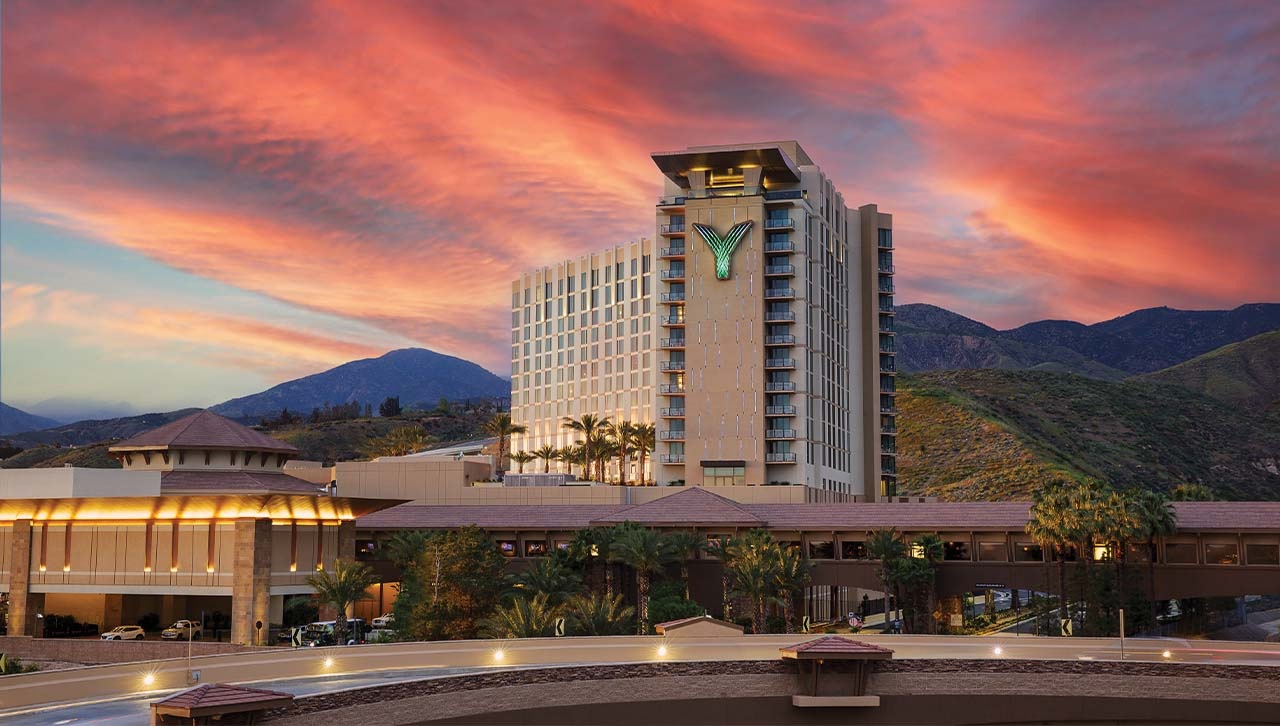
While the San Manuel Indian Bingo Hall had grown into southern California’s most prominent Tribal gaming venue in less than 20 years, its 2005 expansion was but a fraction of the overturn witnessed by 2021. Following a $760m development initiated in 2018, the Tribe rebranded the property to Yamaava’ Resort & Casino at San Manuel from the Serrano word for “spring” to honor its ancestral lands and cultural heritage.
The rebranding preceded the December 13, 2021, grand opening of a 17-story hotel tower – representing the first on-site lodging launched by the Yuhaaviatam of San Manuel Nation – comprising 432 rooms, a pool deck and spa. On the gaming side, what started as a bingo operation to generate economic self-sufficiency had evolved into a multi-level offering with the largest number of slot machines available across the western US. Yaamava’ Resort & Casino at San Manuel GM Kenji Hall spoke with Global Gaming Insider on the “sense of pride” felt once the project was completed, even with difficulties faced due to the Covid-19 pandemic.
“When you see the project and understand the reasons behind it, how we were able to grow and just change to a whole different scenario, that was such a sense of pride for me personally, and what our teams committed to during one of the most difficult times to do construction,” Hall said.
“Building out during Covid, going through all of that chaos and knowing how hard the team worked to put it all together, being able to see it come to fruition was one of the coolest things. It’s been a good ride. And being able to turn out something as beautiful as we did during one of the most difficult times to be working in this industry, that’s super satisfying.”
Ventures in Vegas
While growth across southern California was coming naturally for the Yuhaaviatam of San Manuel Nation, the Tribe’s gaming operations also began expanding to the gambling capital of North America. At the same time as its rebranding of Yaamava’ Resort & Casino at San Manuel, the San Manuel Gaming and Hospitality Authority, an instrumentality of Yuhaaviatam of San Manuel Nation,
acquired The Palms Casino Resort in Las Vegas. The deal was worth $650m, purchasing from Red Rock Resorts, making it the first Las Vegas resort fully owned and operated by a Native American Tribe.
While forced to close its doors due to the pandemic, The Palms had undergone $690m in renovations as recently as April 2019, and concluded a yearslong quest for the Tribe to expand across the California/Nevada border.
We choose to think about governance and the impact these things could have in the future, as opposed to what it can do for me today
To this day and even back when ownership of The Palms changed hands, the Yuhaaviatam of San Manuel Nation has been well-engrained across the Las Vegas area, forging partnerships with the city’s professional sports franchises and providing support for various local charities. When asked how the Tribe’s leadership differs to that of typical Las Vegas casino-resort ownership, Hall describes the “longer-term format” in which strategy is developed across both properties.
Hall explains: “When I compare it to corporate gaming, specifically, the decisions made from a Tribal perspective are generational in the way they plan. Oftentimes, when you’re at the beholden of shareholders, you have to make decisions that are very unpopular to get to a number. The Tribe isn’t about doing that.
“They’re looking at ‘how do we make decisions that are going to further our reputation,’ and those decisions allow us to create a different experience and not be so beholden to ‘I’ve got to get to this specific number.’ That gives us a lot more leeway than most other Tribes or every other corporate gaming place. It’s a different feeling.”
Reaching for the stars
In April 2022, the Yaamava’ Theater debuted as a 2,800-seat entertainment venue in partnership with Live Nation, marked by an opening performance from the Red Hot Chili Peppers and establishing the property as a regional hub for top musical and comedy acts.
With a reservation which now expands to over 1,100 acres, the Yuhaaviatam of San Manuel Nation has been able to expand its footprint to serve as a tantalizing middle ground between Las Vegas and the Los Angeles-San Diego region. Despite the rich successes that have stemmed from becoming a gaming powerhouse, the Tribe has yet to lose focus on its initial goal of preserving lifetime value for its community.
“It begins with the Tribe’s vision,” Arceo explains, “and they’re very clear in generational-style thinking. Not only thinking about today, but tomorrow, the day after, the next generation and so on and so forth. The key strategy here is generational thinking and applying it to business.
“By being able to do that, we’re able to think about what’s best for the long term, as opposed to a short-term gain that may yield negative long-term results. We’re able to build around a world-class guest service property, but that didn’t just happen overnight. That’s an investment in long-term thinking and having that sort of mindset is how we shape the business. We choose to think about
governance and the impact these things could have in the future, as opposed to what it can do for me today.”
Trading competition
Celebrating its 40th anniversary in 2026, Yaamava’ Resort & Casino at San Manuel is still not without threats, however, although most are products developed online rather than in the commercial space. The Tribe has helped deter opponents from sports betting and sweepstakes casinos in California, but a new challenge from prediction market operators has left many scrambling across the US.
When you see the project and understand the reasons behind it, how we were able to grow and just change to a whole different scenario, that was such a sense of pride for me personally, and what our teams committed to during one of the most difficult times to do construction
According to Vice Chairman Johnny Hernandez Jr., prediction markets have become a threat not just to the Yuhaaviatam of San Manuel Nation, but to Indian gaming as a whole.
“There’s a lot of threats coming along and prediction markets are one that’s not just affecting California, it’s affecting Indian country as a whole,” Vice Chairman Hernandez Jr. said.
“Whenever there’s a threat (to) all types of gaming, you see some strange bedfellows get together and they’re suing everybody to try and tie everything up in court. Tribes are really looking at how to best move forward with trying to get through their strategy. They have the resources, the money and it seems like they may have some type of support, but it’s just one of those great issues that came out of the blue. It’s a really confusing issue, so we have to continue to educate, educate, educate.”
With a portfolio that also includes the Waldorf Astoria Monarch Beach Resort & Club, Bear Springs Hotel and fellow hospitality properties across the US, the Tribe may be better prepared to survive threats such as prediction markets as compared to other Native communities. However, the Yuhaaviatam of San Manuel Nation’s efforts to build a greater life for members of its community extends to all of Indian country, especially after requiring its own assistance prior to gaming development.
“We’ve come from a history of reciprocity, not just from our clans, but to neighboring communities. We’ve also been on the receiving end of that in times of hardship. As Chairwoman Valbuena mentioned, waiting for the Salvation Army, Goodwill and assistance from local hospitals. We’re more than happy to jump out and promote those philanthropic efforts and look for the needs of not just our local and neighboring communities, but in all of California and Indian country,” Culture Seat Member Joe Maarango shares with Global Gaming Insider. “Because we’re not just isolated. We’re not on an island here. When our time here is gone, we want to leave
everything better than when we found it.”
What comes next...
Following four decades of building its community into a thriving enterprise, the Yuhaaviatam of San Manuel Nation’s work remains nowhere near complete. According to what should have become a noticeable theme by this point, Tribes don’t operate in a similar fashion to that of the corporate mindset which shapes areas such as Las Vegas and Atlantic City. While quarter-to-quarter responsibilities certainly carry its own challenges, building for the next seven generations is a task only so many choose to take on in gaming.
What is undeniable, though, is that those who came before Hall, Arceo and even Chairwoman Valbuena would be astonished by what has been built on the same lands that once represented a forced shelter for the Tribe. Elders and members who helped organize the original bingo hall may still look up in disbelief at a property which now stands over 15 stories high and provides gaming offerings far beyond traditional games of chance.
As Hall tells Global Gaming Insider, the Tribe’s leadership maintains a “competitive” spirit even 40 years into an operation which has become a staple of southern California. While expansion remains “a little more difficult” due to the property’s mountainous residence, the Yaamava’ Resort & Casino at San Manuel GM spoke to the “diversification” in which the Tribal community has fostered over the past few years. Hall’s sentiment is attested by the Tribe’s commercial portfolio in the US, which may also represent an uplifting irony for a community whose original homeland was once reduced to a fraction of its original state.
As Yaamava’ Resort & Casino at San Manuel celebrates its 40th anniversary in 2026, the property represents more than just an evolution of Tribal gaming, but the 300-year survival of the Yuhaaviatam of San Manuel Nation. For as much success as the casino-resort produces each year, it still stands on the legacy and perseverance of the Tribe’s
previous generations, and those who helped fight for its Native independence.
With four decades now in the books, Yaamava’ Resort & Casino at San Manuel marks an eternal flame that has routinely fueled the Tribe’s economic engine, and helped leadership look toward a brighter future than ever before.