



























CEO Special: Gambling Commission's Andrew Rhodes - Striking the balance
Gambling Commission CEO Andrew Rhodes joins Global Gaming Insider Editor Tim Poole to discuss everything from overcoming absolutism to the future of European regulation.

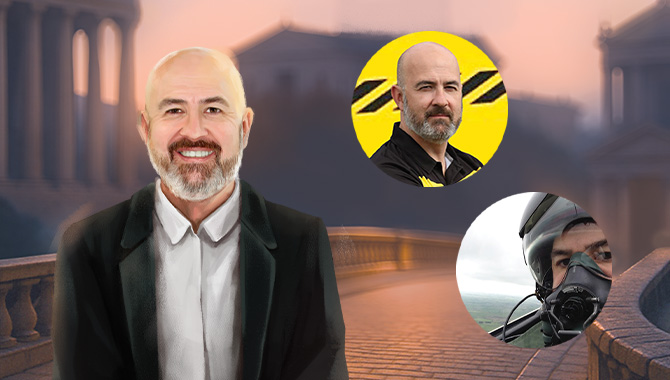
When you run the Gambling Commission, criticism approaches from all sides. Antigambling campaigners berate the regulator for letting the UK market run amok, while industry stalwarts claim the CEO himself bears a personal agenda against the sector. Since June 2021 (as Interim CEO) and May 2022 on a permanent basis, this has become part and parcel for Andrew Rhodes. As we’ll go on to discuss, there is an inherent absolutism that forever shrouds the gambling discussion. That is not a plea for sympathy, rather a simple insight into the reality of daily life as the Gambling Commission CEO.
“You do need to have a very thick skin,” Rhodes tells Global Gaming Insider to kick off our CEO Special. “I think you have to be very resilient and it’s unlike any other job I’ve done.
It is tremendously personalised and has been from when my appointment was announced – actually before I even started. You’ve got people piling in with different views as to what they think of you and what they think you should do. Throughout the four and half years I’ve been in the job, there’s been a constant commentary.”
Rhodes admits this is something he can’t “ignore completely,” yet paying too much attention can lead you to “quite a dark place.” Different types of stakeholders hold “remarkably strong views” and, in their “strength of feeling, are prone to personalise.” That attribution of Rhodes’ supposed views and drivers is something one has to price into the job. In fact, Rhodes acknowledges this is true for public-sector roles more broadly in recent years, with social media’s “democratising effect” serving as a “megaphone for certain views.”
Rhodes is no longer on X (formerly Twitter). Even when he quit the platform, this was interpreted as “meaning something.” All it meant was Rhodes no longer believes X works as a platform: “You just can’t have a dialogue because, if you post anything, you get a load of people screaming across it with their views and trying to drown out anything they disagree with.” This is one of the hardest parts of the job, Rhodes remarks, due to just how “very, very activist” people on all sides of gambling are. Perhaps it is the same for the water or energy regulator, he wonders, but the scrutiny Rhodes’ comments receive adds an extra microscope to proceedings. His recent discussions on cryptocurrency provide an example, with “numerous articles really stretching” his words.
And, with November’s UK Autumn Budget announcing an increase in remote gaming duty from 21% to 40% in April 2026 – among other measures – this scrutiny will be as heightened as ever. “From this interview, I can guarantee there will be a single sentence in it, which you and I will know is pretty innocuous or nuanced, but someone will extrapolate it into something it wasn’t. Maybe not wholly misrepresenting it, but conveying a certain strength that was never there. I’ve never seen that in any other job I’ve done.” Well, let’s see, shall we?
***
Flying high
Our CEO Special features always aim to give a rounded profile of interviewees. As such, we delve extensively into their stories, rather than just asking about their latest conference appearance or financials. Rhodes and I will naturally go on discuss today’s hugest gambling topics – neither of us would be doing our jobs if we didn’t! But what of the person behind the day job, his story and his motivations?
It will not surprise readers to know the Gambling Commission CEO always held a strong interest in the law and debating. As an “upholder of rules in a general sense,” Rhodes also grew up in the 1980s, when there were “a lot of cop shows on TV.” One of his early passions, though, had nothing to do with regulation (or gambling). Indeed, Rhodes always wanted to be an airline pilot and has even done a “little bit of flying.” That love of flight prompted Rhodes to spend seven years as a Non-Executive Director for the Royal Air Force Air Command. The role was independent and deliberately separate from the Air Force, so Rhodes did not serve in the military as such, though both his grandfather and uncle had done so.
At one point, after serving in the Air Cadets, flying was a genuine career direction Rhodes might have pursued. Years later, he applied for the Air Command job and was able to undergo several station tours, simulation work and tasks in an advisory capacity. Striking a balanced tone Rhodes will later apply to our conversations on gambling, he prefaces that he wouldn’t want to “oversell” his contribution, but he had small involvements in some “big programmes and drawdown from Iraq and Afghanistan.”
“I was very much at a distance. But it was a great experience and nice to be able to turn your mind to something that isn’t your normal day job, where you don’t have day-to-day responsibility for delivery. It makes you think a little differently and that’s something I think people sometimes miss. They’re so steeped in what they’re doing; it’s hard to step back and think: how would this look if I could think about it differently?”
Swans, darts and Pep Guardiola
Outside of the day job, another life-long drive for Rhodes has been his “absolute love” for sports – including watching “virtually any sport.” That passion has translated as much in his voluntary work as it has in his leisure time. A case in point, during our interview Rhodes is actually carrying a heel injury from playing squash. In a more formal capacity, Rhodes has been Chair of the Swansea City Association Football Club Foundation since August 2021. The charitable arm is a separate legal entity from the Welsh club and does a “huge amount of outreach” in the local community and across South West Wales. Rhodes tells us: “In partnership with the Premier League, we do all sorts of development work, particularly with disadvantaged kids and schools. It brings the structure and the fun of sports where that might be missing from someone’s life. We run football camps in the school holidays, and it’s great for the kids to be in that environment. We also do a lot of community work to do with mental health, people getting older, health and well-being generally. I’ve been doing that for four and a half years.”
Rhodes is a season ticket holder at his beloved Swansea and has been for years. Due to understandable time constraints in the day job, Rhodes is unable to travel to every away match but still attends several a season. Football, moreover, isn’t the only sport he has attended in person recently. Having bought Premier League Darts tickets, Rhodes’ son “loved” the experience in Birmingham (tickets were sold out for Rhodes’ ‘home’ week in Cardiff). Interestingly, he describes the Premier League Darts as a “really long football match but where the match gets good lots of the time.” By contrast, he’s sat through numerous 90-minute football matches that have left him “wondering about my life choices...”
Still, Rhodes remains a “proper football fan” and even coaches children’s football, something he has been doing at grassroots level for around 10 years. Here is where a humorous connection comes to light and it’s one that – similarly to his love of flying – no one who simply deals with the Gambling Commission CEO in his day job would ever guess. Indeed, he is affectionally nicknamed ‘Pep.’ “I’ve got a qualification with the Football Association of Wales,” he tells Global Gaming Insider. “But the reality is now at the age the kids are, there’s less I can bring. One of the other coaches, she played for Wales at a young age and she’s very talented. She knows far more about football than I ever will, in terms of the technical side. So I can watch a game and see what’s going on with individual players, but as for the more technical side… the reality is, as they’ve got older, I find what I can offer as a coach is limited.”
That, however, does not preclude the Pep Guardiola comparisons. Working only with his children’s teams, Rhodes got into coaching “completely by accident.” In fact, none of the children or parents actually know his real name. For 10 years, he has instead been known as Pep! Not, Rhodes points out, because he shares the Spaniard’s “talent’ but because he has a “very animated coaching style on the touchline.” He adds: “There’s a long story I won’t bore you with, but one of the parents christened me Pep and it’s stuck. It’s really funny that my son’s friends, who I don’t even coach, all call me Pep because that’s just how I’m known.”
Time at the DVLA and Food Standards Agency
In our last major discussion point before we dive into the crux of Rhodes’ current role, it is well worth exploring his previous jobs at the Driver and Vehicle Licensing Agency (DVLA) and Food Standards Agency (FSA). Especially as, if you set aside the topic of gambling, there is a “surprising amount of overlap.” At the DVLA, Rhodes was Director of Products and Services during a “channel shift.” His tenure oversaw a time when it was essentially a paper factory, but people were only just starting to buy their tax discs online. His job was to transform the DVLA from a paper-based company to an online business.
“It was all about consumer behaviours: how to influence people to do things differently, how to tap into things people naturally wanted to do: convenience, lower cost and speed of getting things done. We actually won best marketing strategy at the European Business Awards against multinational banks, which you wouldn’t imagine an organisation like the DVLA would – but it’s what we did.” There are further similarities to when Rhodes was COO at the FSA. Food safety is about a “risk-based approach” and “protecting vulnerable people.” “The vast majority” will be fine, but some people “definitely won’t be.” That will certainly sound familiar to gambling industry professionals. Rhodes joined the FSA a few years after a major incident in 2005 that saw a young schoolboy named Mason Jones (Rhodes says he will “never forget his name”) die from E. coli after eating a school meal. The episode cast a “very long shadow” on how regulation works and what it means to be risk-based.
“Food is the largest manufacturing industry in Britain,” Rhodes explains. “You’ve got a very strong consolidated arm of all the retailers that you would know, and then the tremendously long tail of smaller operators, which again, is very similar to gambling. But how you interact with them is quite different. You’ve got strong lobbies, so those who think lots of things should be banned because they’re unsafe, and you’ve got others who are about personal choice: like people who want to drink raw, unpasteurised milk.”
There were even similarities when Rhodes was responsible for regulating the UK’s abattoirs (slaughterhouses) as part of his role. “It was a really strange profession to be in and, like what I do now, I always had a go-look-see approach. I visited all the different types of abattoirs on a regular basis. It was partly about showing respect to the industry you regulate; you develop a deeper understanding of how things really work...
You’ve got some tricky trade bodies in there.” Referencing our earlier discussion on the need for a thick skin, Rhodes says there is one individual from a trade body who still “occasionally tweets rude things” about him over 10 years since his FSA departure... Yet, “apart from the job I’m in now, the job I enjoyed the most was at the FSA because regulation, I think, is quite interesting. It’s quite challenging. You’re in an organisation where you are at an arm’s length for a reason, and that brings some challenges – with some freedoms as well – and the ability to do things in a way I could never do when I was in a central government department. I found it far more constraining being at the Department of Work and Pensions, for example, than I ever did at the FSA.”
Industry engagement and the political climate
And so to the here and now, where Rhodes applies his career learnings in an industry that is equally as punishing as it is dynamically rewarding on a daily basis. Whatever one’s stance on the Gambling Commission, an undeniable tenet of Rhodes’ tenure is increased industry engagement. The UK’s regulator was once considered a closed book for operators. Media, too – this interview wouldn’t have happened under previous leadership. I ask Rhodes about this approach, as well as how much can improve. “There is always room for improvement,” he states. “I think there is too much invested in individual personalities, but I feel that if you want to effect change and have a reasonable dialogue, you have to invest in it. That involves being more open, more accessible, more candid and taking some risks. That’s just how I think it should be done; it’s how I’ve done it in other jobs, so it’s not unique for me in this role. But it has changed quite a bit, and it’s something people seem to value.”
As a regulator, Rhodes warns one must guard against “regulatory capture and being overly familiar.” Additionally, there are those who “just want to have a meeting because others have met you – and that’s not really what this is about.” A major challenge, Rhodes feels, is “just how poor the debate is” – especially when increased engagement is ongoing. “So much information gets used poorly, wrongly and out of context, and people present arguments quite poorly in and around the industry,” he opines. “Sometimes the industry itself, sometimes campaigners – it’s both sides. I think sometimes there are good points to be made that get made badly, and they get made by overusing or over relying on information that doesn’t quite say what people wish it did. I’ve seen poor discipline on that.”
The eventual arrival of the industry’s White Paper in April 2023 (after years of anticipation) gave Rhodes hope that this quality of debate would improve over time. In his eyes, though, it has only gotten worse. Gambling doesn’t particularly follow party political lines – a feature common throughout the world not just in the UK – so individual ministers can be “in quite different places to each other.” The Commission is right in the middle of this polarised debate: “People want you to take sides on issues where I don’t think there are always sides to be taken.” There is a balancing act for Rhodes: “Things are never all good or all bad, and people are rarely ever all good or all bad, with some exceptions in life. Generally speaking, the regulator’s job is threading that needle. That’s very difficult and I don’t think it’s getting easier.”
Absolutely not
For Rhodes, the Commission’s position is to be the “trusted voice” on the facts about gambling. In this regard, the CEO believes there has been “some success” – but he feels the regulator has not imposed itself here quite how he would have liked. “It’s hard actually turning up and being reasonable. It isn’t what the media wants a lot of the time,” he remarks. “They want ‘I absolutely love betting, don’t you dare touch it’ or ‘betting is an absolute moral evil and should be banned.’” While Rhodes admits not all media work is like this, the competition for attention in today’s landscape can often relegate reason. “We don’t want to referee all the arguments; that’s not our job. Being the authority on the facts about gambling, up to a point, is our job.”
Rhodes has regularly turned down other media engagements because they will be a “cross-examination” instead of an interview. In a formal capacity, a cross-examination in front of a select committee is not something the CEO is opposed to. Other conversations, however, hold “no value” because the interviewer is simply pursuing “media clips of them giving you a hard time and you looking uncomfortable.” Having taken part in multiple podcasts and interviews over the years, the CEO is unafraid of scrutiny and accountability, yet clickbait headlines that constantly fight each other for attention can be “quite dangerous” with a technical and nuanced topic like gambling. “The absolutism you see in a lot of coverage now – we see it a lot in the industry and different sports – is not going to help in the long run.”
This all ties in with how Rhodes aims to go about his role in leadership. Indeed, he emphasises his attempts to “strike a balance.” A common misunderstanding is the assumption everything the regulator does is because its CEO “wills it to be so.” “You can hold two things in your head at one time,” Rhodes says. “Gambling is something millions of people engage with and do not necessarily have a problem with. It is a lesser part of what they do socially, and they want to do that with a minimum of friction. But you can also acknowledge that gambling carries risk, and that some people have been severely harmed engaging with it.”
The Gambling Commission must therefore address gambling’s everlasting, inherent paradox – the regulator must not displace bettors unnecessarily but, at the same time, create a system that curbs potentially dangerous or harmful behaviour. Rhodes summarises: “What I’ve tried to do is be open, candid and engaging with all sorts of different groups. It’s getting harder to engage with some groups because of the absolutism, desire to take sides and to interpret that you are or are not on someone’s side – and I really don’t think that is our job as a regulator. That’s not how we were set up by Parliament. This is a job where you’re being pulled in many different directions, and those directions really do conflict with each other.”
The Football Index saga
When I ask Rhodes what some of his toughest times as a regulator have been, he is quick to single out two individual periods. Intriguingly, one is right now. The other is when he first joined the Gambling Commission – just a couple of months after the collapse of BetIndex (Football Index). Football Index was essentially a stock market where users could trade shares in professional footballers. It was a novel idea – and the platform was, frankly, fun to use. It built up a sizeable following – 500,000 accounts was a quoted number – and even embarked upon national advertising campaigns. But its messaging soon unravelled: marketing focused on investment without highlighting the fact this was still gambling. And, eventually, the floor underneath Football Index fell through; liquidity ran out amid accusations that this was, essentially, a Ponzi scheme where the initial investment needed to run the company ultimately came from later players – an unsustainable business model.
From bettors who lost their money, there was unequivocal fury. Rhodes recalls: “The collapse of BetIndex was an important moment for lots of different reasons and not all the reasons that some people argue. But the Commission was in a tricky place. We had the Gambling Act review still pending; we were towards the end of the National Lottery licensing process; there had been quite a lot of turnover in the Commission’s senior team within a 6-12-month period. We had a brand new Chair; we didn’t have a great relationship with the Government at the time or with the industry… or with campaigners either. I don’t dwell too much on the personalisation, but it was and still is super personalised around the collapse of Football Index. I’m almost reticent to talk about it, because it is still such a flashpoint for some people and their perceptions of me.”
And yet, despite all of the above, today’s environment still poses a greater challenge in the CEO’s view. While Rhodes qualifies this with the fact there are “lots of positives,” the Commission’s current difficulties are compounded by “a lot of litigation,” including an active case involving Richard Desmond and the National Lottery. Enforcement wise, the Commission is also engaged in around 90 current cases – an “unprecedented level.” Overall, the organisation is “very stretched,” according to Rhodes. The recent Autumn Budget announced £26m ($24.7m) in funding for the regulator, but the increasingly polarised nature of the job is not making it any easier.
“I think it’s more symptomatic about the broader environment and the differing perspectives that make it more conflicted,” Rhodes comments. “You are trying to lead an organisation of 400 people and give them the clarity they deserve. There are lots of different conflicting demands on your time and attention, and that’s where your resilience is important and being candid with people about some of the challenges. That’s not about making excuses; it’s about sharing the context.”
The absolutism you see in a lot of coverage now – we see it a lot in the industry and different sports – is not going to help in the long run
"Compliance at the earliest opportunity"
Naturally, though, as a regulator, the Gambling Commission cannot be judged on its actions alone – but additionally how its licensees are operating. Here, Rhodes says “compliance has improved very, very significantly” in recent years. “We generally don’t see many of the same issues as we did before,” he tells Global Gaming Insider. “We can cite figures of how many times more compliant the industry is now compared to four or five years ago, in terms of serious failings and enforcement action being required. It’s many, many multiples better today than it used to be. I would definitely say the industry is considerably more compliant than it was.”
Regarding the specifics of enforcement and compliance, Rhodes is unsurprised that some areas for improvement remain constant: interaction with customers, AML controls and adhering to policy are “common themes.” But these are, after all, consistent areas of discussion and focus within the industry. The Commission has over 2,400 licensees, so does not have a regular yearly auditing model – instead it heads where risk is highest. There is some frustration for Rhodes when the “exact same things get repeated,” because, as he puts it himself, “there isn’t really an excuse for that.”
As the CEO points out, there is further nuance, as the precision of other industries is something gambling can never offer. Going back to his time at the FSA, Rhodes recalls rules dictating a fridge’s temperature, contact time for a disinfectant, storage requirements and many more fixed conditions. Whereas in gambling, “your exposure and my exposure could yield quite different results. We might both not have a problem, one of us might, the other might not – with a seemingly similar experience. So this is an outcomes based regime and that’s where things are different. Someone’s whole life circumstances could affect their risk of harm from anything; but certainly gambling has an ability to escalate quite quickly at a financial level.”
When Rhodes first joined the Commission, there was a period of “significant activity” and the CEO remembers discussing ‘tackling recidivism.’ “That’s a terrible catchphrase, but I didn’t want to see the same things happening again and again. I think we see some repeat issues, but not generally at the same scale.” UK gross gambling yield has grown since, standing at £16.8bn for the 24/25 financial year, but a lot of “extremes have been smoothed out” in terms of consumer behaviour. “On the whole, the overall compliance of the industry is considerably better than it was. Some of that is about the relationships, and I coined a phrase a few years ago: ‘Compliance at the earliest opportunity.’ What I was really saying to the industry is, if we’ve identified an issue, I expect you to fix it quickly. I don’t expect you to wait for enforcement action because, if you are, that enforcement action will be worse.”
The black-market debate
Thus far, Rhodes and I have only discussed the regulated, legal market. But, as the UK’s Autumn Budget approached, Entain CEO Stella David told us the black market will be rubbing its hands ready to claim market share if taxes go up. David is, of course, far from the only commentator to bring up the black market of late and the subject is, obviously, nothing new to Rhodes. “Something that is frequently misreported or misquoted is me having denied the existence of the black/illegal market,” Rhodes states. “The reality is: I set up a specialist team in the Commission more than three years ago on this. We were the only regulator in the world, to my knowledge, to have done that and to have invested significantly in this. “What I did say several years ago is that people overstate the risk of it in relation to changes in regulation. Most sensible commentators, including the industry by and large in this country, will tell you that illegal gambling is not at scale in Great Britain. And that’s partly to do with the work we do and partly to do with the environment. The environment in other countries is quite different in terms of their regimes. I think it is a building risk because of how easy it is for criminals to engage in this, and we’ve got a lot of information about organised crime groups engaged in offering illegal gambling.”
Here, Rhodes says the Commission has an “obligation” to act. He states clearly that any regulatory action must benefit all consumers – as well as the legitimate industry. While the idea that you can completely remove the illegal market “is nonsense,” according to Rhodes, it is important to understand who is gambling illegally and how that can be disrupted. “I’ve said for the last few years that this was the fastest growing area of work in the Commission, and it’s remained so. We’ve published our research, we’ve been very open about it, which really is the opposite of what gets claimed sometimes. But I think some of that really stems back to the debate where people would say ‘everyone will go to the black market.’ That’s not true but, likewise, others say the black market is scaremongering. I don’t think that’s true either. The reality is there is more nuance to this than some commentators wish to regard.”
The future for Europe
I close our interview with a question we’ll be asking every interviewee in this year’s CEO Special. Where is the future of European regulation headed – and not just in the UK? Given Rhodes was recently at the G7 European regulators’ meeting in Madrid, his knowledge on this topic is fresh – and his first key point is that he does not foresee harmonisation. That is “exceptionally unlikely,” due to the difference between EU countries in their political and social perspectives on gambling. While there is some universal EU rulemaking around AML, European countries will increasingly have their own regimes, the CEO says, adding: “There is a question, and this could spark some debate, about jurisdictions that have portable licences. Malta, Gibraltar, the Channel Islands, Isle of Man etc... what will their role in the future be?”
A broader principle Rhodes envisages is the continuation of gambling’s moral debate. How do regulators and policymakers address licensing something that has an association with harm, versus the risk of not licensing it and the harm being “far greater” in the illegal market? “I’ve said many times, you could ban gambling, but you will not stop people gambling. That is one of my worries about some campaigns and policymaking. The risk in policymaking is to remember that every time you displace someone into the illegal market who could be legitimately gambling in the legal market, the risk to them is higher and the likelihood of harm is higher.
“The biggest proportion of people in the illegal market are the self-excluded. We need to get to a position where the interventions operators make reduce the likelihood of someone’s gambling reaching the point where they should self-exclude. And I’ll be careful how I express that, because some people argue that Gamstop’s a terrible thing as those players should be kept in a legitimate industry. Well, I sort of see the point, but the problem with that is some people just are not in a place where they should be gambling, and there has to be a facility for them to stop.” All this, of course, will also be externally influenced by “governments looking for different ways to get tax revenue... at a time when most governments are struggling economically to some degree.”
For a final word, conversations between Rhodes and his team have often emphasised “building relationships” with others in government and within the industry. Industry lawyers have been included a “a lot more” and there has been a focus on productive relationships – not just relationships for the sake of it. “There are people who think I’m the worst thing to ever happen to gambling,” Rhodes remarks. “I think that’s probably a bit harsh! But there are others who completely misinterpret things. Hopefully, the things I’ve tried to do and the things people think I did well are the same, but they won’t always be and that’s the nature of it. I’m clear on what people think I’ve done well – and I’m clear on what I’ve been trying to do for the last four and a half years.”