




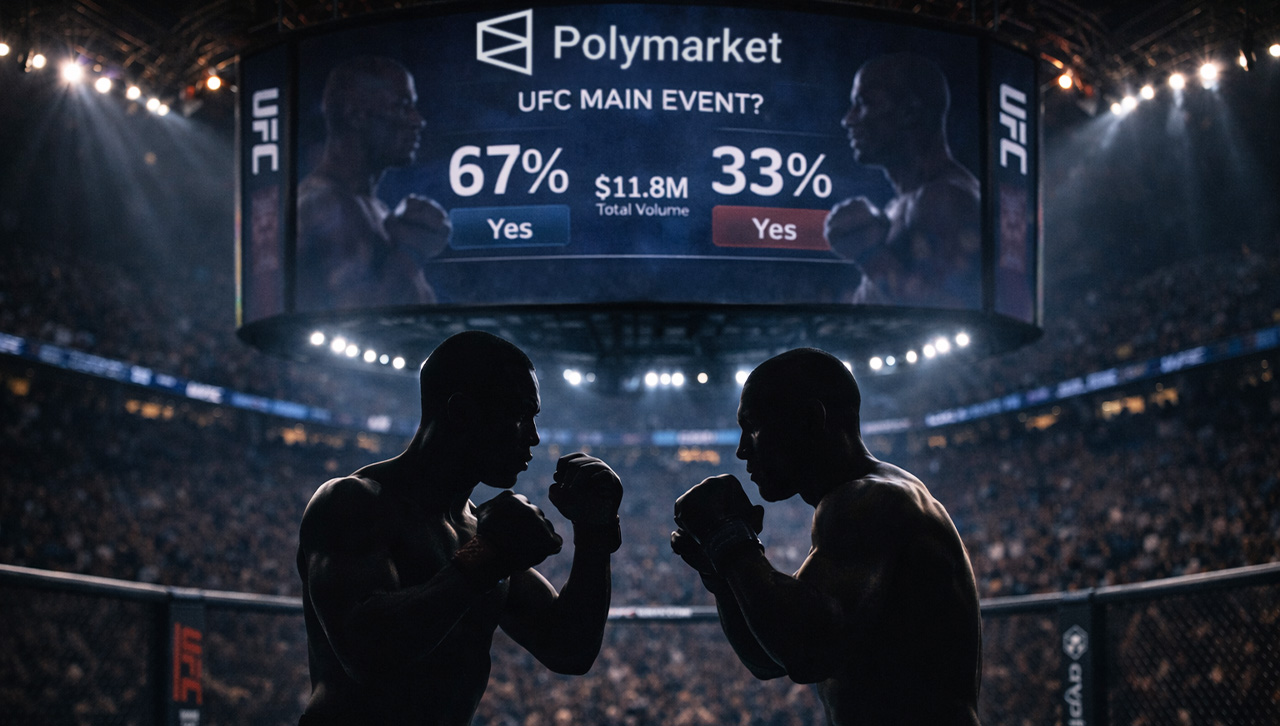
When the UFC announced its partnership with Polymarket in late 2025, it was easy to dismiss it as another “fan engagement” play dressed up in industry buzzwords. Sport has no shortage of those.
But the more you dig into this deal, the harder it becomes to categorize. Is this a betting partnership? A data play? A media experiment? Or something that sits, awkwardly, between all three?
Whatever the answer, one thing feels increasingly clear; this is not just another logo-on-the-canvas sponsorship. It could be an early signal of where the betting ecosystem is heading next.
What does the UFC–Polymarket deal actually look like in practice?
At its core, the agreement makes Polymarket the official and exclusive prediction market partner of the UFC and Zuffa Boxing. That alone is notable, given it marks the first time a major sports organization has formally embraced a prediction market platform in this way.
But the interesting part is how the integration shows up.
Rather than sitting quietly in the background, Polymarket is being woven directly into the broadcast and live experience. Viewers are now being served real-time “fan prediction” data, effectively turning crowd sentiment into a visible, evolving storyline during fights. At times commentators have even been leaning on those probabilities mid-bout, framing momentum swings not just through striking stats or control time, but through how the market is reacting.
This is where things start to feel genuinely new. Sports betting odds have long been part of the viewing experience, but they’ve always come from operators. Polymarket flips that dynamic by presenting something closer to a live, crowd-sourced probability engine.
And that subtle shift matters.
Does this complement traditional sportsbooks – or quietly compete with them?
Here’s where the situation gets a little more complicated.
The UFC isn’t just working with Polymarket. It also has a long-term agreement with bet365, which remains firmly rooted in the traditional sportsbook model. That partnership is all about driving wagering activity, with integrated odds, in-play betting prompts and same-game parlays baked into the broadcast.
Indeed, now there are two parallel layers sitting on top of the same product. One is trying to convert viewers into bettors. The other is trying to turn them into participants in a prediction market.
In theory, the two can coexist quite happily. Polymarket’s probabilities could act as a “second screen” data point, giving fans additional context before they place a bet with a bookmaker. For affiliates, that could even open up new content angles, comparing market sentiment with sportsbook pricing and leaning into that gap.
But there’s an underlying tension that’s hard to ignore.
If fans begin to trust prediction market pricing as a more accurate reflection of reality, sportsbooks risk losing some of their informational authority.
Odds are no longer the only narrative in town. They’re just one version of it
And once you introduce competing versions of “truth” into a betting ecosystem, things tend to get interesting quickly.
Why are prediction markets suddenly everywhere in sport?
The UFC deal might have been the first of its kind, but it didn’t stay unique for long.
Major League Baseball has already moved into the space with its own Polymarket partnership, complete with data-sharing agreements and regulatory coordination. At the same time, other leagues have started to follow suit.
The NHL, for example, has explored partnerships with both Polymarket and rival platform Kalshi, while Major League Soccer has also struck its own deal with Polymarket. Even individual franchises, such as the Chicago Blackhawks, have tested the waters with team-level agreements.
Meanwhile, companies like Sportradar are openly talking about the commercial upside of prediction markets, while Kalshi continues to push into a range of sports-related contracts too.
Taken together, this doesn’t look like a one-off experiment. It looks like the early stages of a land grab.
The appeal is obvious. Prediction markets offer something that sportsbooks don’t naturally provide, which is a clean, market-driven view of probability. There’s no overround, no trader bias, no promotional skew. Just price discovery in its purest form – or at least that’s the pitch.
For sports leagues, that creates a new storytelling tool. For media companies, it creates new content. And for affiliates, it potentially creates an entirely new funnel.
The question is whether that funnel leads into traditional betting, or away from it.
Are prediction markets operating in a legal grey area?
If the commercial opportunity feels clear, the regulatory picture does not.
Prediction markets in the US fall under the remit of the Commodity Futures Trading Commission (CFTC) rather than state-level gambling regulators. That distinction has allowed platforms like Polymarket to operate in a space that looks a lot like betting, but is framed as financial trading.
Not everyone is convinced.
There are already legal challenges emerging around such platforms, alongside broader debates about whether sports-based event contracts should be classified as gambling.
That uncertainty hangs over everything.
From an affiliate perspective, this is where the opportunity starts to feel slightly uncomfortable. Traffic is great; engagement is great, but if the underlying product sits on shaky regulatory ground, monetization becomes harder to rely on.
In other words, the upside is real, but so is the risk.
Are sportsbooks and prediction markets heading for a collision course?
This is probably the most interesting question of all, and the answer isn’t obvious.
On one hand, prediction markets look like a natural competitor. They offer lower friction pricing, a different kind of user experience and a product that appeals strongly to data-driven and crypto-native audiences. If they continue to integrate with major sports leagues, it’s not hard to imagine them eating into betting spend over time.
On the other hand, there’s a strong argument that we’re heading toward convergence rather than conflict.
Sportsbooks could easily incorporate prediction-style markets into their existing platforms. Prediction market operators could just as easily layer in more traditional betting mechanics. And both sides could end up drawing from the same underlying data infrastructure.
The UFC deal arguably points in this direction. By positioning Polymarket as a “storytelling” tool rather than a direct betting product, TKO is threading the needle. It gets the engagement upside without explicitly undermining its sportsbook partners.
Whether that balance holds is another question entirely.
What does this mean for affiliates and the wider betting ecosystem?
For affiliates, this feels like one of those moments where standing still is probably the worst option
Prediction markets open up new types of content, new audiences and new ways to engage users. There’s an obvious play in analyzing price discrepancies, tracking sentiment shifts and building editorial around how “the market” is reacting in real time.
But the commercial model is still evolving. These platforms don’t necessarily plug into the same affiliate structures as traditional sportsbooks, which raises questions about how traffic is ultimately monetized.
There’s also a broader strategic consideration. If prediction markets become a meaningful part of the sports consumption experience, affiliates will need to decide whether to treat them as a complement to betting, or as a vertical in their own right.
That decision could shape content strategies for years to come.
Is this a one-off experiment – or a sign of what’s coming next?
It’s tempting to view the UFC-Polymarket partnership as a novelty. Combat sports have always been more willing to experiment, and the UFC in particular has built a reputation for leaning into betting and data-driven engagement.
But the follow-up moves from MLB suggest something bigger is happening.
If more leagues start exploring similar partnerships, prediction market data could become as commonplace as sportsbook odds in broadcasts. At that point, the distinction between “betting” and “predicting” starts to blur in a way that’s difficult to reverse.
And that’s when this stops being an interesting side story and becomes a structural shift.
For now, the UFC deal sits in that intriguing middle ground. It’s experimental, slightly controversial and not entirely defined.
But those are often the deals worth paying the most attention to.