















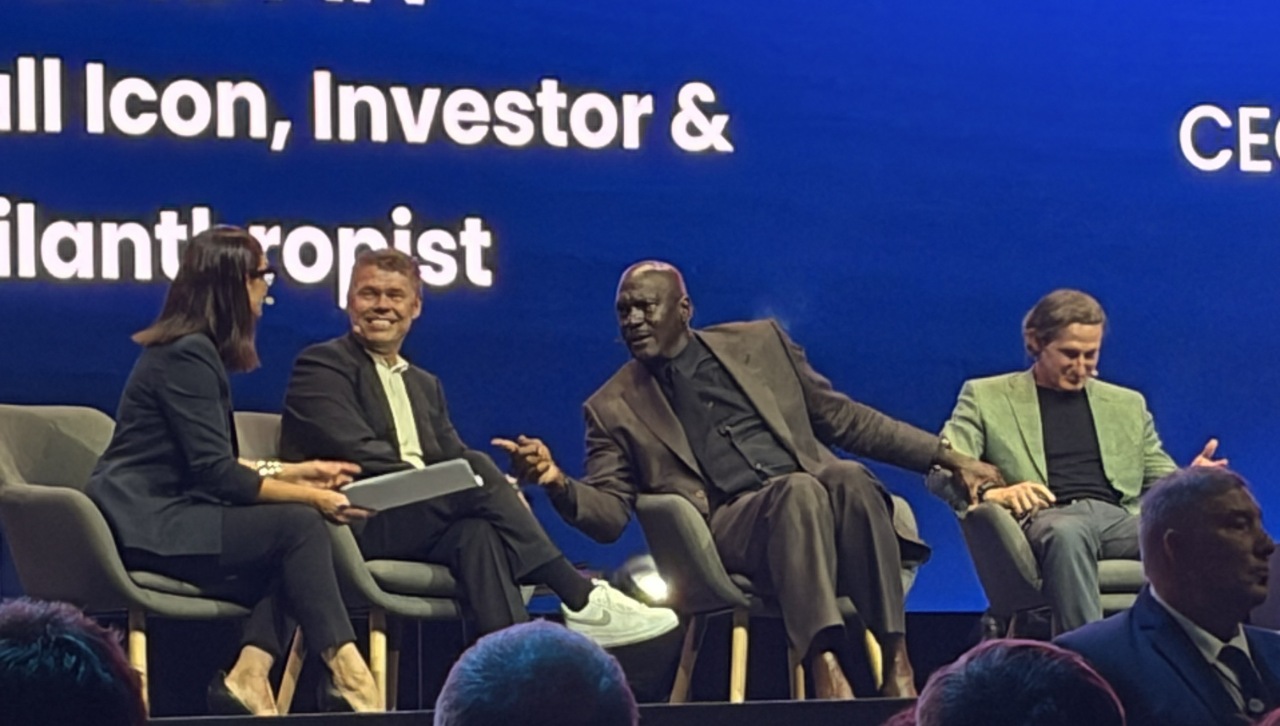
SBC Summit Lisbon 2026 started off with a powerful lineup: Leadership in Sports Business brought together NBA legend Michael Jordan, DraftKings CEO and co-founder Jason Robins and Sportradar CEO and founder Carsten Koerl.
Hosted by broadcaster Kirsty Gallacher, the conversation moved between fan engagement, technology, betting, investment and the changing role of athletes.
Fans become part of the action
The central theme was the changing relationship between fans and sports, and how technology and betting are increasingly becoming part of that relationship.
Koerl described an industry that is learning more about the people on the other side of the screen, using data and social media to understand what fans want and how to connect with them in an increasingly 24/7 sports environment.
Robins approached the same question from the customer side. For him, betting gives fans another reason to care about an event or team because it creates a personal connection with the outcome.
“We help them care about the outcome past just enjoying the tremendous athletic ability on show all over the world,” Robins said.
That idea of moving fans closer to the action became one of the main threads of the panel. For Robins, sports betting can turn a passive viewing experience into something more personal, giving customers another reason to follow what happens on the field or court.
Jordan offered an interesting perspective on the same development because he has seen the sports industry from both sides. As a player, he said, his attention was almost entirely on the game. His perspective changed after becoming involved in ownership and technology.
Rather than making customers decide which product or application to use, the technology should allow them to access different experiences in one place
“As a player I never really focused on what fans were thinking, but once I started looking at it from an owners and technologies perspective, I now know the fans have a better understanding today on the outcome and they really want to get involved in that way,” Jordan said.
That change also helps explain why the modern sports ecosystem has become considerably more complicated. Fans now have access to more information, more ways of interacting with athletes and teams, and more products built around individual events.
The NBA star acknowledged the controversy that comes with betting, particularly when it intersects with sports. Pointing toward Robins and Koerl, he joked: “You're always going to have some people angry at these guys, and sometimes these guys are gonna be happy as hell!”
Prediction markets raise new questions
The conversation then moved into one of the industry's more immediate questions: prediction markets. Robins compared the current excitement around the sector with DraftKings' previous involvement in NFTs.
The company participated in that market, but the initial expectations did not translate into a long-term business in the way some anticipated. Prediction markets, he suggested, raise a similar question: how large can the category ultimately become?
The discussion raised another long-discussed question: should prediction markets be viewed as sports betting or as financial products? The only conclusion was how quickly the boundaries around traditional gambling products are changing.
Technology reshapes the customer experience
Technology was another major component of the conversation. Robins explained the thinking behind DraftKings' Super App, which is designed to reduce friction by bringing different products and verticals into one customer journey.
The idea is relatively simple: rather than making customers decide which product or application to use, the technology should allow them to access different experiences in one place. Robins noted that this was not always technically possible.
Earlier generations of technology struggled to host multiple verticals without creating slow or unreliable experiences. Today, he argued, the infrastructure is capable of delivering a high-performance customer experience across several products.
Koerl took the technology discussion further when asked about the industry's next major development. His answer focused on the combination of sports and gaming, including Sportradar's Playradar initiative and the use of AI to create more bespoke products and customized customer journeys.
Jordan pointed to women's sports as an area with significant momentum, while also discussing NASCAR, which he described as having been ''underappreciated'' over the years
The modern athlete’s challenge
The panel also considered how much pressure now falls on athletes themselves. Jordan's answer offered one of the clearest contrasts between his generation and the current sports environment.
When asked how he would have approached the modern game, Jordan said his priorities would remain the same: focus on the opponent, the game and winning. But he acknowledged that today's athletes have a much broader set of responsibilities.
“Today you have to build a brand, worry about the number in terms of financial,” he said, clarifying that this represents a fundamental difference from his playing days. The question used to be relatively simple: could a player win the championship, and could they do it again?
Today, athletes also have to consider everything surrounding the game. Jordan said he would not have approached his career differently, but admitted he does not envy the additional pressures facing current players. He stated: “I can only play basketball.”
His comments on investment followed a similar logic: finding opportunities where sport and audiences already have a strong connection. Jordan pointed to women's sports as an area with significant momentum, while also discussing NASCAR, which he described as having been “underappreciated” over the years.
His interest in NASCAR is partly connected to the possibility of growing its audience, with Jordan pointing to Formula 1 and the impact of Drive to Survive as an example of how a sport can create a stronger connection with consumers. If he can make an impact as an investor, he said, “it's worth the challenge.”
The panel did not provide definitive answers on prediction markets, the future of betting or where AI will ultimately take sports. Instead, it showed an industry moving toward a more interactive model, in which the fan is increasingly part of the experience rather than simply an observer.
Regarding prediction markets, Kalshi recently introduced AI agents to automate trades on its platform