





























Stability can be a fickle thing.
On the operational side, industry giants can go from established leaders to bit-part players and, finally, a historical timestamp in a surprisingly short amount of time.
Indeed, if innovation is the lifeblood, then staying ahead of the curve is the fuel that feeds the fire. And just as operators must innovate to stay alive, so must jurisdictions.
Diversify or face the downturn?
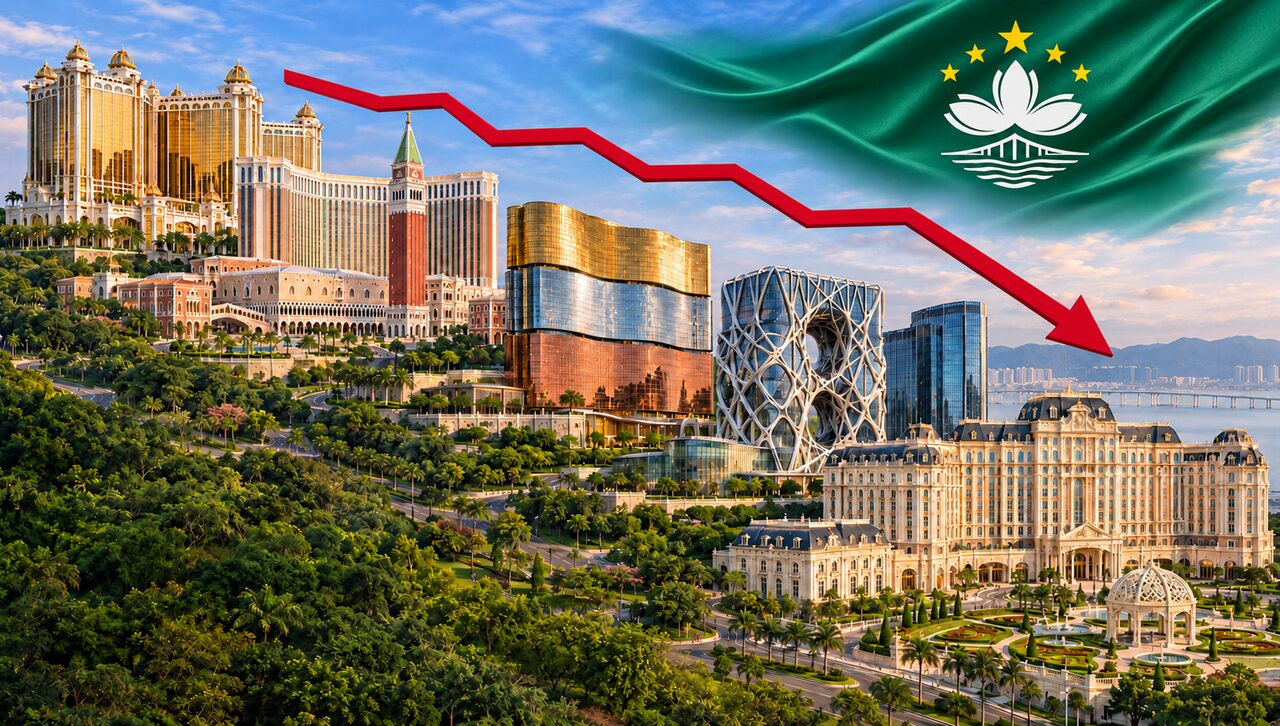
2026 has been so action-packed that anyone could be forgiven for having missed some of the more subtle trends developing under the radar. However, there's nothing subtle about a five-month consecutive run of revenue declines, especially in the industry's highest earning GGR region by geography.
The industry has long looked to Macau as a leader on a global scale. For anyone in need of Westernized context, the region consistently outpaces Nevada's monthly gaming revenues two-to-one – with every month more or less seeing gross gaming revenue exceed the US$2bn mark. And, in a way, that's the problem.
Recognizing the fact that much of Macau's post-pandemic recovery was supported by a mass-market segment that is also experiencing a revenue slowdown is important
One thing the Macanese gaming industry learned from the pandemic was that an economy which is (almost) entirely dependent on a singular industry is incredibly exposed. Thus began the region's well-documented quest for diversification. Macau's big six operator license concessionaries agreed from the outset to aid non-gaming investment, with billions of dollars having been spent over the past five years to try and achieve a more rounded visitor experience for overseas and Chinese tourists, alike.
For the most part, the past three years have seen consistent revenue recovery from the Covid-19 pandemic, which meant consistently advancing figures on a year-over-year basis. Indeed, there was a warning shot for Macau two years ago when revenues faltered in December 2024 and January 2025 – but a five-month downturn is a different thing entirely.
Now, with half of the region's six operators having reported revenue declines for Q3, the outlook for 2027 is looking increasingly uncertain.
Macau's Q3 from the operator perspective
Diving into the numbers, Macau's revenue downturns began with a 12.1% year-over-year drop in June and ended most recently with a 10% year-over-year drop in October – the two most notable reductions of the five-month period.
Observing Q3 results from the region's six operators, SJM Holdings fared the worst, with GGR having dropped 23.9% to HK$5.4bn (US$690m) and adjusted EBITDA also down 20% to HK$705m. Indeed, the closure of satellite casinos mean that the year-over-year revenue comparison is not exactly like-for-like, and interestingly, SJM's non-gaming revenues actually rose 6.6% to HK$530m during Q3.
Melco's Q3 struggle was largely centered around its flagship City of Dreams property, which saw revenue and EBITDA decline 15% and 37%, respectively. This contributed to an overall group revenue drop of 10% to US$1.1bn, and a group EBITDA drop of 24%. Income dropped 45% overall, but the silver lining is SJM's Altira property saw revenue rise 22% to $31.3m, begging the question around a potential property-specific struggle.
With regards to Wynn Resorts, revenue at Wynn Palace dropped 8.1%, and Wynn Macau 8.2%, settling at $583.8m and $335.4m, respectively. Looking a little closer, however, Wynn's results demonstrate that the difficulties are not confined to one property or one revenue stream. Casino, hotel, food and beverage, entertainment and retail revenues all declined.
Macau 'big six' Q3 comparison (US$m)
Who bucked the trend?
On the other side of the coin, Galaxy Entertainment Group, MGM China and Las Vegas Sands' Macau-specific operations managed to turn over more positive results, adding another dimension to the conversation overall.
MGM China's revenue rose 4.6% to US$1.1bn, despite group EBITDA and revenue declining 20.4% and 1%, respectively. Overall net loss also improved by 94%. Elsewhere, Sands' Macau revenue rose 1.8% to US$1.9bn, but a disconnect between rising revenues and declining EBITDA was evident across a number of its properties in the region. This, of course, raises questions around operating costs, margins and the profitability of maintaining an increasingly extensive integrated resort portfolio.
Galaxy's results, however, were unequivocal. There is no doubt that the operator bucked the trend. Net revenue was up 4% to HK$12.7bn, and up 7% quarter-over-quarter. Adjusted EBITDA increased 10% to HK$3.7bn, while group GGR rose 5% to HK$12.9bn, driven by a 41% increase in VIP GGR to HK$2.9bn.
So, pooling the results from all six of Macau's operators together creates a picture that is as fragmented as it is fascinating. A widening gulf between revenue, profit / loss and EBITDA is concerning. Rising operational costs and within a struggling Chinese economy at this moment in time make for a difficult operational environment. Adding significant investment commitments to the mix doesn't help. But when you consider the fact that Macau's diversification and subsequent survival is dependent on that investment, the problem starts to feel very real.
Picking apart the problem
While a diversification scheme that is dependent on investment from operators that cannot afford to invest is something of a Catch-22 for Macau – there is, of course, a lot more at play.
Despite being a separately governed autonomous region, Macau's fortunes remain heavily reliant on mainland Chinese visitation and consumer trust. The good news is that, in September 2026 alone, arrivals from the mainland grew 17.4% year-over-year, as well as rising 13.1% over the course of the spring period. Indeed, Golden Week visitation in Macau also experienced an upswing.
What's more, September 2026 visitation from overseas also included notable upswings from Taiwan (+18.7%), the US (+24.7%), Thailand (+42.3%), Australia (+15.4%), India (+11.4%), Japan (+2.7%) and a surge from Russia (+124.3%).
This makes the region's inability to turn over positive revenues all the more puzzling. But, then again, in an increasingly war-stricken, high-volatility global economy, maybe not. Encouraging people through the door is one thing, encouraging them to spend big at a time where so much wealth is held by so few is another. Macau will have to find a way, though, if it wants to invest itself back into growth.
A diversification scheme that is dependent on investment from operators that cannot afford to invest is something of a Catch-22 for Macau
Recognizing the fact that much of Macau's post-pandemic recovery was supported by a mass-market segment that is also experiencing a revenue slowdown is important. This could mean that operators may have to compete more aggressively for high spenders – a strategy that (in part) appears to have aided Galaxy over the course of Q3, as VIP GGR rose 41% to HK$2.9bn.
The year ahead...
Picking apart the problems of any region will inevitably start to sound inherently 'doom and gloom.' It wasn't too long ago that people were having these kinds of doomsday conversations around Las Vegas. And yet, the wheel keeps on turning.
Macau's resilience is perhaps its greatest strength, and strong tourism numbers serve to highlight the fact that the players are still very much present. As with a number of markets across the world, increased financial strain is likely to lead to something of a divide. It's not just revenue and profit / loss / EBITDA that will be pulled apart, but operators, too.
Those who can afford to draw an enhanced focus on premium players – such as Galaxy, MGM and Sands – may start to outperform those who don't, creating a two-speed market.
In any other region, this would likely mean consolidation. But with only six operators so deeply embedded into the region's architecture, this outcome remains unlikely – at least in the year ahead. The remaining three operators are likely to feel the squeeze of the mass-market slowdown, but if Chinese and global economic turbulence settles down, consumer confidence may improve in tandem with new developments – perhaps sparking some recovery in GGR.
Last year, November and December GGRs both exceeded MOP 20bn, with January 2026 GGR reaching MOP 22.63bn, up 24% year-over-year. So, while 2027 marks a major inflection point for the region in the medium-term, recovery in the short-term is still very possible – as three typically lucrative months lie ahead.
It's sink or swim in the gaming industry. And, in years to come, Macau's response to this alarming downturn may become the defining moment of its long-term success story.
Despite having made a full recovery from the Covid-19 pandemic, Macau's revenue has yet to return consistently to pre-2020 levels