
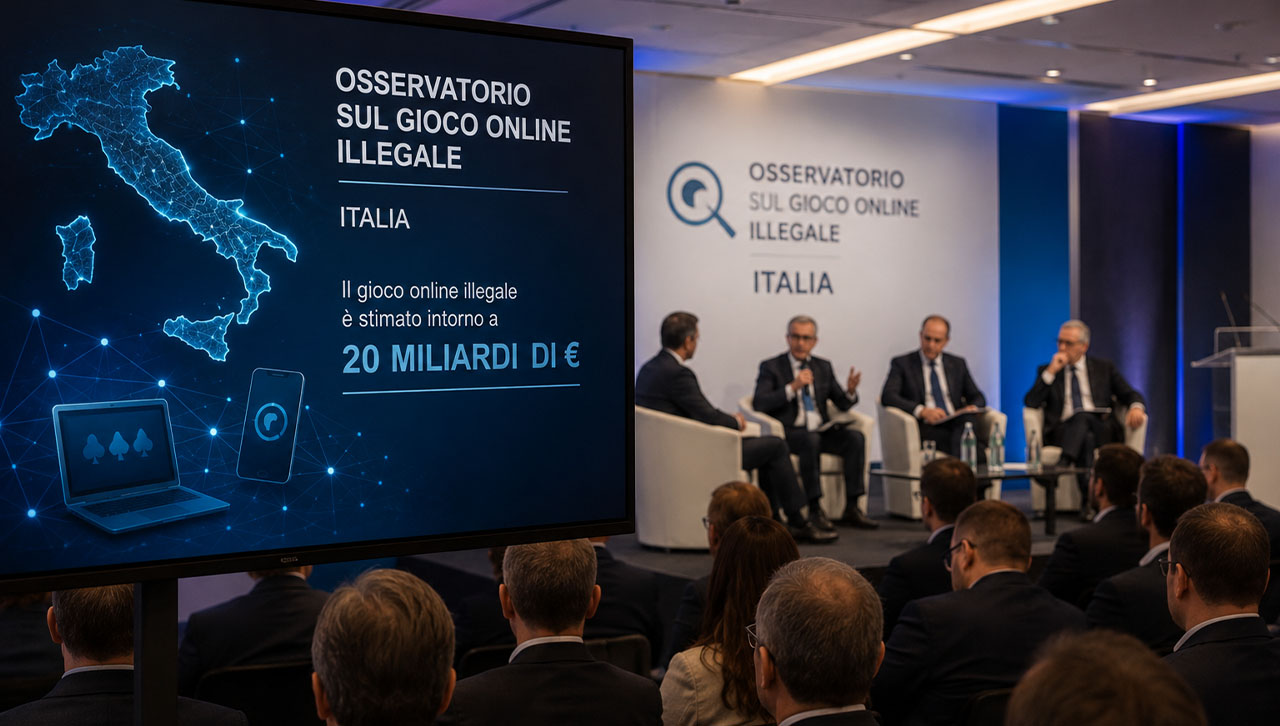
Illegal online gambling in Italy is estimated to generate around €20bn in annual activity, according to findings from the Observatory on Illegal Online Gambling at Data Room Nexus.
4.5 million users and 13 million accesses recorded in first quarter of 2026
In the first three months of 2026, 4.5 million Italian users were active in illegal online gambling, and more than 13 million accesses were recorded.
During this period, the Observatory used a methodological approach based on empirical observation of digital environments and structured data analysis. It identified an average of four to five new illegal sites per day, resulting in a sample of 500 domains. It estimates that at least 5,000 such sites are active annually in Italy.
The difficulty in combating illegal sites stems from the ecosystem’s dynamic and fragmented structure. The Nexus study finds it is driven by numerous small and medium-sized operators that can quickly reappear through “twin sites” after being blocked, maintaining operational continuity.
Social media platforms identified as key channels for illegal gambling advertising
Social networks are playing an increasingly important role as a point of contact between players and operators through advertising. According to the report, advertisements on social platforms are perceived as more credible, creating a mechanism of implicit legitimisation, lowering perceived risk and increasing trust in illegal content.
The Observatory identified Facebook, TikTok and Instagram as the three main platforms with a significant presence of such advertising.
EU Digital Services Act seen as potential tool for stronger cross-border enforcement
Communications regulator AGCOM Director of Media Services and Protection of Fundamental Rights Giorgio Greppi stated: “Illegal gambling advertising is not found in newspapers, radio or television. Everything has moved to social networks.’’
He noted that enforcement is ongoing but has been hindered by longstanding liability exemptions for online platforms.
Greppi pointed to the European Digital Services Act (DSA), in force since February 2024, as a potential solution, stressing that its effectiveness will depend on strong implementation.
Luca Turchi of the regulator ADM said the DSA could be an important tool in tackling illegal activity, but requires coordinated cross-border enforcement due to the sector’s ability to regenerate quickly.
The European Digital Services Act (DSA) is an EU regulation requiring online platforms to address illegal content, harmful activity and disinformation while protecting users’ fundamental rights