






























Key Points
- Effective disruption of illegal online gambling requires coordinated action among regulators, financial institutions, technology platforms and law enforcement across multiple jurisdictions
- Countries are combining website blocking, payment restrictions and targeted raids to dismantle criminal networks and prevent access to unlicensed operators
- Regulators are working with major digital platforms and social media networks to limit the promotion and visibility of unlicensed sites
- Despite enforcement measures, illegal operators continue to adapt, making ongoing vigilance and cross-sector innovation essential
Tackling illegal online gambling is a multidimensional challenge that requires cooperation among multiple stakeholders, as no single actor or strategy can address it alone. These networks have gotten increasingly sophisticated, and the growth of online and cross-border gambling, along with the use of digital payment methods, has made it harder to monitor.
Countries worldwide are deploying increasingly sophisticated technical measures to disrupt access to offshore gambling platforms, including DNS interference, payment blocks and financial transaction monitoring. Illegal gambling advertising is also targeted, especially on social media, which has the potential to reach massive numbers. This multi-layered approach requires coordination among regulators, operators, financial institutions and authorities, and should be built on cooperation and knowledge sharing.
So, how do we eradicate this issue completely? Simply put, it is impossible. The fight against illegal gambling will never end in a single definitive victory. However, that does not mean the battle is a lost cause; large criminal networks can still be disrupted and their operations hampered.
The following infographic illustrates strategies against illegal gambling, a multi-layered regulatory and law-enforcement framework authorities use to detect, disrupt and dismantle unlicensed online gambling operations.
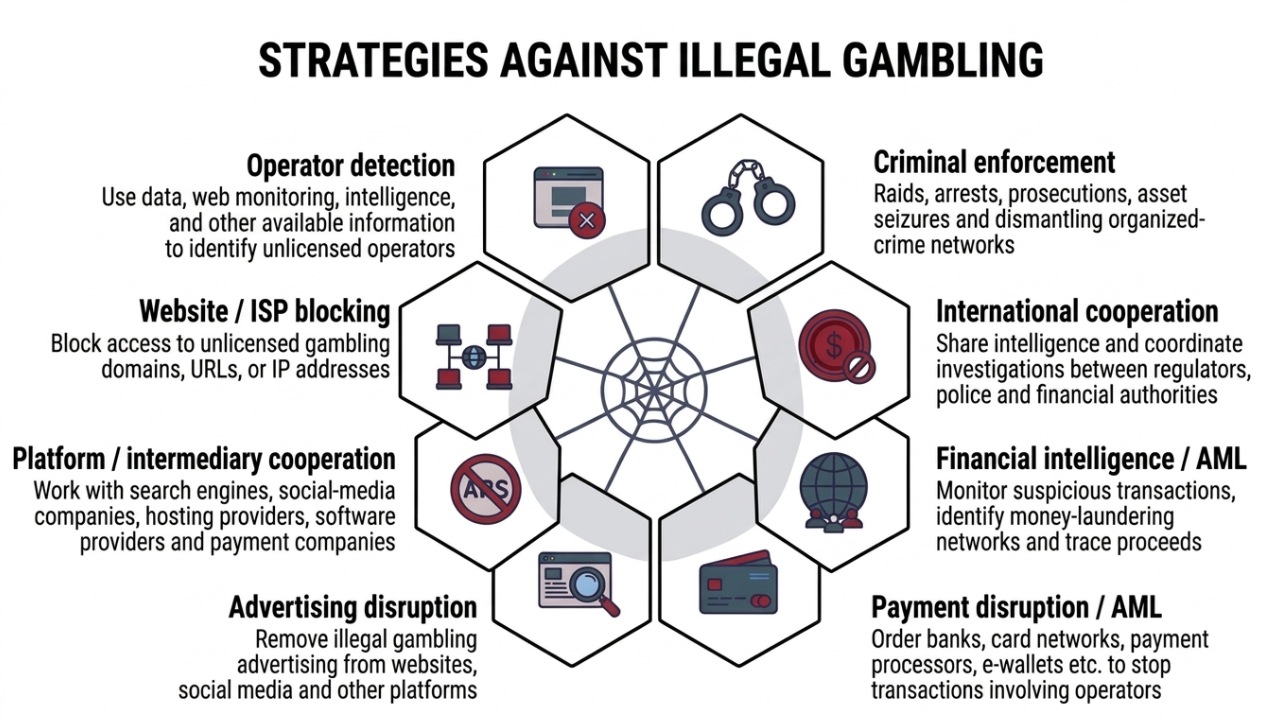
Below, we examine each strategy in detail, providing real-world examples and analysing how these methods can be integrated for an all-encompassing approach.
Why website blocking alone is not enough: Lessons from Great Britain
Website blocking, of course, starts with operator detection. This requires constant web monitoring to identify illegal sites. Research published by the UK Gambling Commission in October 2025 found that registrar blocking and website suspension were each linked to an average 91% reduction in estimated website traffic across eight domains. Geo-blocking was associated with a 60% reduction across 53 domains, while removing websites from Google search results was associated with a 30% reduction across 80 domains.
Geo-blocking has limitations because consumers may use virtual private networks (VPNs) to circumvent geographic restrictions. Similarly, removing websites from search engine results can reduce their discoverability without necessarily preventing access through direct links or other routes.
These estimates were based on web-traffic data from Similarweb, comparing estimated engagement in the month before an enforcement action with average monthly engagement spanning the following three months. The research suggests that registrar blocking and website suspension may be more effective at lowering traffic to affected domains than geo-blocking or search engine removals alone. However, the results should be interpreted cautiously because the samples were small and multiple enforcement measures may have affected the same websites.
The most defensible policy recommendation is a coordinated system that combines financial disruption, action against the digital infrastructure that supports illegal operators, alongside intelligence-led criminal investigations and international cooperation
Crucially, these figures measure estimated changes in engagement with affected domains, not the overall prevalence of illegal online gambling. A reduction in visits to a particular website does not establish that users have stopped gambling illegally. Some may migrate to mirror sites, alternative domains or other platforms. Therefore, the reported reductions cannot, on their own, demonstrate a comparable decline in total illegal gambling activity.
The Commission has also identified evasive tactics used by illegal operators, including rotating domains, changing URL structures and embedding gambling content within unrelated websites.
Website blocking remains an important enforcement tool, but it should not be used in isolation. Addressing illegal gambling calls for a multifaceted approach, including targeting illegal advertising - which we discuss next. After all, reducing the visibility of illegal gambling operators is a key priority in tackling the problem.
Does the industry have a Meta advertising problem?
The Gambling Commission noted that collaboration with platforms such as Google and Meta is increasingly important to reduce the promotion and visibility of unlicensed operators across search results, digital advertising and mobile applications.
Evidence from the Netherlands suggests that illegal gambling advertising is prevalent on Meta’s platforms. In May, the Dutch Association of Online Gambling Providers (VNLOK), in collaboration with Responsible Affiliates Quality Mark (KVA), published an analysis estimating that the social media giant earns between €7.3m and €13.6m annually from such ads targeting Dutch users.
The study found that at least 15,114 illegal gambling advertisements were visible to Dutch users in March 2026. According to the report, these ads generated an estimated 75.8 million impressions for Dutch Facebook and Instagram users that month. Annually, this equates to about 910 million impressions. Consequently, VNLOK summoned Meta to court over the latter's dissemination of illegal gambling ads.
VNLOK asked the Amsterdam District Court to rule that Meta is failing to meet its obligations under the European Digital Services Act (DSA).
The DSA sets out procedures for reporting and removing illegal online content, including advertisements for unlicensed gambling services. Under the DSA, hosting providers and very large online platforms such as Meta must provide accessible mechanisms to report illegal content and respond to sufficiently precise, substantiated notices. What constitutes illegal gambling is determined primarily by national law in each EU Member State.
Over the summer, in response to questions from German MEP Sabine Verheyen, the European Commission confirmed that the Digital Services Act offers mechanisms to address the promotion of illegal gambling and other unlawful products online.
Verheyen raised concerns about content creators promoting unlicensed gambling websites through affiliate marketing on platforms such as YouTube and Twitch.
Europe has a regulatory mechanism to sanction Meta for such violations, but the giant has historically not fully complied with EU regulations and has received GDPR fines.
The Meta advertising problem is not strictly European. A Brazilian study by PUC-Rio found that 84% of betting operators Instagram most recommends to users operate illegally in Brazil.
The research analysed more than 55,000 accounts and found that the platform’s recommendation system can direct users who follow a betting or online casino account towards other operators, content creators and specialised betting media. The 100 most recommended profiles analysed had more than six million followers and 114,000 publications.
Cooperation with social media and search engine giants
Google and Meta generate massive amounts of data, making real-time self-monitoring impossible, even with the most advanced technology and machine learning models. That is why regulators and authorities must step up as well. While some national and pan-national laws require such platforms to monitor what happens on their sites, local authorities should do the same.
Regulators for both gambling and advertising, along with operators and countries' cybersecurity units, can work with platforms such as Google and Meta to reduce unlicensed gambling promotion and offerings by combining cooperation, stricter advertising controls, search-result monitoring, app-store enforcement and information sharing. How would the process work from start to finish?
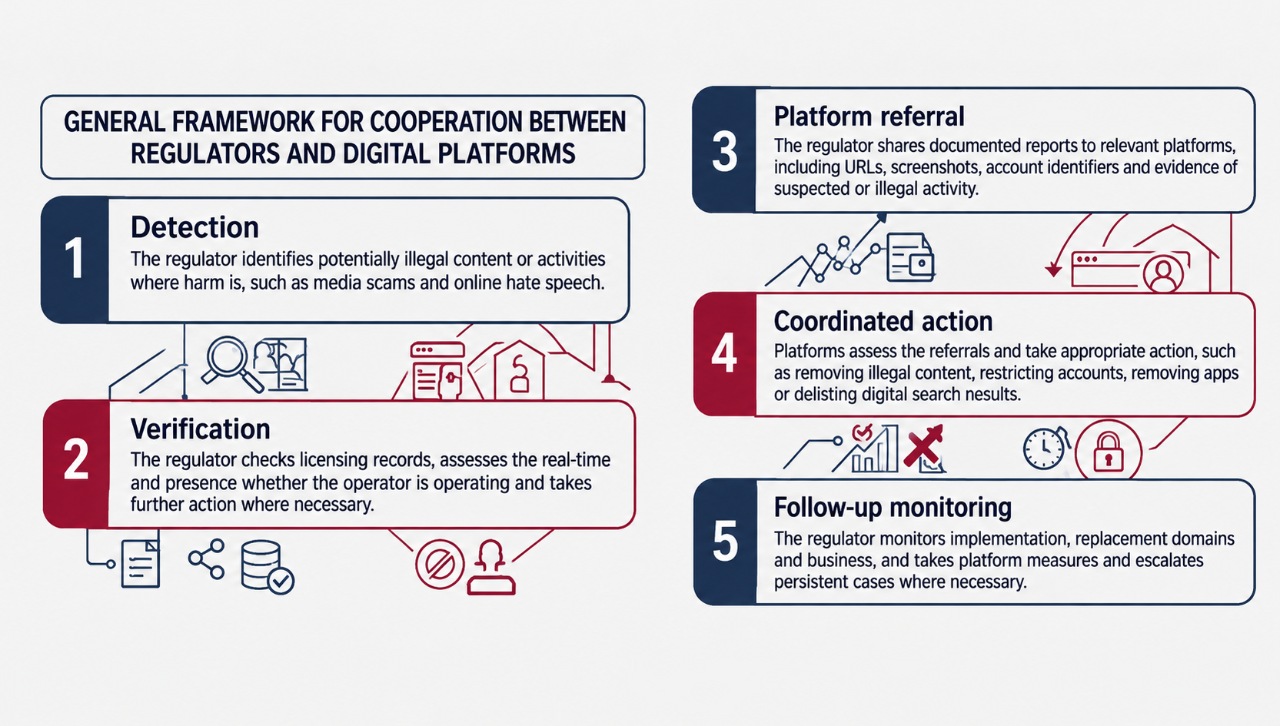
To detect illegal advertisements and sites, authorities can also use the public's help, and regulators from multiple countries do. Many of them have set up illegal gambling reporting portals where citizens can flag illegal sites and promotions.
For example, Australia’s Communications and Media Authority (ACMA) accepts online complaints about illegal gambling services and their advertising. The UK Gambling Commission’s “tell us something in confidence” service lets people report unlicensed gambling and other regulatory concerns. In the Netherlands, the Dutch Gambling Authority (KSA) encourages the public to report illegal gambling and related advertising.
Geo-blocking of illegal sites has limitations because consumers may use virtual private networks (VPNs) to circumvent restrictions
Meta collaborates with regulators around the world. It maintains a close working relationship with the UK Gambling Commission and the Advertising Standards Authority. Both organisations have access to a dedicated reporting channel for expedited ad removal, and they meet with Meta regularly to discuss illegal gambling ads and share intelligence on bad actors. Meta is also an active member of the Ministerial Illegal Gambling Taskforce convened by Baroness Twycross in January 2026. The Gambling Commission also works with Microsoft and Google to improve referral procedures and enhance search engine coverage.
The KSA has partnered with Google to explore creating a Europe-wide whitelist of licensed gambling operators. In October, KSA Chairman Michel Groothuizen confirmed that a joint task force had been formed following talks with Google and Meta earlier in the year.
The initiative followed a meeting in Dublin, Ireland, where the KSA and other European gambling regulators met with representatives from both tech companies at their European headquarters. The resulting task force aims to curb the online visibility of illicit gambling operators.
Beyond Europe, the Alcohol and Gaming Commission of Ontario, in collaboration with Meta, historically identified unlicensed operators in the province, leading to access restrictions and warnings on certain gambling websites. Similar efforts are underway with app stores and digital advertising platforms. Nigeria is taking a similar approach by working directly with Meta and Google to combat illegal online gambling.
Indonesia’s Online Gambling Task Force intensified its crackdown on illegal online betting by blocking more than 8,600 gambling-related keywords on Google and Meta platforms between 4 and 20 November 2024. The Government is pressing major technology companies, including Google, Meta and TikTok, to comply with Indonesian law by restricting access to gambling-related content prohibited in the country.
Meta is also open to collaboration with operators. In October, Paf reached an agreement with Meta to launch a pilot project to identify unlicensed gambling operators advertising on the platform in Switzerland. Under the arrangement, Paf will share licence documents and URLs covering both operators as well as affiliates, giving Meta a clearer picture of which advertisers are licensed in the Swiss market. The goal is to build a model that can later scale to additional markets.
The above examples show that cooperation between regulators, law-enforcement agencies and technology companies is essential. Social media platforms are woven into the fabric of the everyday lives of billions of individuals worldwide, and illegal gambling visibility on such platforms should be diminished.
Tackling the broader infrastructure, including suppliers
Social media and search engines are only part of the digital ecosystem that supports illegal online gambling. Behind many unlicensed platforms lies a network of third-party service providers, including web-hosting companies, content delivery networks and software suppliers.
For example, ACMA is constantly working to improve its processes for reporting to third parties such as hosting providers. According to the regulator, it is more effective for illegal gambling sites to be removed by their hosting provider, naturally, as this prevents users from continuing to access the site via VPN.
In 2024, the KSA asked hosting provider DigitalOcean to stop supporting iGaming affiliate websites promoting unlicensed operators. The KSA could not identify the websites’ owners, but contacted the hosting provider directly. This approach can work when site owners are unknown or uncooperative, but it is limited by jurisdiction – if hosting providers are based in less regulated and uncooperative countries, enforcement becomes much more difficult.
Regulators for both gambling and advertising, along with operators and countries' cybersecurity units, can work with platforms such as Google and Meta to reduce unlicensed gambling promotion
In industry circles, the idea that game studios and software suppliers should carefully vet their clients and do more to prevent their games from ending up on unlicensed sites gained popularity. This debate intensified after Evolution games were found on six unlicensed websites targeting or accessible to consumers in Great Britain. The investigation identified shortcomings in the company's risk assessments and supply-chain oversight. Evolution subsequently strengthened its controls and geo-blocked the affected games. The Gambling Commission announced a £4.75 million settlement with the supplier in July 2026.
The Swedish Gaming Authority (SGA) similarly issued a warning and a penalty fee in 2025 to Quickspin AB, a Swedish studio owned by Playtech. The regulator found its titles available on unlicensed websites through third-party content partners. Although this fee was very small (€58,800) compared with Evolution’s UK settlement, it was more of a warning than an actual sanction. At the same time, SGA also imposed two smaller fines on two more suppliers over the same issue.
Since 2023, Swedish software suppliers must be licensed and may only provide software to operators with proper authorisation to target the Swedish market. Sweden is not alone in this, as this regulatory approach is increasingly common worldwide.
This allows regulators to hold providers responsible for ensuring their games do not reach unlicensed operators. In Sweden, as in most highly regulated global jurisdictions, using third-party distributors or content partners does not remove regulatory responsibility, while geo-blocking alone is usually not sufficient to demonstrate compliance.
The approach can be applied to other legitimate suppliers beyond game studios and developers. Ultimately, targeting hosting companies, software, platform and game suppliers represents an important layer of enforcement. Regulators can make it harder for unlicensed operators to access recognised games, established software and legitimate distribution networks.
Nonetheless, it is only effective against compliant, licensed organisations. Once again, we return to the problem of jurisdiction, as enforcement cannot effectively reach those suppliers based in obscure ones.
How can payment blocking and financial monitoring help combat illegal gambling?
It is important to address, arguably, one of the most effective individual strategies in the fight against the black market – payment blocking and financial monitoring – although even this method is not without its limits.
Payment blocking requires banks, card networks and payment service providers to refuse transactions connected to identified unlicensed gambling operators. Financial monitoring, meanwhile, involves identifying suspicious payment patterns, tracing transactions and sharing intelligence between financial institutions, regulators and law-enforcement agencies.
Several countries have introduced mechanisms to make financial intermediaries part of their enforcement strategies. Finland offers a clear example of targeted payment blocking. The National Police Board identifies unlicensed operators banned from targeting Finnish citizens and publishes an up-to-date list. Payment and virtual currency providers must block outgoing payments to these companies.
The payment-blocking provisions are part of Finland's outgoing gambling framework and are scheduled to remain in force until the end of June 2027, as the country transitions to a licensing system. Nonetheless, the incoming legislation will continue comparable payment-blocking measures. A similar framework exists in other markets, especially mature ones.
Still, blocking and monitoring individual transactions is insufficient. Financial institutions and payment service providers rely on various identification mechanisms, including merchant category codes (MCCs), transaction identifiers and information supplied by payment networks, to identify and classify gambling-related transactions.
Because illegal operators cross borders, enforcement efforts must also be international in scope. Information sharing and a coordinated approach are thus not just important at national levels, but also pan-national
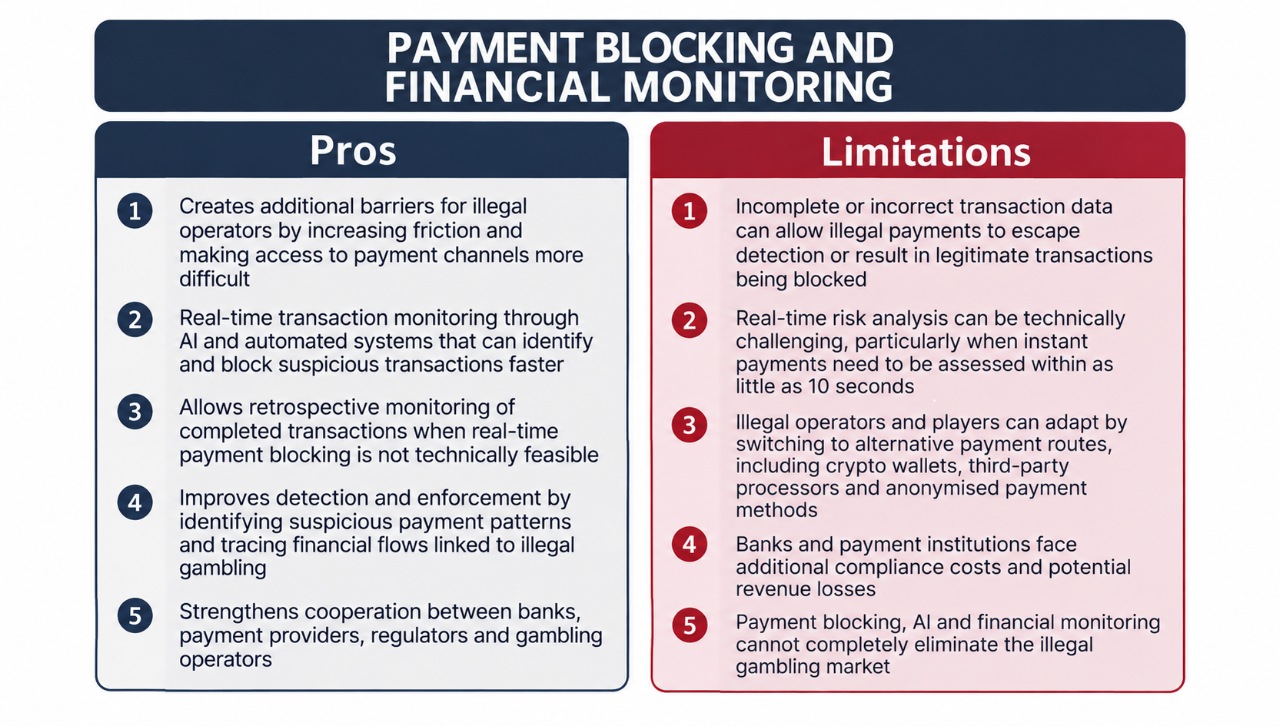
The effectiveness of these mechanisms depends largely on the accuracy and completeness of the information provided across the entire payment-processing chain. Slip-ups at any point can allow transactions involving unlicensed gambling operators to escape detection. Conversely, inaccurate classification may also mistakenly block legitimate transactions.
These limitations highlight the importance of combining individual transaction blocking with consistent financial monitoring, effective merchant due diligence, information sharing and cooperation between financial institutions, operators and regulatory authorities.
Poland’s cross-sector approach: Combining real-time payment blocking with AI-driven financial monitoring
One real-world example of a coordinated approach comes from Poland. In June, experts from Totalizator Sportowy, the Polish Bank Association and the National Clearing House called for a new approach to tackling illegal online gambling. This includes a focus on financial data analysis, artificial intelligence and stronger cross-sector cooperation.
A discussion between Totalizator Sportowy and financial institutions highlighted AI as a potential tool, particularly as the growth of instant payments has reduced the time available for risk analysis. Wojciech Pantkowski, Vice President of the National Clearing House, noted that transactions may need to be assessed within as little as 10 seconds.
Furthermore, Polish mobile payment system BLIK began blocking transactions linked to illegal gambling websites from 1 September. The mechanism automatically checks whether a website initiating a transaction appears on the Ministry of Finance’s register of prohibited gambling domains. If it finds a match, it blocks the payment.
The system uses an API connection between BLIK and the Ministry’s register and also covers transactions processed by foreign payment agents.
BLIK is Poland’s dominant mobile payment system. It enables users to make instant payments online and in retail stores primarily using their bank's mobile application. In 2025, BLIK users completed a total of 2.9 bn transactions worth PLN 441.5bn ($118.5bn). The number of active users at the end of December was 20.7 million.
Given BLIK’s large user base and convenience, the new controls could significantly disrupt payment access for average players gambling with illegal operators and create additional friction for operators. However, determined players will adapt to alternative payment routes.
Marek Plota, a Polish online gaming legal expert, told Global Gaming Insider that while real-time payment blocking is ideal, it is not always technically feasible – but retrospective analysis remains valuable.
The main challenge, he explained, is not a complete lack of legal tools but differing stakeholder priorities: regulators and licensed operators aim to reduce illegal gambling, while banks and payment institutions face extra compliance costs and potential revenue losses.
Targeting hosting companies, software, platform and game suppliers represents an important layer of enforcement. Regulators can make it harder for unlicensed operators to access recognised games and established software
Still, improved cooperation between the betting sector, regulators and financial institutions has already led to meaningful regulatory actions in Poland, including warnings to the payment market.
Plota noted that financial restrictions are harder for illegal operators to circumvent than DNS blocking, as they directly disrupt deposits and withdrawals.
However, operators are highly adaptive, using crypto wallets, third-party processors and anonymised payment methods that are difficult to police.
While AI, financial monitoring and cross-sector collaboration won’t eliminate the black market, they can increase friction, raise costs for illegal operators and reduce their ability to convert customers.
How can international cooperation help combat illegal online gambling?
Because illegal operators cross borders, enforcement efforts must also be international in scope. Information sharing and a coordinated approach are thus not just important at national levels, but also pan-national.
In November 2025, gambling regulators from Austria, France, Germany, Great Britain, Italy, Portugal and Spain issued a joint statement calling for stronger international cooperation against illegal online gambling.
The regulators highlighted the cross-border nature of illegal gambling and the growing use of social media, video platforms and affiliate networks to advertise unlicensed operators.
They committed to sharing information about illegal operators, encouraging digital platforms to strengthen advertising controls and exchanging knowledge and best practices for identifying, investigating and sanctioning illegal businesses.
Financial Action Task Force’s (FATF) 2026 reports highlighted how criminals exploit differences between national regulatory systems, particularly when gambling operators, financial intermediaries and payment providers operate across different jurisdictions.
It emphasised the need for stronger international cooperation, improved information sharing between public and private institutions, better oversight of offshore operators and greater transparency around beneficial ownership. It also stressed the importance of monitoring cross-border financial transactions and virtual assets to identify and disrupt suspicious financial activity.
How are law enforcement agencies tackling the problem?
Authorities around the world are dismantling illegal gambling networks through investigations, raids, arrests and asset seizures. Once again, a coordinated approach and the use of the latest technology are beneficial.
For example, Turkish authorities are exploring AI-powered tools to track operators alongside tighter controls on payments, advertising and online networks. Enforcement operations throughout 2026 have resulted in thousands of arrests and targeted networks reportedly processing billions of dollars in suspected illegal gambling transactions.
Nevertheless, as stated above, since these illicit gambling actors operate cross borders, criminal enforcement must also include international cooperation.
In a 2024 massive international operation targeting illegal football gambling, Interpol collaborated with 28 countries and territories, which resulted in over 5,100 arrests and the recovery of more than $59m in illicit proceeds.
Interpol enabled intelligence sharing, case mentoring and local training. The operation was supported by the Asia-Pacific Expert Group on Organised Crime, the Interpol Match Fixing Task Force and UEFA.
Operation Soga X, conducted between June and July 2024, targeted the period during the UEFA 2024 European Championship, anticipating a surge in betting and criminal profits.
Soga X investigations have gone beyond taking down tens of thousands of illegal websites, also uncovering money laundering networks and helping rescue victims of human trafficking.
While AI, financial monitoring and cross-sector collaboration won't eliminate the black market, they can increase friction, raise costs for illegal operators and reduce their ability to convert customers
What role does player education play?
Another important part of the fight against the illegal market is player education. Sometimes players simply can’t distinguish between licenced and unlicensed operators, with the latter running sophisticated sites that may appear legitimate.
Social media and influencer content can expose consumers to unlicensed operators without making their legal status clear. Players should not assume that popularity, follower counts or endorsements mean an operator is licensed.
Australia provides an interesting example of how regulators can address the awareness gap through public education. ACMA has conducted several campaigns warning consumers about the risks of using illegal offshore gambling websites.
Initiatives such as social media campaigns "Even if you win, you might lose" and "Offshore gambling, don't bet on it" aimed to highlight the lack of player protections and the risk of unlicensed operators withholding winnings.
ACMA reported that its June 2021 campaign generated an 863% increase in visits to relevant information pages on its website.
Beyond general warnings, player education should provide practical guidance on identifying licensed operators and checking regulatory registers. Ultimately, the objective is to ensure that consumers can recognise illegal gambling services before depositing money, rather than relying on regulators to intervene after problems arise.
What is the current state of the fight against the illegal gambling market?
Tackling the illegal gambling market is a omplex issue. Crypto, e-wallets and virtual assets can all be exploited for illicit purposes, while anonymous payment methods remain difficult to regulate and monitor. Complex ownership structures can conceal the individuals behind gambling platforms and help them evade regulatory scrutiny. Operators based in obscure or poorly regulated jurisdictions are particularly well placed to exploit oversight gaps and avoid enforcement.
The most defensible policy recommendation is a coordinated system that combines financial disruption, action against the digital infrastructure and advertising that support illegal operators, alongside intelligence-led criminal investigations and international cooperation. Website blocking remains useful, but it should be one component of a wider enforcement strategy, not a solution in itself.
The black market is unlikely to ever be eliminated entirely, but authorities can still weaken criminal networks and limit their ability to operate. The goal for regulators is to make it increasingly difficult for these operators to function and reach players.
Good to know
In 2025, the American Gaming Association estimated that illegal and unregulated operators account for 31.9% of the US gaming market