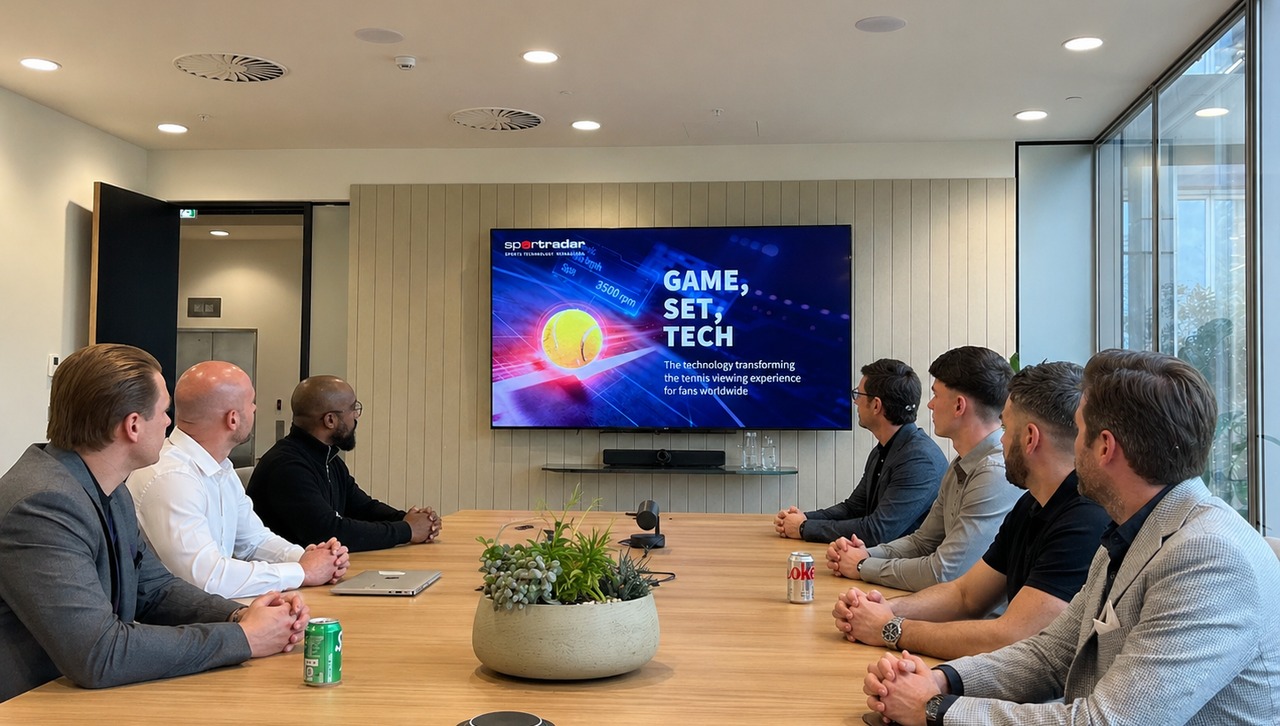
The sun was shining in London as Sportradar welcomed Global Gaming Insider to its new offices in the Barbican.
The sportsbook supplier presented a panel overviewing new technologies in tennis, in collaboration with the Association of Professional Tennis.
The future of tennis betting data
Opening discussions were David Lampitt, CEO of Tennis Data Innovations (TDI) – an Association of Professional Tennis (ATP) Tour subsidiary – and Rainer Lichtmannegger, SVP Sports Content Products at Sportradar.
TDI was originally set up to focus on driving use, productisation and enhancement of data technology across the tour, specifically.
Indeed, Lampitt explained that TDI and Sportradar have built automated and machine learned data to access shot type, error, length of rally – alongside coordinates (both player and ball) and a plethora of further ‘deeper data’ integrations – which are now all accessible: “It’s been transformative for us.”
Lichtmannegger built on this, concurring on the deeper data topic by explaining that there are always two elements to sports betting data, timeliness and depth. When it comes to betting, he explained, real time is incredibly important, with tennis being one of the most popular real-time betting sports. Market types such as shots per rally and additional momentum bets open a wider array of betting opportunities and motions for players.
“The more data you have, the more comprehensive your offerings can be.”
Commenting on new data products, Lampitt explained a concept called ‘internally true time data,’ which operates “not-dissimilarly to a financial market.” New technologies can help send a signal on given micro-outcomes such as a point outcome or ball positioning before the umpire has access to the data, helping prevent time delays and reducing the risk of a given market for players, especially when decisions must be reviewed by the umpire.
The key is, unsurprisingly, AI. More specifically, generative AI, which Mostboeck labels the great enabler
Picking up on the risk-management aspect, Lichtmannegger added: “In-play betting now accounts for 90% of betting volumes globally. It is the perfect live betting sport. There are a range of points within the match where, differently to football for example, there are often many more ‘moments’ throughout the match.”
Indeed, Lichtmannegger built on this point by explaining that tennis is too fast-paced to build a bet, which naturally has placed more emphasis on in-play, and by extension the technology that is required to enable it.
There will be a shift from reactive data points to predictive data points in the future and, due to the riches of data, bringing the physical and technical performances closer to the fans will become more achievable. The level of sophistication behind maturing chat services could – theoretically – speak to the chatbot as if it is a coach, with it drawing on statistics and data points to explain plays ahead of time.
Traditionally, wearable data has always been used to help predict things like injury – and is not yet expected to come into the betting fold, but Lampitt underlines that in the future he could imagine this materialising.
Patrick Mostboeck: The visualisation of tennis data
Speaking next as part of a solo presentation, Sportradar’s SVP of Fan Engagement, Patrick Mostboeck, followed up by explaining how the supplier is planning on visually optimising the previously underlined technology.
The key is, unsurprisingly, AI. More specifically, generative AI – which Mostboeck labels the “great enabler.”
Fan behaviour is changing, with attention and engagement consumption now being much shorter in the modern world. This lends itself to tennis – especially in a live context. “There is so much opportunity to enhance the story-telling from a betting perspective in the game.”
Mostboeck also outlined that visualisation helps to give context behind what is happening, as many tennis enthusiasts still don’t necessarily have in-depth expert knowledge. The data representation in Sportradar’s new application visually represents things in a way that further explains how the data impacts the game. 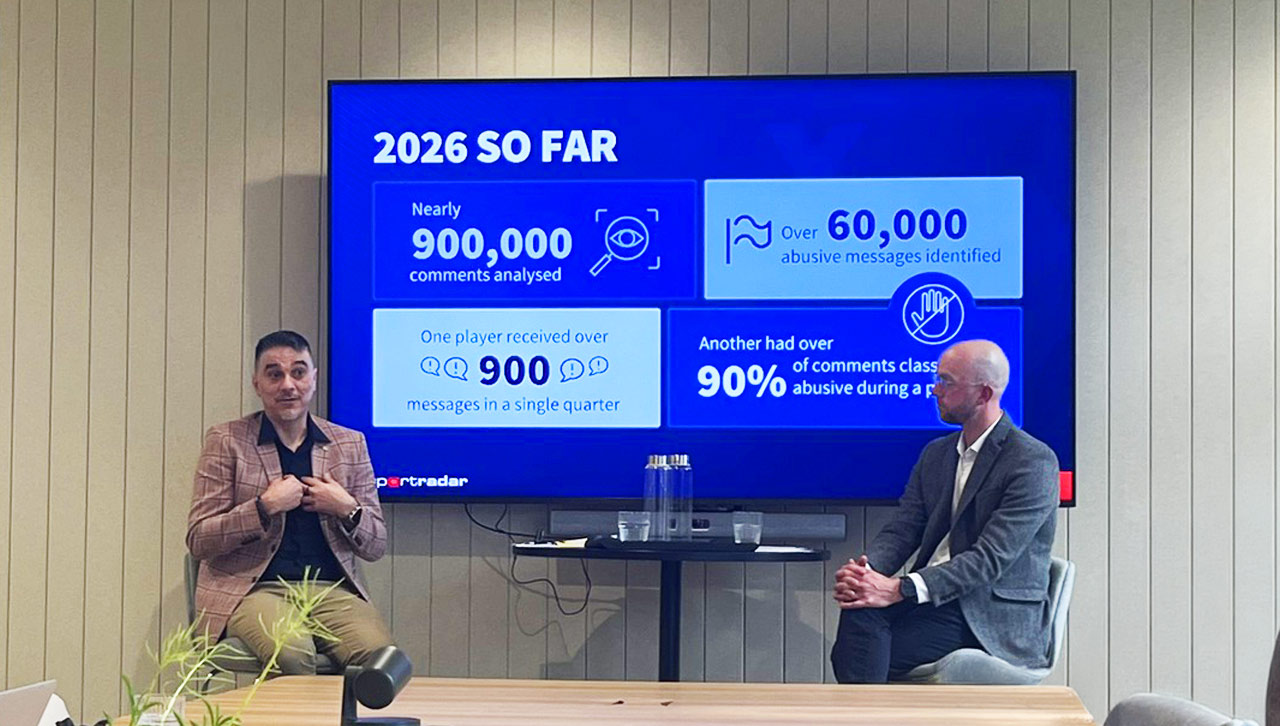
Protecting the game in partnership with ATP
Sportradar’s VP of Risk & Investigations, Adam Pennock, later sat beside Andrew Azzopardi, ATP’s Director of Safeguarding, as part of the afternoon’s concluding panel. Together, they explored data to enhance the protection of athletes and other individuals from online abuse.
Azzopardi began by recalling that, some years ago, a tennis athlete reached out to him, explaining that he was inundated with online abuse relating to a small incident that happened on court in a prior game. The athlete stated that they felt scared and alone.
Pennock then explained that, over the course of their two year-partnership, ATP and Sportradar have scanned 4.8 million comments across ATP profiles, with 420,000 classified as severe, and 300,000 (around 6.5%) as abusive. Indeed, 93% of monitored athlete accounts were subject to abusive comments of some form. It was also gathered that there were 116,000 individual and unique abusive profiles, with a smaller number of individuals responsible for large amounts of the observed abuse, and some individuals operating as many as 50 social media accounts.
Humanising this from a player’s perspective, Azzopardi explained that the online abuse is not ‘background noise,’ but rather a constant. He believes a small percentage of fans completely de-humanise athletes – which is not a problem unique to tennis, but it stands alone in some sense as it is an individual sport. He also believes that, as a broad society, more consequences in certain jurisdictions need to be introduced.
Utilising this segue, Sportradar’s Pennock moved forward to introduce Safe Sport, a new monitoring tool designed in partnership with ATP.
Built on three pillars, Safe Sport’s initial function is to scan and categorise each comment of any given athlete signed up to use its services. Pennock explained that Safe Sport is also geared to support families of players, umpires and other involved individuals.
Observing a case study, Pennock underlined a death threat was caught by the system – which was not observed by the player who had moderation protections. The account was deemed to be in the same city as an upcoming tournament, the individual was then seen posting photos from the tournament, with law enforcement locating and then removing them as a threat from the grounds. Safe Sport had done its job.
Plenty to ponder, then, overall.
Sportradar CEO Carsten Koerl last week penned an open letter to shareholders following recent short seller reports