
While the hoops get smaller for regulated casinos, illegal platforms have been left fairly unsupervised to offer whatever services they like. In light of recent tax changes that saw remote operators in the UK responsible for 40% duty, many licensed operators have cut back promotions as a way to save money. But what exactly are these businesses having to compete against, and what can we learn from this?
How black markets encourage user referrals
One of the most lucrative promotions on many of these online casinos is the referral system. This encourages individuals to send out invitational links or promo codes to sign others up on the site.
Most of these sites offer around $1,000 and a 25% commission on all future wagers from that account, which is lucrative indeed. The sites are not subtle about this either, writing “the more you invite, the more you will get!”
On one site alone, the operator brags that this system has resulted in over $25m paid out to players.
While this is not a feature exclusive to illegal sites, as many licensed platforms also offer referral schemes, the prize here is much more impressive.
What we can learn from this: One of the most effective ways to attract new customers to a business can be through word of mouth, or by recommendations from current users. Forums and social media platforms have always been a key source of marketing in this regard, but direct user-to-user recommendations are likely going to be stronger than statements made anonymously. Players could be rewarded with something other than money (such as ticket draws) to compete with larger monetary rewards from black market sites.
How play time leads to crypto staking
Another feature that is gaining momentum across black-market casinos is the concept of ‘automatic staking.’ This means that, for each hour you play, a certain amount of proprietary cryptocurrency will be entered into a pool. This then grows each day with ‘interest,’ or is part of a currency giveaway at the end of a certain period.
This encourages people to play for longer when they may have otherwise left or stopped playing altogether, especially when sites use terminology such as ‘earning’ rewards that make a player feel like their effort will be rewarded.
What can we learn from this: Getting a player to sign up for a casino is easy, but getting them to stay presents more of a challenge. Illegal casinos have found a way to incentivise players to stay for longer with the promise of monetary rewards,. This encourages brand loyalty, because why would they play on another platform if they have already begun building rewards elsewhere?
Play time rewards would be difficult to get past regulators, but many offer Drop & Win mechanics that offer random prizes awarded as players spin the reels. Concepts of retention and gamification are also nothing new to the regulated market – but there are far less limits on where these can go in unlicensed territory.
Why leaderboards for money spent are effective
One of the simplest ways that illegal casinos encourage players to spend money is by offering leaderboards that reflect the amount of money spent during a set period. These are usually daily or weekly ‘races’ that offer cashback or free spin prizes for people who place towards the top of the leaderboard. Again, leaderboards and gamification are nothing new to the regulated space, either, but black-market operators are marketing these far more effectively.
What can we learn from this: Many people who enjoy video games are competitive by nature, especially when cash is involved. The majority would probably revel at being seen by other players as having ‘beat the house.’ This also helps to create a sense of community between players. Leaderboards based on spend would never fly in legal casinos, but something else could be focused on instead.
No player is going to turn down the opportunity to try a game marketed at 100% RTP, even if they know it is unlikely to be the actual figure
VIP Levels with rakeback, cashback and monetary rewards
VIP treatment is nothing new, especially not in the gambling industry. However, there are certain rules in place that prevent online casinos from encouraging people to spend a certain amount just to rise a level. Regulated markets, including Macau (land-based) and the UK (online) have clamped down on VIP programmes and VIP managers in recent years.
Many of these offer cash rewards for completing certain levels, cashback on deposits or rakeback on wagers, exclusive missions that can reward the player with hundreds of pounds a day and invites to special events with “celebrities.”
What can we learn from this: A sense of progression can be a great incentive to keep returning to one particular platform. After all, the human brain is wired to get dopamine from making progress, even if that is progress through casino VIP levels. Places like BetMGM offer free daily spins on a Golden Wheel as a way to bring customers back each day, and other licensed operators have created free-to-play boards to encourage daily play.
Why lootboxes provide a tricky grey area
Lootboxes are usually associated with esports or the chance to win in-game characters, skins or other similar prizes in video games.
These have been classed as gambling in some countries, but illegal casinos have taken this concept and relaunched it in a way that defies any arguments about whether they are or are not gambling.
One site offered a range of options, including iPhone Lootboxes ($7.98), Gift Cards Lootboxes ($15.98), Lego Lootboxes ($16.98) and Lamborghini Lootboxes ($59.97), just to name a few.
When looking at the Lambo Lootbox, each entry costs USDT$59.97, and players can win pin badges, gym bags, caps, wallets, or even a legendary Lamborghini Huracán, priced at $400,000.
For the sake of fair journalism, we tried some of the demo spins. The process was eerily similar to pack openings, and our very first spin landed on the bracelet worth around USDT$900. The second spin landed on the USDT$700 headphones. Predictably, the third spin landed on the “Drive a Lamborghini Huracán EVO in Mugello” experience, valued at USDT$5,000. Would this have happened in the real-money mode? That can be left to your imagination.
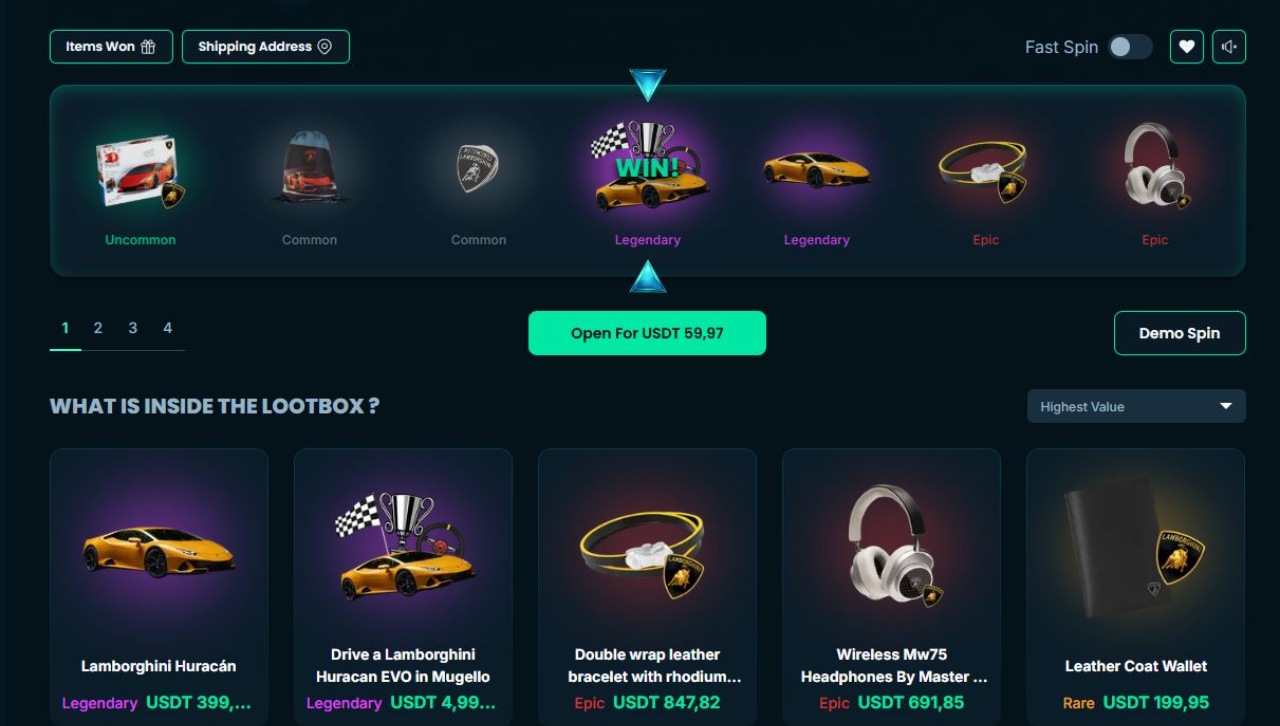
Truly, what are the chances?
What can we learn from this: Players love to feel like they’ve gotten a bargain and ‘won’ something. Lootboxes continue to migrate away from eSports and into casinos rather unshamedly. As previously mentioned, some operators such as BetMGMm Sky Bet and Paddy Power offer free daily spins for potential prizes, so this could be further enhanced in a legal capacity.
Why original games have a powerful impact
One of the hardest things about creating new games for the gambling market is remaining compliant. A very cool idea might never make it to the light of day because it violates one of the guidelines or principles of various gambling acts. It might also not pass Provably Fair tests.
But illegal sites have recently figured out that, as they operate outside of the law, they can create their own casino games that do not have to pass any regulations. For example, on one notable website, a new Originals game is described as having “a 100% RTP, and a potential $2,950,000 maximum win.”
This means that not only can these sites create genuine exclusives, but they can describe them however they like. No player is going to turn down the opportunity to try a game marketed at 100% RTP, even if they know it is unlikely to be the actual figure.
What can we learn from this: Innovation is both the boon and bane of this industry. Not only do studios need to compete with one another to stand out in licensed casinos, they also need to shine when compared to illegal (and oftentimes more enticing) games. This may drive new ideas in the industry, or cause regulators to ease restrictions on what studios can legally make in order to remain competitive.
Overall, there is plenty the regulated industry can learn here. But there are, equally, several examples of why this is a losing battle.
Regulators must also take note. They face the unenviable task of balancing true enforcement with rules that do not simply punish operators with a licence. At the very least, though, they need to be aware where regulations are causing the greatest market imbalance.
Many of the black-market websites here had a warning explaining they could not be accessed in the UK, but were easily navigated by pressing the ‘X’ in the top corner of the pop-up