On the final day of the 19th International Conference on Gambling & Risk Taking, discussions were held concerning the responsibilities of C-level executives, gaming regulation and efforts to enhance responsible gambling resources across the US.
Prior to the event kicking off on May 28, however, news broke of Caesars Entertainment entering into a definitive agreement to be acquired by Fertitta Entertainment in an all-cash transaction valued at around $17.6bn. The overall transaction figure consists of an $11.9bn assumption of Caesars' total debts, alongside a $5.7bn acquisition fee.
Coincidentally, Wondr Nation President & CEO and former Caesars employee Anika Howard started Global Gaming Insider’s coverage, having taken part in a Candid Conversation on C-Suite executives with Wynn Resorts Chief Global Compliance Officer Omar Khoury.
Caesars-Fertitta deal represents a ‘full circle moment’ in gaming
Khoury began the panel by stating one of the biggest "myths" about compliance is sometimes being described as the "department of 'no.'" While some on the C-Suite level may shy away from the "tension" of disagreeing with CEOs, the Wynn Resorts Chief Global Compliance Officer "wants" those types of conversations.
“Sometimes everybody thinks we're going to say no, but we work for the business. My compliance program should help advance the business,” Khoury explained.
“I don't feel pressured in my role ever. A lot of the decisions made 10-15 years ago, and those which have resulted in enforcement action, came because compliance felt pressured to make a decision a certain way. As soon as your compliance officer feels that way, it's time to go.”
Howard responded by describing compliance as a "sound board," given the department "covers so much more" than most believe in gaming. The Wondr Nation CEO shared that if her operator’s general counsel "billed by the hour," they would be "billionaires."
On Tilman Fertitta’s acquisition of her former employer, Howard shared exclusively with Global Gaming Insider: “It felt like a full circle moment for me because I joined Caesars when they were buying the Rio from the Fertitta's. It's a very interesting time for the industry to see what's next for Caesars.”
The Wondr Nation executive also spoke on the use of AI in gaming, describing automated operations as an “enabler,” but not “something that will replace what people do.” Khoury echoed the statement, having said, “It doesn't replace human judgement. Somebody still has to review information and make those decisions.
“There's also a nefarious side to AI. You're asking customers to provide information and they're using AI to create it.”
Howard concluded the Candid Conversation by sharing that a "misconception" of the industry is operators "don't want" players to win, while Khoury stated they just don't want players "to win too much." Otherwise, as Howard believes, players would "never show up."
While potentially true, there’s also a reason the “house always wins” phrase has become entrenched with gaming history.
How regulators can ‘lose sight’ of gaming’s ‘crucial balance’
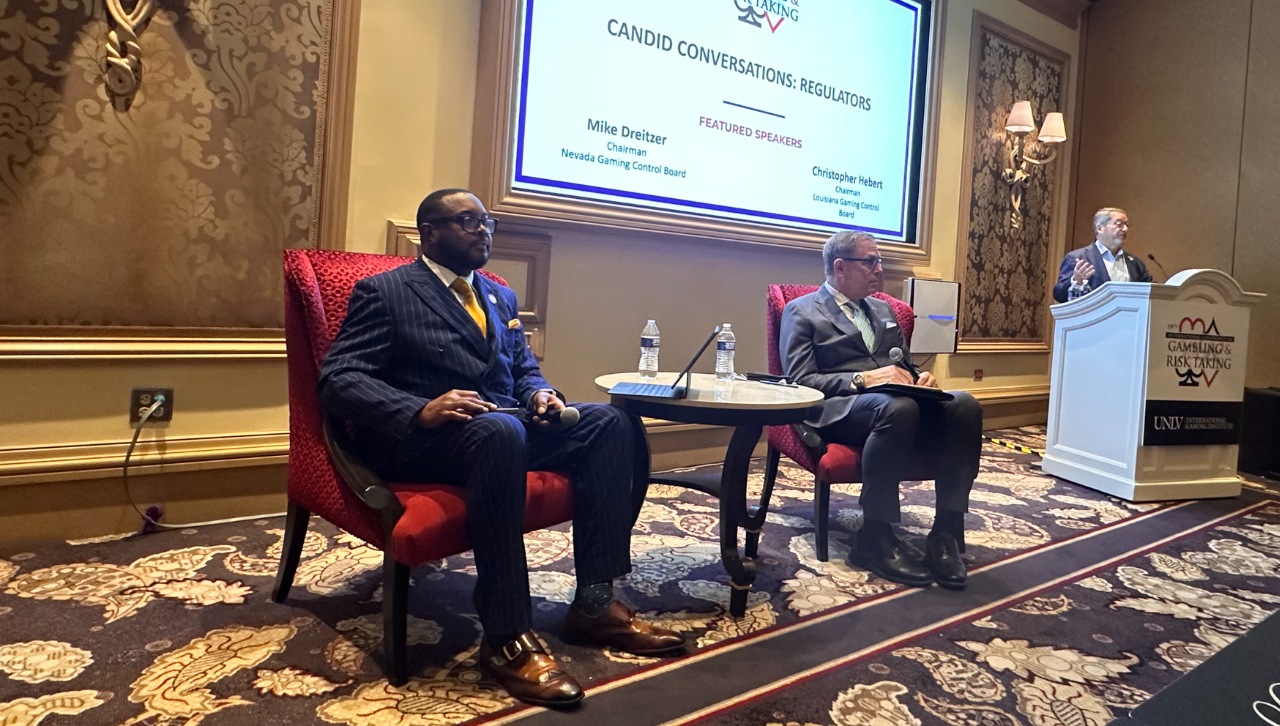
As part of a discussion on US gaming regulation, Nevada Gaming Control Board (NGCB) Chairman Mike Dreitzer was joined by Louisiana Gaming Control Board (LGCB) Chairman Christopher Hebert on May 28. Hebert spoke on the “toxic” regulatory environment which had developed in Louisiana due to “past corruption,” as well as his obligations as Chairman of the LGCB.
“I didn't find gaming, gaming found me. Success in this industry is about attitudes. I remember an environment that was toxic in how our department regulated, perhaps a cause of past corruption. I don't think we treated the industry with the right respect,” Hebert said.
“Regulation is about balance. We have an obligation to protect the public, but we have to do it in a way that allows our operators to operate successfully. There are dire consequences if you don't treat the industry with the respect it deserves.”
Agreeing with his Louisiana counterpart, Dreitzer believes regulators “have to be accountable” to licensees, representing a crucial balance easy to “lose sight of.” Dreitzer also spoke on how the Chairman position can be seen as "iconic," but it's his job to not get "caught up" and "act with arrogance or ego."
The Chairman stated: “I don't care what you call me, but look to see how I approach things. Those things don't mean anything, it's about what you do and how you treat people.
“I wouldn't have taken this job if I didn't feel I could add something. There are days you are just done and think 'wow we really made a difference today.' There are days where you feel like your butt's kicked.”
A lot of the decisions made 10-15 years ago, and those which have resulted in enforcement action, came because compliance felt pressured to make a decision a certain way. As soon as your compliance officer feels that way, it's time to go
On prediction markets, Dreitzer offered a longer answer to attendees, but confirmed Nevada “wants” prediction markets, but in the “right way.”
“We have to, as an industry, have standards. That's not regulatory capture, that's not over-regulation. So when this wholesale creation comes about, we have to stand up to it. We have to look it in the eye and say 'this is sports betting,’” Dreitzer said.
“Now is the time to be heard on this issue, to stand up and say 'no, this is not being done in the right way.' We want prediction products in Nevada, but do it the right way. Do it so there won't be insider betting stuff, do it so I can't be 14 and betting, do it with integrity. If we don't stand up for it now what will happen when this thing keeps going? When does it end?”
Believing the industry is at a “crossroads,” Hebert backed Dreitzer’s claim by reiterating “the time to stand up is now.” The LGCB Chairman stated it's important for operators to know regulators "are listening," including his efforts to have "candid conversations" with multiple casino GMs to discuss potential issues, finding that many were "easy fixes."
“We’re always better together,” Hebert concluded.
Why RG insight alone ‘does not produce change’ in player safety
Capping off Global Gaming Insider’s coverage was a responsible gambling (RG) panel with JR Consulting Managing Director Jay Robinson, University of Memphis Assistant Professor Ganga Urumutta Hewage, and Incumental Founder & CEO Michael Zhang. Robinson stressed "more interaction, less intervention" increases consistency in RG practice, while an "automatic ceiling" can develop when operators resist letting safer play methods become a "culture primer."
Robinson explained: “Training alone is not sufficient. Promoting safer gambling is promoting guest experience. What the evaluation shows is not a gap in knowledge. It is a shift in application.”
Hewage believes RG advertisements are "buried" behind efforts to push players toward betting, as the Assistant Professor cited studies which found a “communication gap” and evidence that 71% of active bettors cannot remember specific responsible gambling advertisements. Hewage recommended establishing a "source of communication" for responsible gambling, and believes operators view RG as an "abstract concept."
“It's happening, but they are not doing a good job of measuring the response to advertisements,” Hewage said.
“We want to work more on finding the right measures so we can capture reactions to RG.”
On the gap between gambling environments and recovery support, Zhang believes the disconnect is not “merely structural, it's psychological.”
Insight alone does not produce change. The field can underestimate the power of information alone.
The Incumental Founder & CEO stated: “Insight alone does not produce change. The field can underestimate the power of information.
“Recovery often happens in moments no one else sees and gaming emerges through ordinary emotional frequencies. There are real tensions between engagement and exploitation.”
Zhang shared how gambling can become "psychologically functional," and that "recovery support must exist during vulnerability." He finished by stating how "optionality" defines responsible gambling, as the "main challenge" is providing accessibility in the "moments of decision.”
“We can do all the training, but ultimately, you have to make the choice.”
The NGCB reported the state’s total gaming activity for March 2026 on April 30, as revenue increased 11.8% to just over $1.4bn, assisted by 12.7% growth in the Clark County area to nearly $1.3bn