

















New Jersey has long been regarded as one of North America's most sophisticated sports betting and iGaming markets. It was the lead challenger in Murphy v NCAA (2018), the Supreme Court case that struck down the federal prohibition on state-authorised sports wagering under the Professional and Amateur Sports Protection Act of 1992 (PASPA). Since then, it has developed into a mature, commercially viable wagering environment.
If measures such as New Jersey’s proposed restrictions on microbetting are enacted more widely, the industry response is likely to shift from a compliance-led model of responsible gambling towards a product-design model, where risk mitigation is built into the betting experience itself. In practical terms, this means that operators may no longer be able to rely only on user-facing tools such as limits, alerts, cooling-off period or self-exclusion.
Instead, they may be expected to design products in a way that reduces risk from the outset, including by addressing the speed, frequency and intensity of betting opportunities. This reflects a broader regulatory trend in which responsible gambling is increasingly expected to be embedded into the structure of the product, rather than applied retrospectively as an external compliance layer.
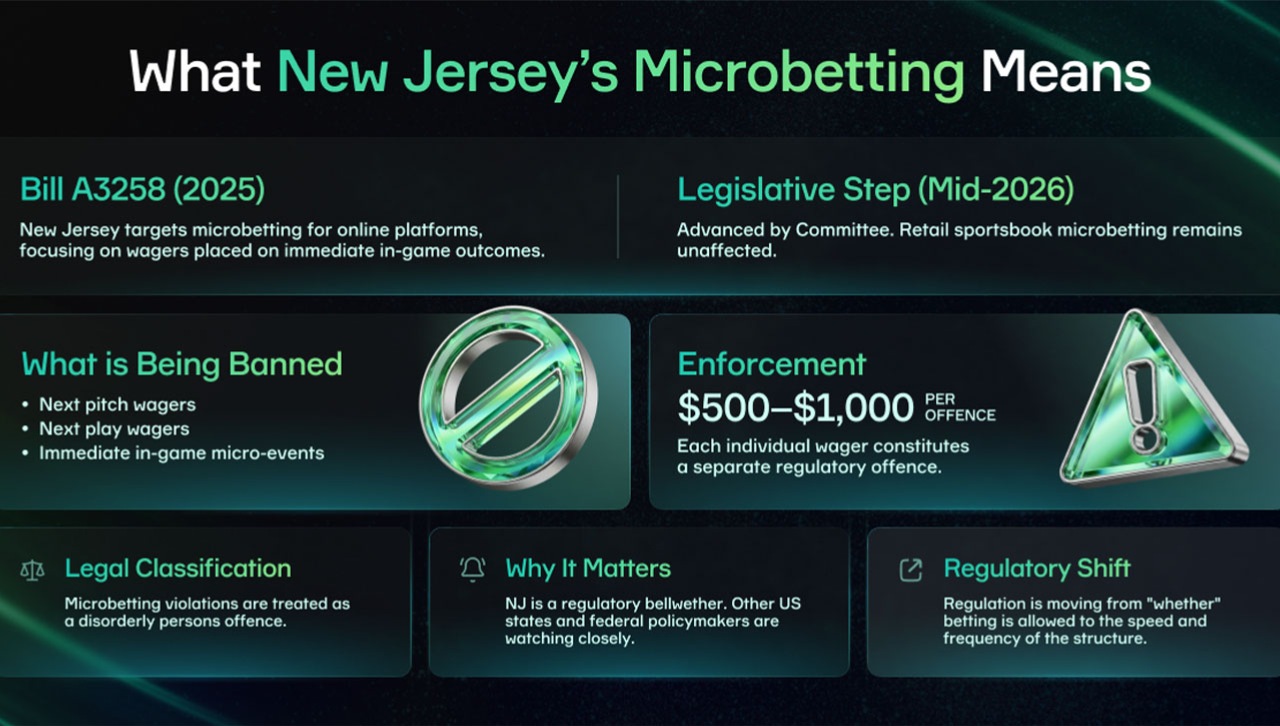
New Jersey Assembly Bill A3258 introduces restrictions on wagers placed on narrowly defined, real-time in-game outcomes. These are bets that resolve almost immediately after being placed, the next pitch, the next point, the next play. In practice, they turn a sporting event into a continuous stream of betting micro-opportunities.
Increasing compliance complexity
One of the most important features of the New Jersey proposal is its approach to enforcement. The Bill does not treat a breach involving microbetting as a single compliance failure. Instead, each prohibited wager constitutes a separate violation.
This matters because modern betting systems are not static. Markets are generated dynamically through real-time data feeds and algorithmic pricing engines. A single technical misconfiguration could result in thousands of bets being offered and accepted before detection.
The consequence is that regulatory exposure becomes a function of system output, not just system intent. Operators can no longer rely on post-event monitoring. This represents a shift from operational oversight to design-led compliance.
Shifting philosophy of microbetting
Microbetting is often described in simple terms, but its structural characteristics are important. It refers to wagers placed on discrete, rapidly occurring events within a live sporting contest. These may include the outcome of the next pitch in baseball, the next point in tennis or the next play in American football.
Microbetting will remain a vital component of the modern sports ecosystem, but its long-term viability depends on a transition toward sustainable, deliberative play
In industry practice, microbetting generally describes a form of in-play wagering in which betting markets are created and settled around discrete events occurring during a live sporting event, with odds updated in real time as new data becomes available.
The commercial logic is clear. The more granular the market, the higher the frequency of betting opportunities created. Industry estimates suggest that in-play betting now accounts for around 47% of global online sports wagers, with the share already exceeding 50% in several mature regulated markets.
What is emerging in New Jersey, and increasingly elsewhere, is not just a concern about specific products, but a broader shift in regulatory philosophy. This is where speed becomes a regulatory variable.
The strategic implication is that responsible gambling can no longer be treated solely as a set of user tools or opt-in controls. Instead, it is becoming a question of product architecture, where the speed, frequency and granularity of engagement are themselves regulatory variables.
Broader picture outside New Jersey
It would be a mistake to view New Jersey’s proposal as a localised policy intervention. The broader regulatory direction is already visible across multiple jurisdictions.
In the UK, reforms have already targeted high-intensity online gaming features. More broadly, regulators are increasingly focused on product characteristics such as speed, frequency of betting opportunities and behavioural intensity.
Regulators are now beginning to ask whether some forms of friction may need to be reintroduced deliberately.
Integrity and player protection
Alongside consumer protection concerns, there is an additional issue: sports integrity.
Microbetting extends wagering into highly specific, granular moments within a match. As markets become more fragmented, so too do the potential points of influence.
A single play, serve or pitch becomes a standalone betting opportunity. Existing monitoring systems are generally calibrated to detect irregularities at match level or broader market movement. Industry integrity monitoring reports, including those from the International Betting Integrity Association (IBIA), consistently indicate that the vast majority of alerts are still triggered at match level rather than at individual micro-event level.
There is currently limited public evidence establishing such a connection. However, regulators are operating in a space where precautionary risk assessment plays a significant role.
Prohibition and displacement risk
As with many regulatory interventions, there is a counter-consideration. Restricting microbetting within regulated markets does not eliminate demand. It may simply displace it.
If consumers migrate to offshore or unregulated platforms, they may lose access to safeguards such as self-exclusion systems, transaction monitoring and affordability controls. This raises a policy consideration, whether prohibition reduces overall risk or relocates it outside the regulated perimeter.
Enforcement proportionality under legal design
The most legally interesting aspect of New Jersey’s proposal lies in its enforcement logic.
By treating each individual prohibited wager as a separate violation, the Bill introduces a model of liability that is highly granular in nature. If a restricted market is inadvertently exposed through a pricing feed, should liability attach to the system design, the operational controls or each resulting transaction?
There is also an operational question. In high-frequency environments, real-time identification of individual prohibited wagers is not straightforward. It requires monitoring capabilities that may be difficult to maintain consistently at scale.
The policy objective is to deter the creation and distribution of restricted betting products, while reinforcing responsible gaming standards. The challenge is ensuring that enforcement mechanisms remain workable in systems defined by speed and automation.
Without that balance, there is a risk that legal certainty becomes fragmented across thousands of micro-level violations arising from a single underlying issue.
Evolving policy trajectory
The broader trajectory is clear. Regulation is moving away from purely transactional oversight and towards product-level scrutiny.
The key shift is that legality alone is no longer the decisive question. Increasingly, regulators are asking a second question: not just whether a product can exist, but whether it should exist in its current design. This represents a structural change in how gambling regulation is conceived.
For operators and suppliers, it also changes the nature of innovation. Competitive advantage may increasingly depend not on maximising engagement velocity, but on designing products that can demonstrate regulatory resilience from the outset.
What microbetting tells us about responsible gaming
At a practical level, operators will need to reconcile maintaining product engagement in highly competitive markets, while ensuring that engagement mechanics do not trigger regulatory concern around speed, intensity, or continuous play.
This reflects a broader regulatory trend in which responsible gambling is increasingly expected to be embedded into the structure of the product, rather than applied retrospectively as an external compliance layer
This challenge is already visible in existing European regulatory developments. In the UK, for example, reforms implemented by the Gambling Commission have restricted features such as autoplay and other rapid-cycle mechanics in online casino products, explicitly on the basis that they increase play intensity and reduce natural breaks in play.
Similarly, the UK Gambling Act Review White Paper emphasises a “safer by design” approach, signalling that product features themselves are now within the scope of regulatory scrutiny.
Within this evolving framework, adaptation to responsible gambling is likely to occur along three axes. First, product teams will increasingly be required to incorporate regulatory constraints at the design stage, rather than treating responsible gambling as a post-development compliance layer. Second, operators may seek to differentiate between high-frequency engagement products and lower-intensity wagering formats, effectively segmenting product portfolios based on regulatory risk profiles. Third, there is likely to be greater investment in real-time behavioural monitoring and intervention tools, although these are increasingly viewed by regulators as supplementary rather than substitutive to structural design changes.
In this context, the industry challenge is not only to ensure compliance with emerging rules, but to redesign engagement models in a way that preserves commercial viability while aligning with an emerging regulatory preference for more focussed and deliberative forms of interaction.
Ultimately, the debate over microbetting signals a decisive turning point for the industry. New Jersey’s proposal serves as a bellwether for a broader regulatory shift: moving away from transactional, post-event oversight toward scrutinizing product design itself.
For operators, this represents a fundamental change in strategy. Responsible gaming can no longer be treated as a peripheral compliance layer; it must be integrated into the product architecture from the outset. Success in this evolving framework requires balancing commercial engagement with regulatory resilience, specifically by incorporating natural friction, managing play intensity, and ensuring that engagement mechanics are sustainable by design.
Microbetting will remain a vital component of the modern sports ecosystem, but its long-term viability depends on a transition toward sustainable, deliberative play. The future of in-play wagering lies in "safer-by-design" architecture, where operators master the technical art of keeping fans engaged while ensuring the product itself acts as a natural safeguard of the player's experience.
David Yatom Hay is the General Counsel of Soft2Bet and leads the group’s legal and regulatory work. His experience extends over a decade where he has represented gambling companies in complex deals and large-scale mergers and acquisitions. His focus areas include sports betting and iGaming platforms, B2B operations and Tier 1 Lotteries which he is able to combine with the experience he has gained within B2C companies. David has managed successful licensing processes in major European countries and the US, his proficiency also extends to AML regulations and GDPR compliance, ensuring the lawful operation of his clients' businesses.
New Jersey Senators introduced legislation aiming to regulate prediction markets at a state level on June 17, despite rulings which found Kalshi’s sports event contracts fall under CFTC and CEA authority