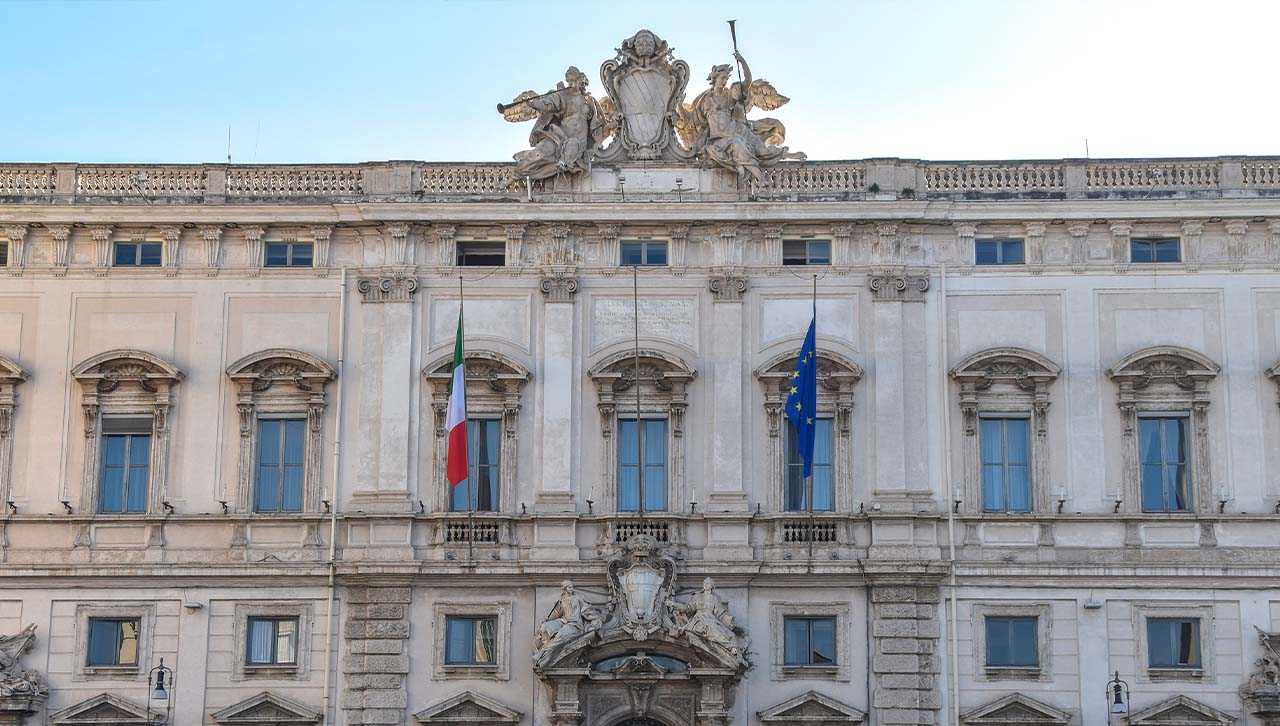
Italy's Constitutional Court has heard a challenge to the minimum €50,000 ($58,500) fine attached to breaches of the country's gambling advertising ban, reopening scrutiny of one of the most contested provisions of the Dignity Decree.
The case concerns Article 9, paragraph 2, of Decree-Law No. 87 of 2018, which introduced a near-total ban on advertising, sponsorship and promotional communications relating to gambling products offering cash prizes.
Under the legislation, breaches are punishable by an administrative fine equal to 20% of the value of the sponsorship or advertising contract, with a minimum penalty of €50,000 for each violation regardless of the campaign's value.
The matter reached the Constitutional Court following a referral by the Regional Administrative Court.
The judges were asked to consider whether the mandatory minimum sanction is compatible with constitutional protections relating to equality, property rights and proportionality, as well as provisions of the European Convention on Human Rights and the Charter of Fundamental Rights of the European Union.
During the 24 June public hearing, State Advocate Maugeri defended the legislation on behalf of the Government, while lawyer Vuolo argued that the fixed minimum sanction is disproportionate. The Constitutional Court reserved its judgment.
Italy's Dignity Decree has remained one of Europe's strictest gambling advertising regimes since coming into force in 2018.
The restrictions extend across television, radio, online media, sponsorship agreements and social media promotions, with communications regulator AGCOM responsible for enforcing the rules alongside guidance on indirect promotional activity.
The proportionality of sanctions has attracted growing attention as AGCOM has continued enforcement against major digital platforms.
Recent years have seen penalties imposed on operators and technology companies over gambling advertising appearing on online services, reflecting Italy's continued emphasis on restricting gambling marketing despite broader debates over the policy's effectiveness.
The hearing also takes place against renewed political discussion about the future of the Dignity Decree.
Football authorities and clubs have argued that the advertising ban has reduced sponsorship revenues while licensed operators remain at a disadvantage compared with offshore gambling websites that continue to reach Italian consumers through digital channels.
At the same time, consumer organisations and public health groups have continued to support maintaining or strengthening restrictions on gambling communications.
The hearing follows the election of Giovanni Malagò as FIGC President, where he called for renewed dialogue over the Dignity Decree while arguing that betting-related revenues could play a greater role in supporting Italian football's long-term financial sustainability.
The Constitutional Court reserved its decision, meaning no timetable has yet been announced for when it will rule on the challenge to the minimum €50,000 sanction