A decade ago, an umbrella licence was enough for an international operator to run a global business. Today, that model alone is no longer sufficient — and the shift explains why «The One Standard» has become the defining challenge for the entire iGaming sector.
One licence used to be enough
Historically, international licences issued in jurisdictions such as Curaçao enabled operators to serve multiple markets where no local licensing framework existed.
It lets operators run legal businesses, enter unregulated markets, build cross-border infrastructure, and launch products in countries without a domestic gambling framework.
This approach worked precisely because so few jurisdictions had built their own regulatory regimes. That simplicity, however, was a product of a specific moment in the industry's history — one that has since evolved significantly.
The first wave: Europe sets the precedent
Europe was among the first regions to break from this model.
France introduced a comprehensive online gambling law in 2010, creating a national regulator (initially ARJEL, later ANJ) and requiring operators to hold a French-issued licence to legally serve French players.
The United Kingdom followed with its point-of-consumption regime in 2014, cementing a principle that has since spread globally: operators targeting local consumers should hold a local licence, regardless of where the company itself is registered.
Over the following years, dozens of other European markets adopted similar frameworks, each with its own advertising, taxation, and player-protection rules.
The second wave: Latin America and Africa
The same pattern later reshaped Latin America.
Colombia was among the first countries in the region to introduce a full licensing scheme for online operators through its regulator Coljuegos in the mid-2010s.
Peru followed roughly six years later, in 2022, with its own comprehensive framework.
Brazil completed the picture on 1 January 2025, when its regulated betting and iGaming market officially launched under Law No. 14,790/2023.
Within a year, millions of Brazilians were placing bets through licensed operators, and dozens of companies had obtained federal licences.
African markets are following a comparable trajectory, gradually moving from basic authorisation toward more structured regulation and player-protection standards.
Over roughly fifteen years, this progression — from unregulated to nationally licensed markets — has become one of the defining trends in global gambling.
From one licence to many regimes
The practical consequence of this trend is a fundamental change in how compliance works.
Where a market has its own regulator, operators must satisfy both their international licence requirements and those of the local one, layering additional obligations on top of a company's global infrastructure:
Global operational infrastructure
International licence
Local licences per regulated market
Local rules for advertising, payments, KYC, AML, and responsible gambling
So when a brand states it holds licences in dozens of jurisdictions, that number does not represent dozens of copies of the same document — it represents dozens of distinct regulatory systems, each with its own obligations.
Licensing as a management system, not a milestone
This is the more mature conversation the industry now needs to have.
A decade ago, obtaining an international licence was effectively the finish line for market expansion. Today it is closer to the starting point.
As more countries build their own regulated markets, international operators must simultaneously satisfy dozens of licensing regimes, each imposing distinct rules on advertising, KYC (Know Your Customer), AML (Anti-Money Laundering), player protection, and affiliate partnerships.
Licensing has stopped being a one-time decision and has become an ongoing system for managing multiple regulatory relationships at once — a shift that turns «how many licences does a company hold» into a much less relevant question than «how well does it manage all of them together.»
Managing complexity as the new core skill
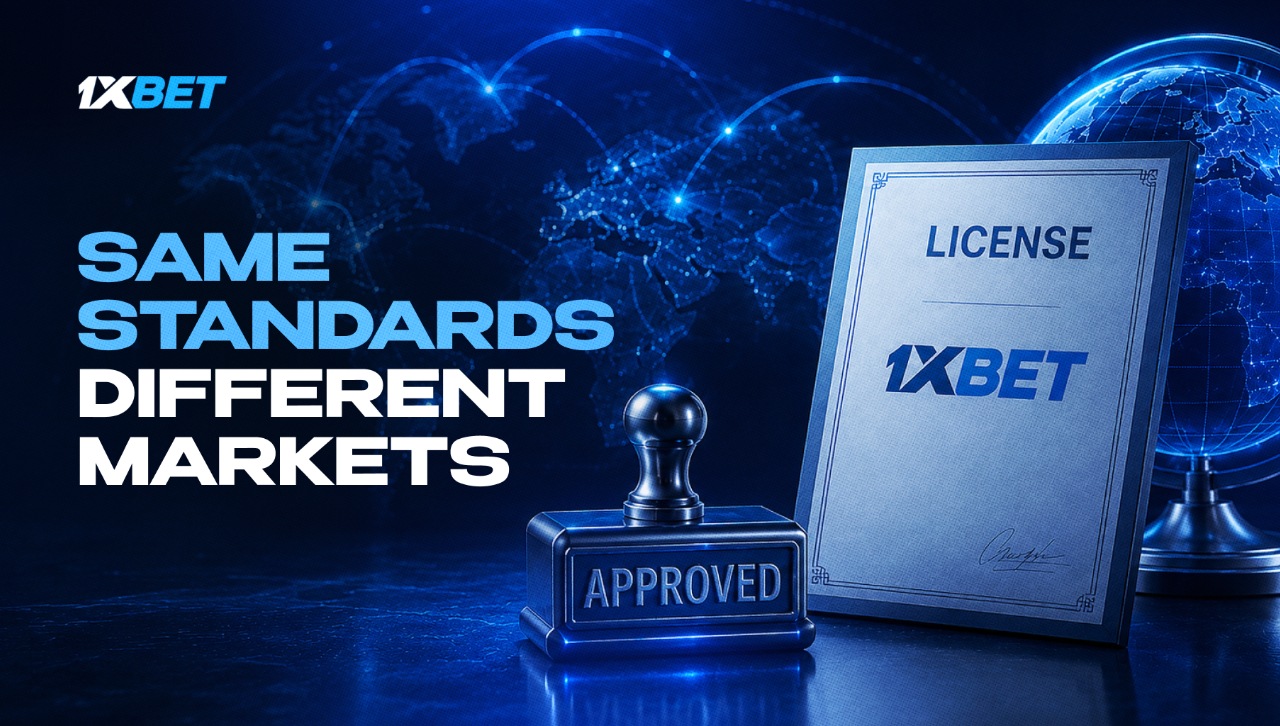
This is precisely the paradox at the heart of «The One Standard»: a brand maintains one internal operating standard while navigating dozens of external regulatory regimes.
Global Standards. Local Compliance is not a slogan so much as an operational necessity — every jurisdiction demands product and process adaptation without compromising the underlying consistency of the brand's controls.
1xBet offers a useful illustration of how this plays out in practice.
Licensing requires adapting the product to each country's specific requirements, and 1xBet operates across several dozen licensed jurisdictions, adjusting its KYC, payment, and responsible-gambling processes market by market while keeping its core compliance framework unchanged.
The company's approach reflects a broader industry reality: managing regulatory complexity — not simply accumulating licences — has become the real competitive differentiator for international operators, and the foundation of what the campaign frames as Built on Trust, Stability and Long-Term Growth.
As more countries build their own regulated markets, international operators must simultaneously satisfy dozens of licensing regime