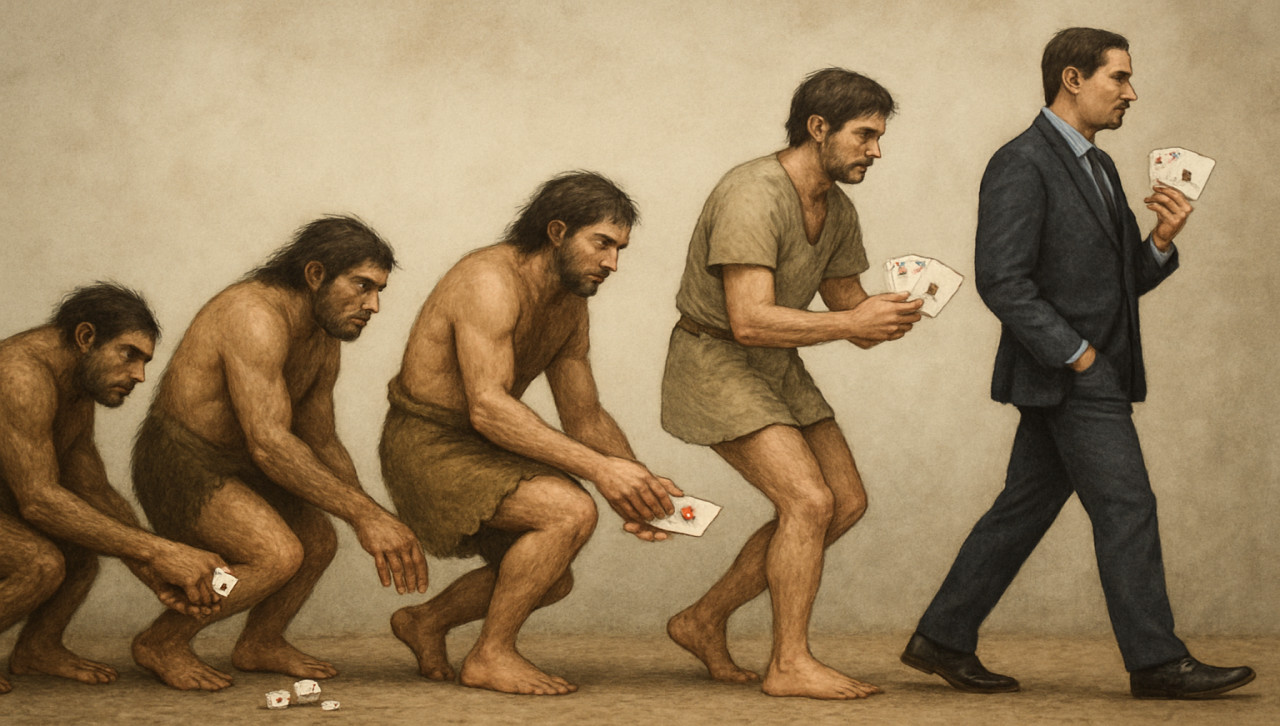
A recent study by Colorado State University has presented evidence of gambling that dates back much further than previously thought.
Indeed, researchers at the University have uncovered a set of dice used by Native Americans on the western Great Plains dating back to over 12,000 years ago. This would place them around the end of the last Ice Age, and predate the earliest known Old World dice by more than 6,000 years.
Robert Madden, a key researcher on the topic, said: “Historians have traditionally treated dice and probability as Old World innovations.
“What the archaeological record shows is that ancient Native American groups were deliberately making objects designed to produce random outcomes and using those outcomes in structured games thousands of years earlier than previously recognised.”
What is the oldest set of dice?
Until this finding, it was widely accepted that dice were created during the Old World, around 5,500 years ago, and that this was humanity's first real exploration into randomness, probability theory, statistics and scientific thinking.
Madden continued: “These findings don’t claim that Ice Age hunter-gatherers were doing formal probability theory.
“But they were intentionally creating, observing and relying on random outcomes in repeatable, rule-based ways that leveraged probabilistic regularities, such as the law of large numbers. That matters for how we understand the global history of probabilistic thinking.”
How were dice games used in the Ice Age?
The dice were used to create equal opportunities and conditions when bartering with other tribes, especially as they created unbiased results that would reduce the chance of conflict.
Madden explained that: “Primarily used by women, dice games were commonly used not only for entertainment but as a way to barter with other tribes.”
This was deduced by studying the morphology of the dice and using an 809-page reference book called ‘Games of the North American Indians’, by Stewart Culin.
He continued: “These games are one-on-one; there’s no house. This is me against you. It’s a fair game, everybody’s got an equal opportunity, equal conditions, and it was used as a form of exchange, as you say, particularly between groups of people who did not come into frequent contact with each other, so they didn’t really know each other.
“They didn’t have pre-existing relationships because in traditional societies, that’s how exchange works.
“It’s really a form of gifting over time that creates enduring reciprocal relationships. It’s not about a commercial transaction where you and I are going to swap something and then go our separate ways.”
Who played the earliest dice games?
According to Madden’s research, around 70% of these games were played exclusively by women to barter for goods between tribes.
A further 7% were exclusively between men, while the remaining 23% were mixed gender games.
There is also an argument that gambling is best accepted when it does not centre itself around winning or losing money, but instead a communal outcome
Looking at gambling through a modern lens, this is a particularly interesting point. Most of the sportsbooks and prediction market platforms nowadays advertise towards a male audience.
However, this research shows that women were the drivers behind investment-style gambling interactions and were responsible for brokering trades with other tribes.
What could modern gambling learn from this?
The most obvious learning point here is the social factor. Whether it is part of bartering with other groups, throwing down chips at a casino or cheering at a racecourse, gambling has always been rooted in interacting with others.
With the rise of iGaming, much of this was lost as online casinos and sportsbooks became available through home computers and phone devices. Perhaps it is no surprise, then, that some of the biggest developments in recent years have circled back to the social element. Online games with chat rooms, communal predictions, crash games with messaging and leaderboards, and even watching streamers play casino games – all of them return to gambling being a shared activity rather than a private one.
Another factor is the predominantly female playerbase. While it would be ludicrous to recommend that games should be made only for a particular gender, whether that’s male or female, it does prove that gambling is not just a pastime for men… nor should platforms singularly cater towards them.
Kalshi has recently received attention for marketing itself towards women through Get Ready With Me (GRWM) influencers on platforms such as TikTok, but why not? If a platform has products that a particular demographic would be interested in, such as Taylor Swift markets, then that demographic should be made aware that such products exist.
There is also an argument that gambling is best accepted when it does not centre itself around winning or losing money, but instead a communal outcome. And, of course, the idea of the journey, entertainment and thrill of playing.
For example, while bingo and lottery draws are still considered gambling, they are less frowned upon because they are viewed as games that support communities: either through providing social opportunities for old people or directly funding good causes.
This can also be seen in products that have grown popular in the last few years, such as live casino and arcade-style titles (and even potentially prediction markets) all lending themselves to a stronger entertainment factor rather than a pure risk-over-reward experience.
All in all, the latest Colorado State University research shows that gambling may be even more intertwined with human history than many anticipated. That will come as bad news for anyone inherently against the practice.
But gambling's historic roots also show a focus that could help reduce the stigma that surrounds the activity today: a focus on community rather than simply winning, losing and a transaction of currency...
There are 14 different partial or complete artifacts that fit the morphological test from the Folsom period, which dates back to 12,000 years ago