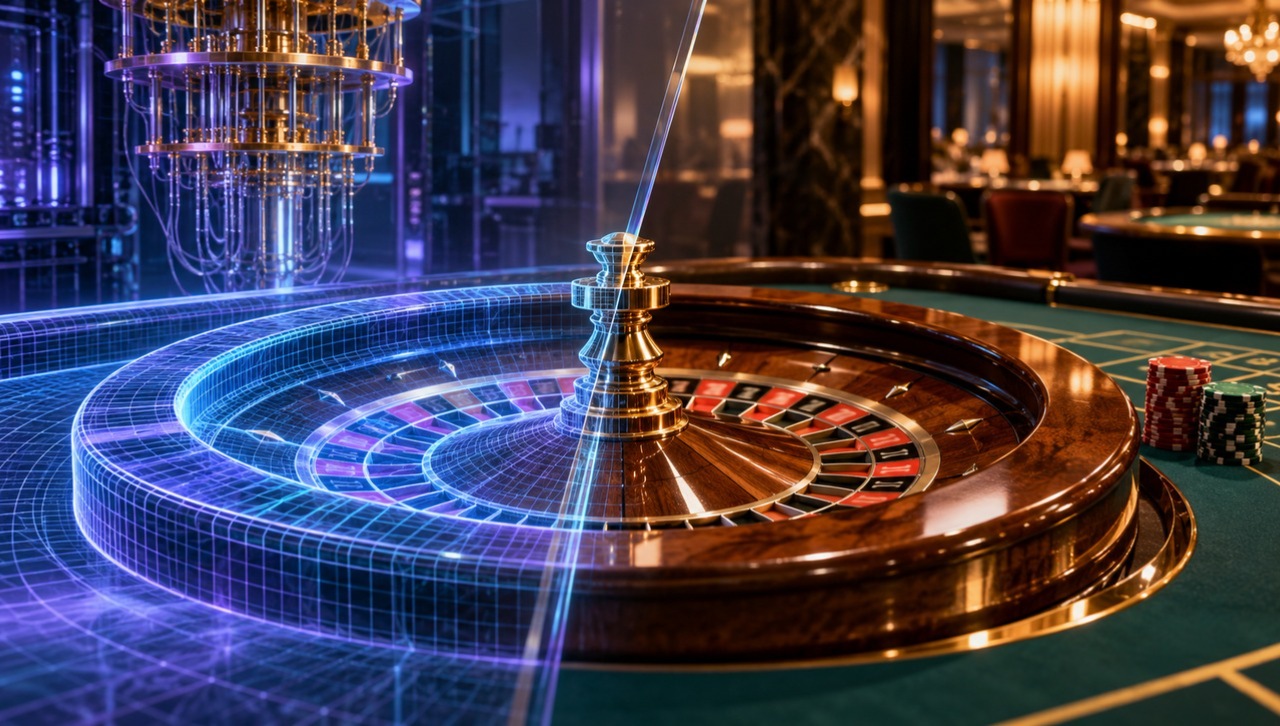
Although it might sound like a term ripped directly out of science fiction, quantum computers are slowly but steadily becoming a reality.
In the simplest terms, these machines use the rules of quantum mechanics to solve complex problems hundreds of times faster than the most powerful regular computers.
This technology could completely reshape online gaming as we know it, by making fraud almost impossible and giving a whole new meaning to "games of chance."
How Constantinople fell
For more than one thousand years, the walls of the city of Constantinople were considered impregnable. That is until 1453, when the relatively newly invented cast-bronze cannons turned those walls to rubble.
Similarly, online payment security is facing a similar threat.
Most transactions that occur via the internet are protected by asymmetric public-key cryptography (PKC) systems.
Today, many online casinos use a popular method, elliptic curve cryptography (ECC), to ensure the maximum level of security to players on their platforms. This system is especially popular with cryptocurrencies as the primary form or sending and receiving tokens.
The way it works is quite simple: a private wallet is identified using a private key, any transaction to and from that wallet will generate a public key that is, technically, a variation of the private one.
The ECC system is a mathematical algorithm that makes it almost impossible for even the most powerful computer to find the private key from the public one.
However, quantum computers can theoretically decipher private keys with ease, which means the whole system would crumble overnight.
Researchers refer to this supposed day of reckoning as Q-Day, and some believe it could arrive as early as 2032.
Despite sounding like an apocalyptic-level threat to the world of iGaming, this instrument of destruction could also be the best tool for defence.
The key distributor is dead, long live the key distributor
Speaking to Global Gaming Insider, Alexandra Mouton, CPO at Slotegrator, addressed the issue of fraud in online casinos.
"Fraud is one of those risks that scales exactly as fast as the business does, so it has to be built in from day one, not bolted on once losses start showing up in the numbers," she explained.
Although deciphering an ECC system would take a regular computer billions of years, it is still an algorithmic system, which means implementation flaws and backdoors could open the possibility of interception.
Today, online casino operators use anti-fraud modules to monitor transactions in real time, however, quantum mechanics present a new opportunity for cybersecurity: quantum key distribution (QKD).
Regular computing works on a binary system, translating data from 1s and 0s. Quantum computing is completely different. Instead of having either 1s or 0s, a unit exists as both until observed.
Quantum computers can theoretically decipher private keys with ease
With QKD, information is transferred through light particles, photons, over fibre optic cables. Each photon exists as both a 1 and a 0 until it travels through a beam splitter forcing it to take a path.
Using this technique, it would be physically impossible to intercept any part of the final encrypted sequence.
Despite sounding fantastical, this technology is already being used. In 2024, the American bank JPMorgan Chase announced that it successfully implemented QKD to secure multiple independent, high-speed virtual private networks.
QKD could help operators improve their overall fraud detection systems, if not make them obsolete.
Why we could have a true game of chance
Beyond the complicated physics that can beef up operators' cybersecurity systems, quantum mechanics offers something simpler but more interesting to the industry.
Games of chance rely heavily on the randomness of a draw, roll or a spin. However, most of the times they are just mathematical equations.
Odds represent that mathematical possibility and are often used by experienced players to know when to stay and when to fold.
Some games can be so mathematical that those good with numbers can technically cheat. The illegal technique of counting cards in blackjack is built upon the possibility of "manipulating" chance through sheer maths and logic.
While live games of chance must account for human variables, such as how a person shuffles a deck, rolls the dice or spins a wheel, online casinos use a system known as pseudorandom number generators (PRNGs).
PRNGs use an algorithm that creates a sequence of numbers that approximate the properties of true randomness but, essentially, is still deterministic.
However, by relying on a quantum event, measuring its outcome and converting it into digital form, quantum random number generators (QRNGs) achieve true randomness.
Quantum computers are slowly but steadily becoming a reality
As of today, QRNGs are being used in tandem with cryptography tools such as QKDs; nevertheless, implementing this system in online casinos could be the closest way of achieving a completely fair and transparent game of chance.
Part of the allure of gambling is its equalising nature. It doesn't matter who you are, how much experience you have or how much money you spent, everyone plays on even ground.
Random number generators appear, by all means, to live up to their name given our limited, human perspective.
But QRNGs guarantee a level of randomness that not even the most powerful computer could predict.
However, could quantum physics give players an edge operators might not enjoy?
Q-day may still be years away, but the technology and systems exist today, meaning quantum casinos aren't a matter of if but a matter of when.
According to the CEO of GammaPlus, Arturs Zagurilo, Crypto casinos magnify both success and failure, as they offer more flexibility