



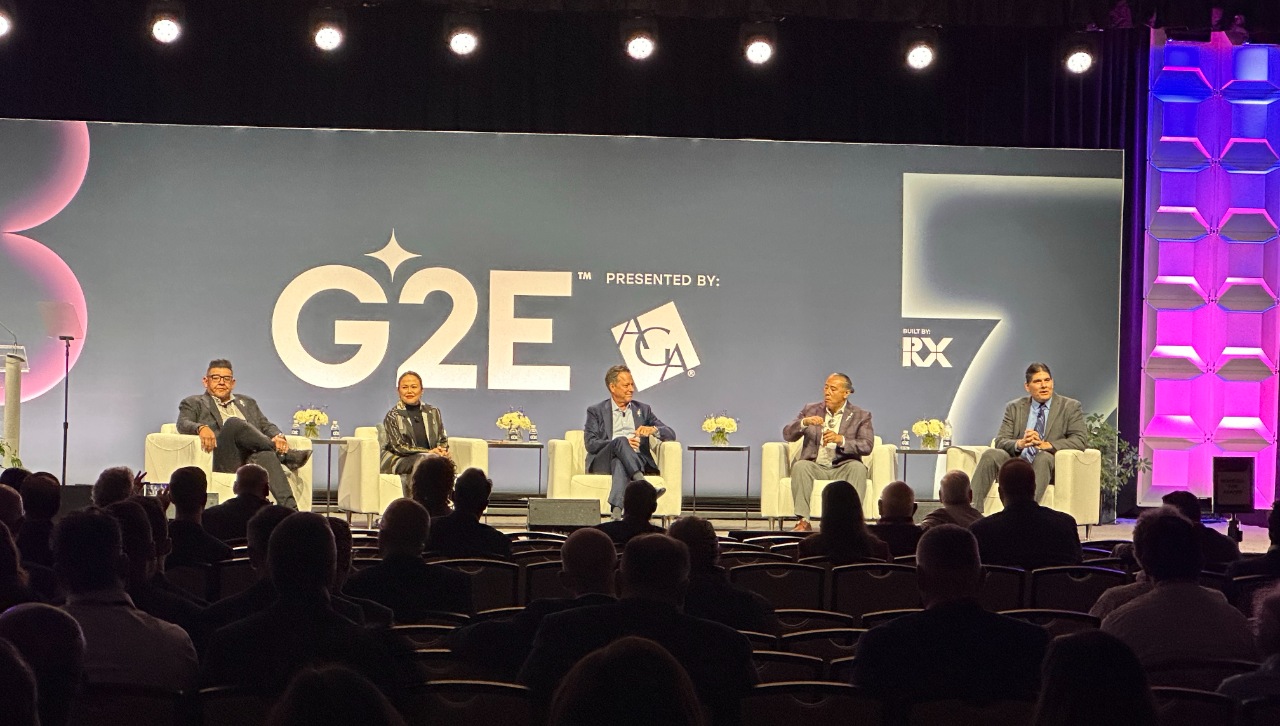
As part of a main stage panel featuring Indian Gaming Association (IGA) Chairman David Bean, Executive Director Jason Giles, American Gaming Association (AGA) President & CEO Bill Miller and California Nations Indian Gaming Association (CNIGA) Chairman James Siva, the leaders discussed why a “coordinated response” is needed to combat prediction markets’ growth at the Global Gaming Expo (G2E) in Las Vegas.
The panel began by Giles calling attention to the near one-year anniversary of the death of former IGA Chairman Ernie Stevens Jr., while Miller believes the impactful Tribal leader would be “proud” of the work currently being done by regulators.
Giles continued by speaking on how prediction markets turned California into “ground zero,” before asking Chairman Siva how the strategy “changed the mission” of CNIGA.
“Sometimes California is seen as the golden goose, but really this entry of illegal activity has done the one thing that they can’t afford to have happen, which is unify California Tribes,” Chairman Siva said.
“In California we remember our history and we’re willing to do whatever it takes to protect that history.”
Giles claimed prediction markets are “nothing more than your corner street bookie offering bets,” and believes the popularity of online betting and social media meant the vertical was always going to “explode.”
The IGA Executive Director directly referred to rulings made by the US Sixth and Ninth Circuit Courts, which found sports-related event contracts cannot be deemed as “swaps,” and are not protected by the Commodity Exchange Act.
According to Giles, the “most offensive thing” Kalshi has claimed is that geofencing Tribal reservations from taking part in prediction markets is “infeasible.”
Miller followed Giles by stating: “The question is going to be how do we go and make the case that this is unlawful. They have contorted the Commodity Exchange Act into something that is unrecognizable.
“Even in places like Utah, which doesn’t have gaming, they’re saying we don’t want the federal government to shove this down our throat. The arguments have gotten refined and the regulators understand what’s at risk here.”
Chairman Siva claimed “everyone has their eye on California,” but also believes the “momentum is shifting” in the fight against prediction markets, mainly due to Tribal regulators being on the “right side of this issue.”
“While these prediction markets continue to pour money into different avenues left, right and center, they are losing,” Chairman Siva said.
Chairman Bean stated the National Indian Gaming Commission (NIGC) has been "surprisingly quiet” in the fight against prediction markets, and that he “wishes the NIGC would be as supportive as the (Commodity Futures Trading Commission) CFTC is of prediction markets.”
The IGA Chairman continued: “It would be great if they took that same type of action against (prediction markets)... and we know who’s in charge over there, and who their family is connected to. Our federal trustee is not out there looking out for us.”
Miller believes prediction markets’ “best days are behind them,” and that “reality is going to set in.” The AGA President & CEO stated operators attempted to “buy off” media organizations and – more recently – Tribes.
Chairman Siva backed the claims by stating “you can feel (prediction markets’) desperation,” while Giles spoke on how Tribes have been unable to expand gaming operations due to the focus on prediction markets.
Referencing the Tunica-Biloxi Tribe of Louisiana’s partnership with Kalshi, Chairman Bean expressed confusion as to why “any Tribe” would be willing to “give up their sovereign immunity” – but the IGA leader still expected prediction markets to “find the weak point.”
Miller closed the panel by quoting Mike Tyson, stating “everyone has a plan until they get punched in the face.” Confirming his Association was “punched in the face” by prediction markets, Miller now confidently claims such operators are “on the run.”
The US Senate voted 49-50 to reject the procedural motion required for the Clarity Act to advance on September 15, as ethics language remained as an uncompromising hold-up in negotiations