



















Key Points
- Global Gaming Insider evaluates the symbiotic relationship between sports, gambling and advertising from financial, regulatory, cultural and historical standpoints
- In which sports is gambling sponsorship biggest – and where?
- The dawn of prediction markets and influencer marketing have paired with 'traditional' celebrity endorsements to create a new environment for athletes and the general public, alike
- How does the visibility of sports sponsorship contribute to shifting public perceptions around gambling?
Is what you see really what you get?
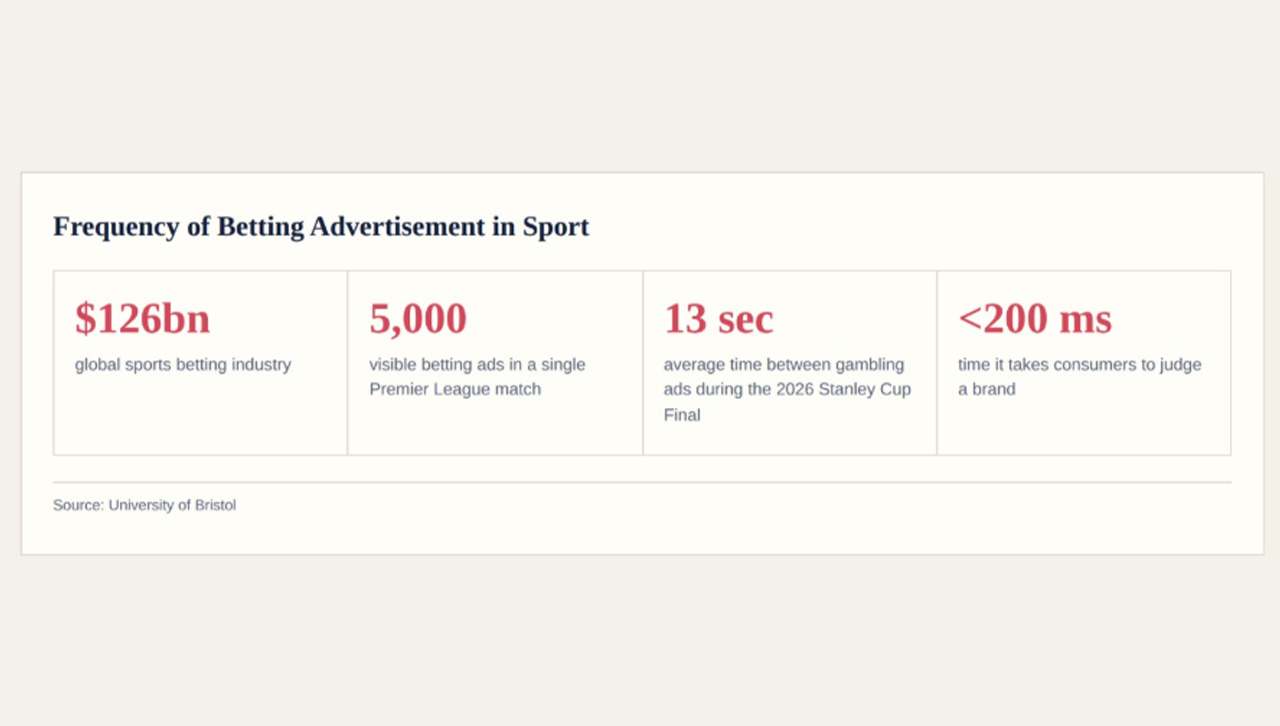
As consumers, psychology tells us that our decision-making process when it comes to brand judgement takes under 200 milliseconds.
Make no mistake, despite our parents' best efforts, we’re all judging the book by its cover – day in, day out. Instant judgement; and instant gratification.
Within the context of the $126bn sports betting industry, this, in essence, is why you see 5,000 cases of visible betting advertisements during the space of a single Premier League football game. It’s why there is a sports stadium named after a betting brand on every continent. And it’s why you see gambling advertisements every 13 seconds during the 2026 Stanley Cup final. Copious as these examples may sound, they are verified instances which serve to highlight the prominence of (and demand for) gambling advertising in the sports industry.
Indeed, on the surface, sports and gambling seem to be two industries happily partnered through convenience and circumstance. Yet beneath the surface hides a pairing deeply intwined through decades of culture, regulation and financial dependency.
Regulation roundtable: One industry, a range of approaches
In the modern market, gambling advertising in sport is truly everywhere. Yet, when it comes to regulation, it is a phenomenon that is governed by vastly differing standards on a global scale.
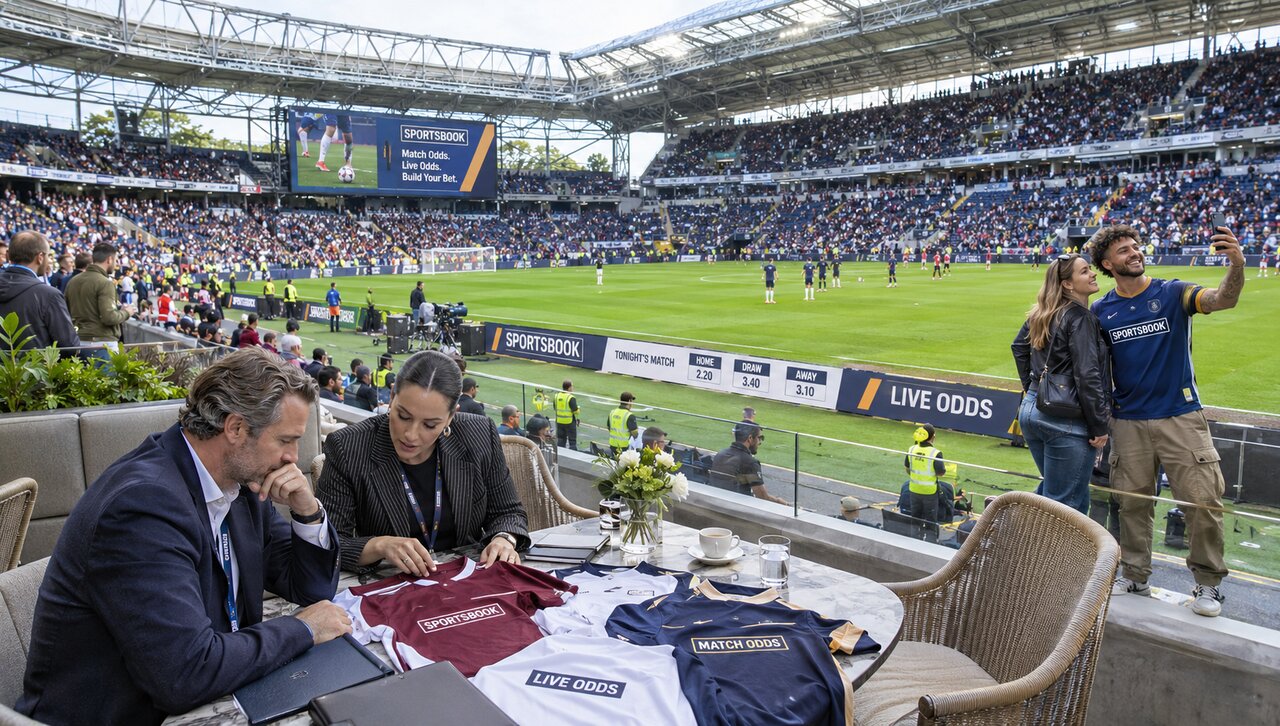
Football shirts, stadium naming rights, broadcast graphics, celebrity endorsements, courtside advertising, digital content and official partnerships. There is a lot going on. And commercial activity that is considered acceptable in one country may be either legally ambiguous or completely restricted in another.
What appears to be the unifying factor in the sports betting sponsorship conversation is – regardless of internationally differing public opinions – sport wants gambling and gambling wants sports. The relationship is symbiotic and, in many ways, co-dependent. But we’ll get to that.
Symbiotic is, perhaps, the word that describes the intertwined nature of sport and betting sponsorship better than any other
While there are unifying factors in the sports sponsorship conversation, the picture can vary significantly depending on which part of the world you are choosing to observe it from:
United Kingdom:
Sponsorship of sports by gambling companies in the UK is surprisingly sprightly for its age. That is to say, given how long the ecosystem has been operational, it remains incredibly sensitive to significant change at the stroke of a pen.
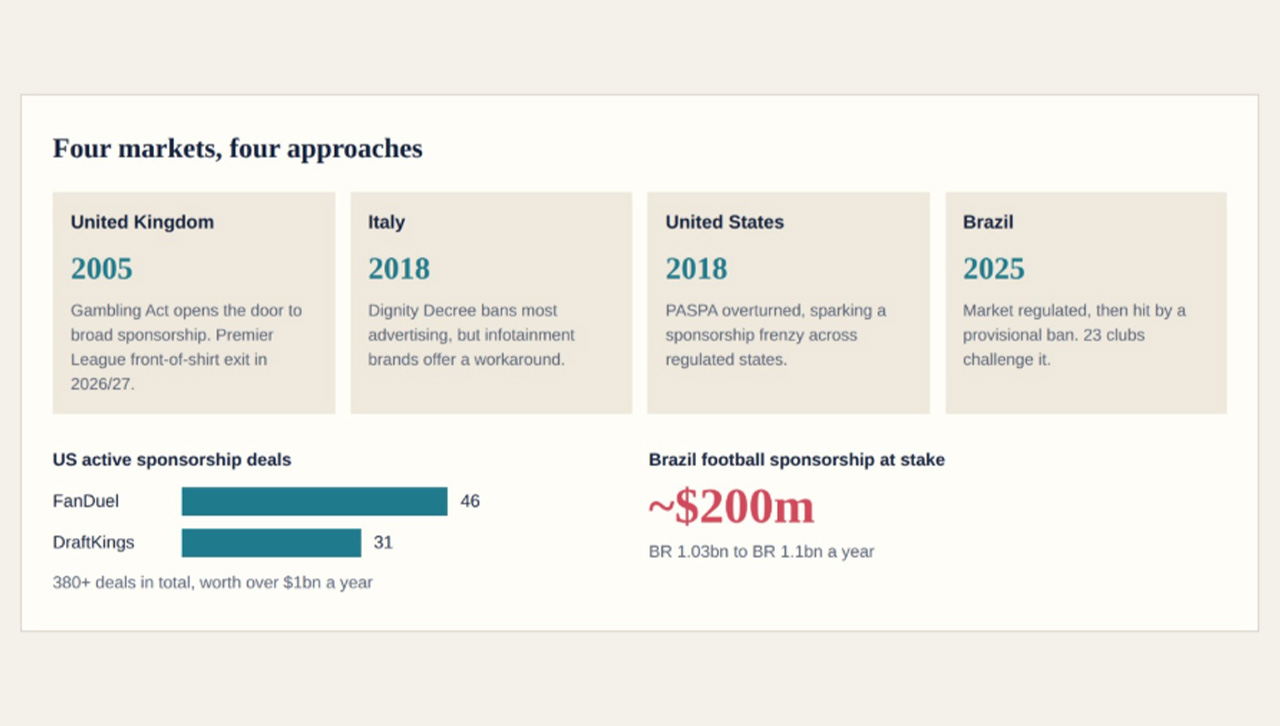
Sports sponsorship in the UK traces back over half a century and remains a deeply rooted tradition in the UK horseracing industry; however, sponsorship of other sports in the nation on a broad scale didn’t begin to take flight until the 2000s. The 2005 Gambling Act allowed for an explosion in endorsement at a time when the online sector was beginning to proliferate.
Ray Winstone’s famous partnership with bet365 paved the way for a wave of celebrity endorsement through the 2010s, with Stoke City also seeing its stadium renamed, a countless number of football teams yielding front-of-shirt sponsors, pitch side banners across a range of sport and TV advertising explosion all combining through a golden era of sponsorship.
As the UK’s market moved into online maturity through the 2020s, however, the Advertising Standards Authority (ASA) has become less forgiving with its policies as shifting public perception and industry priorities have brought player protection to the fore. Many of its outlined policies remain highly interpretive, and the recent ban on front-of-shirt sponsorship in the Premier League has simply seen online casino operators shift their branding to shirt sleeves, training kits and pitch-side billboards – at least for the time being. Shifting regulations, fast rising taxes and a UK black marketplace that is growing at an alarming rate make for a challenging advertising environment in the UK. But if one nation has proved it can innovate when it comes to gambling advertising... it’s Britain.
Italy:
While the UK is looking to manage its advertising industry, albeit somewhat restrictively, Italy has taken a zero-tolerance approach to sports sponsorship regulation... or so it says.
The introduction of Italy’s 2018 Dignity Decree makes it one of the most restrictive gambling advertising markets in Europe – with advertising broadly prohibited across TV, radio, sport, online and print media. Further, as is becoming increasingly common on a global scale, there is a particular focus on influencer endorsement outlined as part of Italy’s advertising regime, with celebrity sponsorship strictly monitored.
However, there is a huge addendum to Italy’s supposedly steadfast rejection of sports sponsorship and gambling advertising as a whole: operators may still sign prominent sports sponsorship deals if they use the infotainment media brand workaround, rather than directly advertising their sportsbook platform directly. This workaround allowed Betsson Sport to become Inter Milan’s front-of-shirt sponsor for a number of years, for example.
While Italy’s sports sponsorship approach is one of the world’s most restrictive, it remains one of the most important and influential approaches on a global scale. Few mature regulated markets have taken such a steadfast approach – particularly in Europe – and Italy’s sponsorship ban has forced innovation in a place where there realistically shouldn’t have been any room for creativity whatsoever.
Indeed, there has been a recent wave of 'infotainment' sites sponsoring clubs, such as bet365 Scores, although Italian regulator AGCOM is now taking aim at them.
United States:
If one nation were to be the antithesis of Italy when it comes to gambling sponsorship, it would be the US.
As Italy went one way, the US went the other. The overturning of PASPA in 2018 – incidentally the same year as Italy’s Dignity Decree – ignited what has turned into a sports betting advertisement and sponsorship frenzy across the US’ regulated state markets.
That point is well illustrated by FanDuel, which currently has 46 active sponsorship deals in the US sports sector – trailed by DraftKings, which has 31. Overall, the number of currently active sports sponsorship deals in the US tops 380+ and exceed $1bn in collective annual value.
Naturally, regulation varies state-to-state. But the general consensus remains a free-for-all, with little standing in the way of what is currently a highly lucrative symbiotic relationship that is feeding a serious amount of revenue for the sports and gambling industries, alike. Of course, there is only so long you can discuss the US market before prediction markets enter the conversation, and they too have begun to enter the action, brokering sponsorship deals with franchises and leagues.
This marketing frenzy has been amplified even further by the rise of prediction markets. Kalshi, Polymarket and, most recently Novig with its Sydney Sweeney campaign, have seen both US advertising and sponsorship flourish. Regulators will most certainly be keeping a close eye. More on prediction markets later...
Brazil:
Until September, many in the industry would have believed they had Brazil just about figured out. That is, typically, what happens before everything goes wrong.
Having only regulated in 2025, Brazil’s market was subject to a provisional online ban in October 2026. A total Federal ban (although this is since being debated). What is important to understand in this context, though, is that one of the main opponents to the ban is the nation's football industry.
A total of 23 Brazilian football clubs have mounted a challenge against the betting ban at the Supreme Court. And with football gambling sponsorship being worth between BR 1.03bn ($200m) and BR 1.1bn, it is no wonder.
The key issue in Brazil, as with much of the rest of the world, is the issue of public perception. Of the four highlighted nations, Brazil’s public distaste for gambling is by far the most intense – and has perhaps been the key driver behind the Government’s U-turn decision on the regulated market.
Nevertheless, the public perception conundrum remains a key issue in almost every regulated market across the globe, relating directly to sports sponsorship – as it raises a number of questions around the acceptability of gambling sponsorship in sports.
Public perception and the normalisation of gambling sponsorship
Do fans distinguish between a gambling company sponsoring their club and being directly encouraged to bet? Do attitudes differ by age, gambling participation, sport and country? Are public attitudes reflected in policy, or do commercial interests and political priorities play a larger role?
Something that influences these commonly levied questions in the public discourse is the gargantuan cross-sell revenue opportunity that links sports and gambling – alongside sports fans and gamblers – so closely.
Sport and gambling each hold a shared interest in the credibility of sporting outcomes, but their commercial relationship can create conflicts over who is responsible for protecting that credibility
This opportunity is something that has been increasingly recognised by operators as the industry has moved into its online era over the past 25 years. Prior to this, gambling in many senses didn’t require advertising at the same frequency; because there were only a handful of ways to do it, and only a handful of operators to do it with.
Prior to the 2000s, the casino, the bookmakers or the racetrack were the only realistic options a market could offer. In comparison to now, such a lack of options feels almost primitive. However, the simplicity of the industry in turn lent itself to a more straightforward public perception: gambling is simply a leisure pursuit.
Those who frequented the casino or the bookmakers were viewed as a habitual sub-sect of society – and those who dabbled infrequently as merely curious passers-by. Fast forward to the present and the public discourse has changed drastically. Broadly, gambling (sports betting in particular) is largely promoted as a leisure pursuit, though there are a growing number of fierce opponents to the industry on a wider scale – and advertising is a key point of tension within the gambling debate.
Indeed, there is a strong case to be made that the exposure element is the sole cause behind the recent decline in industry approval rates within the public domain. And that’s where sports sponsorship comes into the conversation.
The frequency of gambling adverts in sports – when considered on a global scale – is mind-blowing. There’s no two ways around that fact. For those in the sports and gambling industries respectively, it’s easier to understand why gambling sponsorship is, in many ways, a lifeblood to the sports industries adored by billions across the globe.
The challenge for the industry now is to promote a healthy symbiotic relationship between gambling and sport, while addressing the fact that not all people exposed to gambling sponsorship campaigns will support the industry. Tapping into the relationship between sports and sports fans through creative sponsorship may well be one way to win the battle. And while the industry may struggle with the idea that there is a sizable opposition to it, it remains the industry’s job to challenge the narrative.
Players paying the price?
The importance of shifting external perceptions goes far beyond simply protecting gambling revenue streams and reputation. Indeed, the growth of sports betting sponsorships over the years can also affect athletes beyond their role as the faces of sporting competitions and partnerships.
Tension between athletes as commercially valuable assets and potential targets of frustrated bettors exists today, as it has done for many years. In fact, this issue extends beyond just the players, as Betfred boss Fred Done has recounted being the victim of a stabbing at the hands of a disgruntled customer some years ago.
While sports sponsorships are by no means the cause or catalyst of harassment, the commercial expansion of betting in tandem with the rise of social media makes athlete abuse an important part of the sports sponsorship conversation. Online abuse is rife in the modern media, with individual performance markets and micro-markets rising in popularity – placing intensified focus on individual player performances.
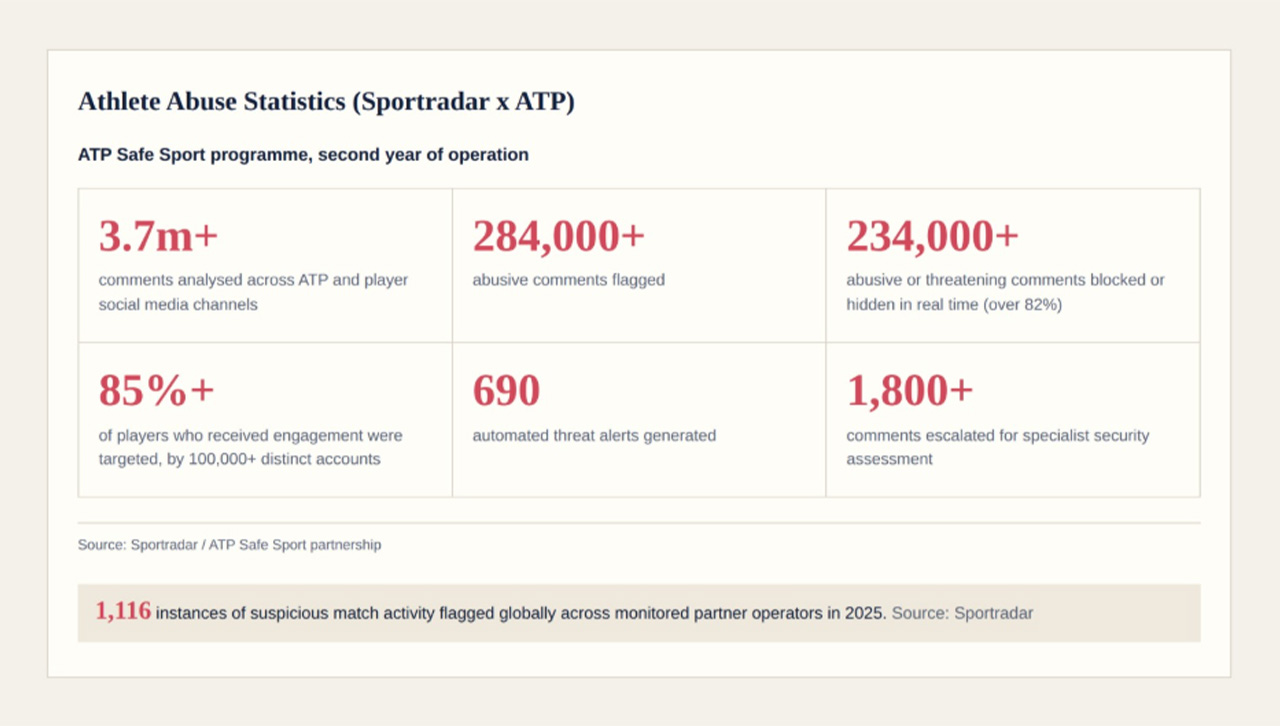
This is one of the core reasons why tennis players have historically been subject to higher levels of abuse. Because it is not a team sport, there is nowhere else to direct the abuse, and little room for respite from the player’s perspective. The gambling industry is increasingly aware of this problem, with Sportradar having partnered with ATP in recent years to develop and implement technological safeguards that have been proven to prevent attacks – and effectively monitor online abuse via artificial intelligence that automatically reports and blocks abusive accounts.
Abuse is one consequence of betting's close relationship with sport. Another is the pressure that betting markets can place on the integrity of the competitions themselves.
The integrity paradox
Of course, sport and gambling each hold a shared interest in the credibility of sporting outcomes, but their commercial relationship can create conflicts over who is responsible for protecting that credibility. The sports industry is built around trust in the underlying product; fans have to believe that results are genuine and competition is fair – and the last thing the gambling industry can do is stand in the way.
For the most part, gambling stands up to its mandate – with bodies such as the International Betting Integrity Association (IBIA) providing centralised regulatory oversight of match-fixing and spot-fixing on a global scale. That said, instances of match-fixing and athlete-gambling engagement remain common, with Sportradar data highlighting 1,116 instances of suspicious match activity globally and across monitored partner operators in 2025.
It is important to distinguish between the presence of a betting sponsor and the risks created by betting markets themselves. The recent growth of micro-markets on a broad scale has created new conundrums around whether sponsorships are now giving operators access to information and commercial opportunities that should require additional safeguards.
Then, there is the question mark around borders. Operators end up with a huge integrity issue when a sponsorship is drawn up between a gambling company and a sports organisation in one given jurisdiction, that then crosses over into an unregulated, illegal region. With these types of deals continuing to proliferate in an increasingly digital world, international governing bodies need to set minimum standards for betting sponsorship and integrity safeguards.
The frequency of gambling adverts in sports – when considered on a global scale – is mind-blowing. There’s no two ways around that fact
The central question is whether markets can retain the financial benefits of betting partnerships without allowing commercial interests to undermine the wider integrity of sport. So good, so far – touch wood...
The next frontier: Prediction markets & influencers
For a region that has only had a handful of newly regulated gaming states in the past few years, the US is currently in the midst of what could become the defining revolution of online gaming this century.
With prediction market mayhem continuing to fester through every sinew of the States, 'gambling' sponsorship has taken on a new definition and begun to evolve far beyond traditional sportsbooks. New financial products, digital personalities and platform-based promotion are challenging established distinctions between gambling, entertainment and commercial sponsorship.
The legal discrepancies of the sector are well established. State gaming regulators view the products as gambling, the platforms skirt gambling regulations by citing federal oversight from the Commodity Futures Trading Commission (CFTC)... and so the wheel goes round.
While everyone is watching the circus court cycle, however, sports franchises are beginning to pick their sides.
Mixed messages from sporting entities and celebrities, alike, serve to add confusion to an already incredibly confusing conversation
From a sponsorship perspective, many of the partnerships drawn up between sports franchises and prediction markets resemble those between sports franchises and traditional betting operators almost identically. Nevertheless, every endorsement continues to add weight to the longevity of the sector, which remains rife with insider trading pitfalls and vague legal classifications.
Now, while partnerships between prediction markets and sports franchises remain comparable to those with betting operators, partnerships between prediction markets and individuals are beginning to break the mould.
Sydney Sweeney's campaign with Novig raised a few eyebrows (to say the least) as the actress went fully nude (aside from some strategically placed sports paraphernalia) to promote the launch of the platform's sports events markets. Would this have happened in the 'traditional' gaming industry 20 years ago? Maybe. 10 years ago? perhaps. Now? Almost certainly not.
This instance of, let's face it, influencer marketing tells us that for these 'new wave' operators, sports endorsement doesn't have to come from those even vaguely related to sports. Why? Because the sector is still in its infancy – and whoever shouts loudest (or most controversially) can win.
The line between influencer and celebrity is becoming increasingly blurred. What isn't changing is the effectiveness of influencer endorsement. With athletes, actors and influencers now essentially running personal branding machines that operate as independent media businesses, influencer endorsements are as common now as they'll ever be – as they provide direct relationships with thousands of potential consumers through social media channels.
In the same way that some celebrities choose to affiliate themselves with legally squeaky-clean corporate entities – while others choose to roll the dice – sports leagues and franchises are (as mentioned) now picking sides for and against prediction markets. Five MLB teams have partnered with Kalshi, numerous NFL and NHL teams have done the same – with the ice hockey league, itself having partnered with both Kalshi and Polymarket. The NBA recently partnered with Kalshi and Polymarket, too. The NFL, however, issued an open opinion to the Supreme Court stating that prediction markets are gambling, and should be regulated accordingly.
Mixed messages from sporting entities and celebrities, alike, serve to add confusion to an already incredibly confusing conversation.
Influencer endorsements are as common now as they'll ever be – as they provide direct relationships with thousands of potential consumers through social media channels
The broader issue within the sponsorship context is that, as promotion moves into digital content, financial platforms and personal endorsements, sponsorship is becoming harder to define – meaning regulators may struggle to distinguish sponsorship, advertising, product integration and ordinary discussion.
Financial co-dependence: Who's the real winner?
Sport has always sold more than the game itself. It sells loyalty, identity and access to audiences who return week after week. For sports betting operators, that makes it an exceptionally valuable advertising environment. For clubs and leagues, it makes betting companies attractive commercial partners. The result is a relationship in which both sides stand to gain – but neither is entirely free from the other’s influence.
For gambling operators, sponsorship offers far more than a logo on a shirt. Official-partner status, branded content, stadium advertising, player appearances and digital promotions can place a betting brand at the heart of the fan experience. The commercial question is whether that visibility delivers a return; the ethical one is what happens when the pursuit of that return conflicts with protecting audiences.
For sporting organisations, betting sponsorship provides valuable revenue to fund operations, attract talent and compete commercially. Yet, the dependence is uneven. A global football giant with lucrative broadcasting and merchandising deals may have greater freedom to replace a gambling partner than a lower-league club or smaller sport with fewer commercial options. For the latter, losing a sponsor could mean more than an empty advertising space: it could mean a smaller budget and difficult decisions about where money goes next. One only has to look as far as Brazil to see what happens to a football club's revenue stream when you pull the betting sponsorship plug.
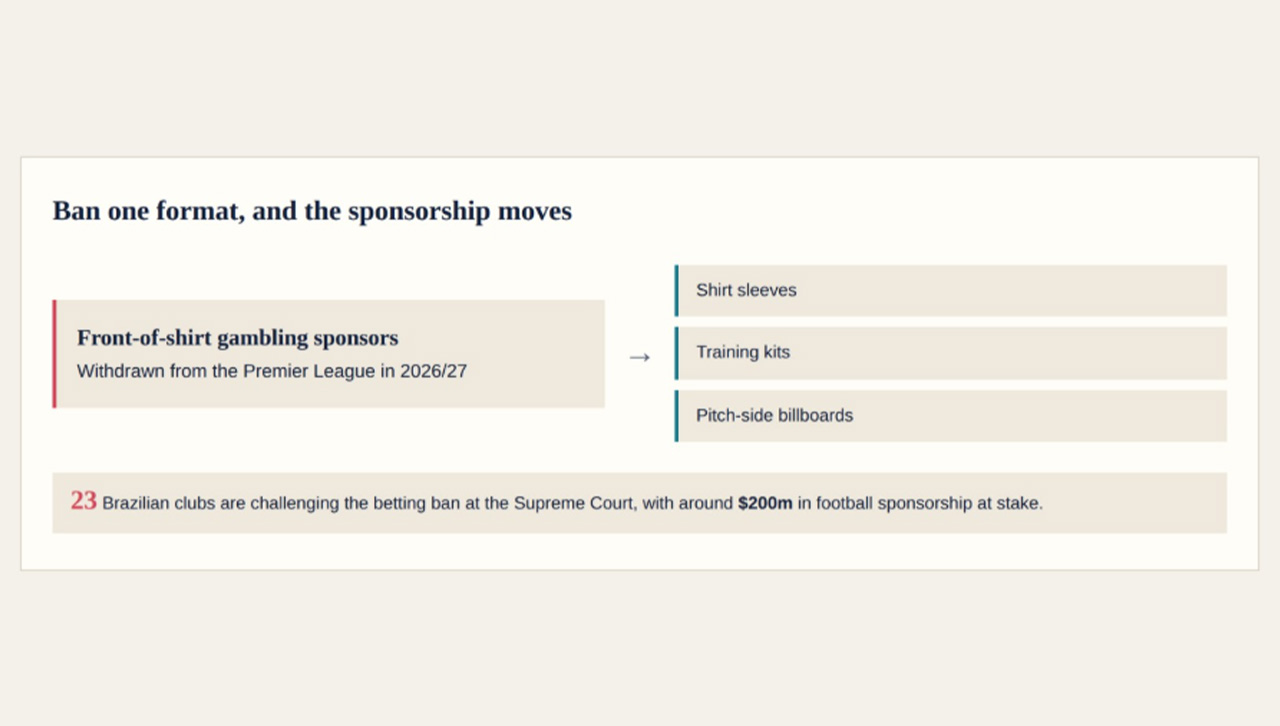
This complicates the argument for tighter restrictions. If betting sponsorship disappears from one format, does another industry step in at an equivalent price? The Premier League’s front-of-shirt withdrawal from gambling sponsors in 2026/27 provides a fascinating case study, as betting partnerships have simply continued through other permitted arrangements. The crucial measure is not simply how many deals end, but how much exposure changes, what revenue is replaced and who bears the cost.
The future of sports betting sponsorship may therefore depend less on whether the relationship survives than on whether sport can diversify its income, negotiate stronger safeguards and prove that commercial gain does not come at the expense of public trust.
Regulating as one ecosystem
Symbiotic is, perhaps, the word that describes the intertwined nature of sport and betting sponsorship better than any other.
Sports betting sponsorship is not simply a private agreement between a betting operator and a sporting organisation. Its effects are shaped by clubs, leagues, broadcasters, digital platforms, athletes, regulators and the audiences who encounter the resulting promotion. Effective safeguards, therefore, need to address the wider commercial ecosystem, not just the sponsor.
Now more than ever, the boundaries between sponsorship, endorsement, advertising and entertainment are becoming increasingly blurred. Sponsorships, therefore, can no longer be truly regulated in isolation – which throws the approach of the UK's ASA into question, as the regulator operates generally on a campaign-to-campaign, case-by-case basis.
Sport has always sold more than the game itself. It sells loyalty, identity and access to audiences who return week after week
Indeed, a betting operator might lose the right to appear on the front of a football shirt while retaining stadium advertising, sleeve sponsorship, official-partner status or branded digital content. Equally, a single agreement might include celebrity endorsement and 'face time,' alongside content, commercial rights and in-person activations. Sponsorships are also, of course, often cross-jurisdictional – blurring the definitions of what is required by (and what is off limits to) operators even further.
National laws will continue to differ... that won't change. Yet, the idea that international sporting bodies could establish minimum standards for all gambling-related commercial partnerships is one that is increasingly more achievable in a globalised industry.
Regardless, regulation of sports sponsorship needs to continually prioritise audience and player safety, as well as fiercely protecting commercial interests through financial and sporting integrity. These expectations must transcend jurisdiction; but the industry is waiting for someone to step forward and ensure that this is the base level before it can start to search for the regulatory ceiling.
Ultimately, the gambling industry's maturity may be judged not by how much money it contributes to the sports sector, but rather how effectively it self-governs its close-knit relationships within the ecosystem.
Good to know
William Hill’s sponsorship of York's 1957 Ebor Handicap was the first horseracing-gambling sponsorship any kind in gambling across the globe