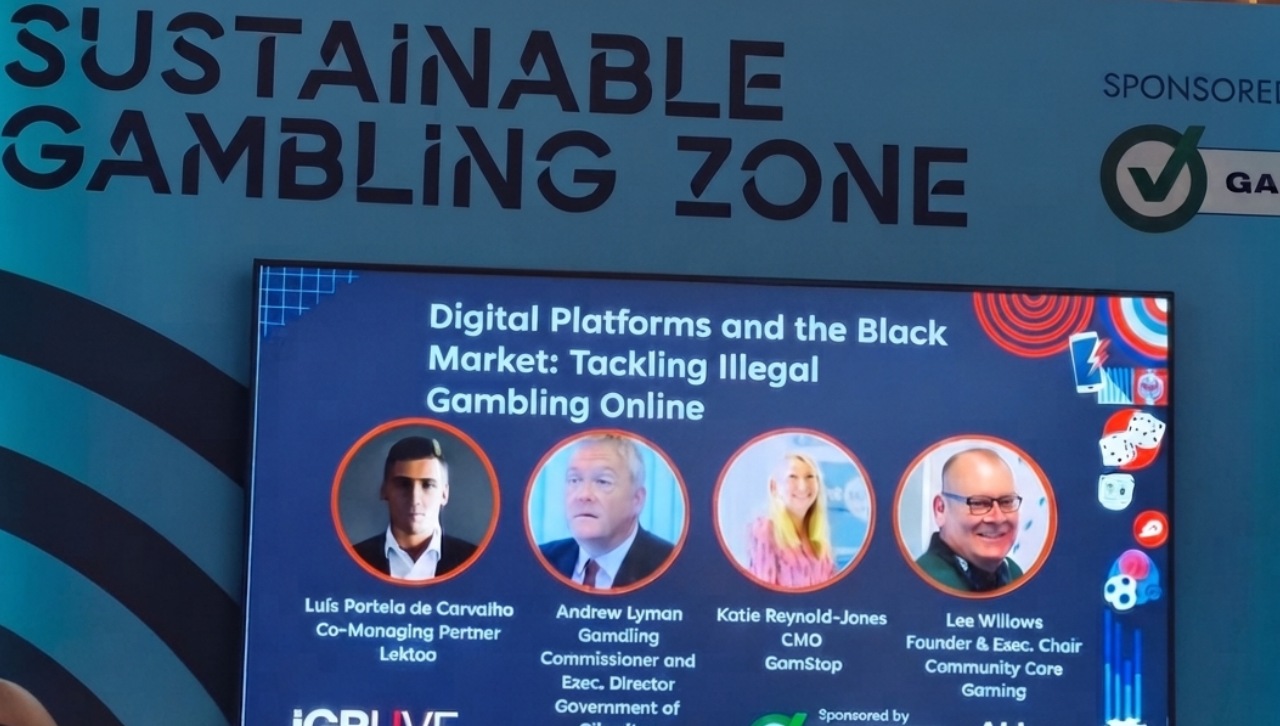
As the online gambling sector continues to evolve, the rise of unlicensed operators and black-market gambling remains one of the industry's most pressing challenges. This critical issue took centre stage during the "Digital Platforms and the Black Market – Tackling Illegal Gambling Online" panel at iGB Live in London.
Illegal gambling remains difficult to measure
Andrew Lyman, Gambling Commissioner and Executive Director at the Government of Gibraltar's Ministry of Justice, Trade and Industry, acknowledged that accurately measuring the size of the illegal gambling market remains very difficult.
However, he added, there is little doubt that the illegal market across jurisdictions, including the UK, is substantial and continuing to grow.
Lyman suggested that one of the key reasons for this growth is that regulation has failed to keep pace with digital technology.
Katie Reynold-Jones, Chief Marketing Officer at Gamstop, echoed concerns about the lack of reliable data.
She noted that illegal operators are increasingly targeting British consumers, particularly through "non-Gamstop" advertising that appeals to self-excluded players.
Influencer marketing raises concerns
A significant portion of the discussion centred on the responsibility of digital platforms in limiting the promotion of illegal gambling.
Lee Willows, Founder and Executive Chair of Community Care Gaming, shifted attention towards the growing issue of social media influencers promoting unlicensed sites.
"Influencers are a new breed of marketers driving illegal advertising practices," Willows said, noting that many have substantial online audiences. Additionally, influencers often find it difficult to differentiate between regulated and unregulated gambling brands, which exacerbates the problem of not recognising when their partners are, in fact, illegal.
Improving consumer awareness
Several panellists agreed that greater consumer and influencer education will be essential in combating illegal gambling.
Reynold-Jones pointed to public awareness campaigns around illegal tobacco sales as a model that could be replicated within gambling.
Of course, the Betting and Gaming Council aims for similar campaigns to help consumers recognise illegal operators and sites that are designed to specifically mirror regulated offerings in the UK. "Why not educate people about what an illegal operator looks like?" Reynold-Jones asked.
Lyman agreed, observing that many illegal operators present highly professional websites that appear entirely legitimate.
"Customers generally want two things," he explained. "They want to be paid when they win, and they want confidence that their payment details and personal data are secure."
Because many illegal sites successfully imitate licensed operators regarding these factors, consumers often struggle to tell the difference.
"Harm is only a few clicks away," Lyman warned, particularly through social media advertising.
Andrew Lyman, Gibraltar Gambling Commissioner, said pressure should be placed on payment providers and other businesses that support illegal operators, rather than relying solely on cease and desist notices, which he said have had limited success
Taking aim at the wider gambling ecosystem
Another recurring theme during this panel was the role played by B2B suppliers, payment providers and affiliate marketing in providing infrastructure and advertising platforms for the illegal market.
Lyman noted that Gibraltar has begun licensing parts of the marketing sector and suggested regulators across Europe, the United States and Africa will increasingly need to consider regulating affiliate marketing and similar promotional channels.
He also argued that greater pressure should be placed on payment providers and other businesses that support illegal operators, rather than relying solely on cease-and-desist notices, which he said have had limited success.
Navigating crypto and prediction markets
The panel also explored the emergence of cryptocurrency payments and prediction markets.
Lyman described cryptocurrencies as high-risk from a regulatory perspective but acknowledged that consumer demand means regulators cannot simply ignore them.
It was also noted that a major social media platform is moving into the prediction market space, likely referring to Meta. They can leverage their extensive user data to drive traffic to prediction markets.
Discussion further focused on how to regulate this rapidly emerging field. Gibraltar has already licensed a prediction market operator. Questions were raised about how to establish effective regulations and standards for harm protection and anti-money laundering (AML) measures.
The need for more agile regulation
Conclusively, the panel drew to a close with all speakers concurring that the issue could be eased by regulators becoming more agile.
Several speakers argued that blanket bans on emerging gambling products risk pushing consumers towards unregulated alternatives rather than improving consumer protection.
Lyman suggested that many regulators remain reluctant to embrace new gambling verticals despite consumer demand. Afterwards, once they regulate the product, political priorities often shift towards maximising tax revenues, thereby reducing the regulated product's attractiveness to players.
In June, ADI PredictStreet was awarded the first prediction market license granted in Gibraltar