













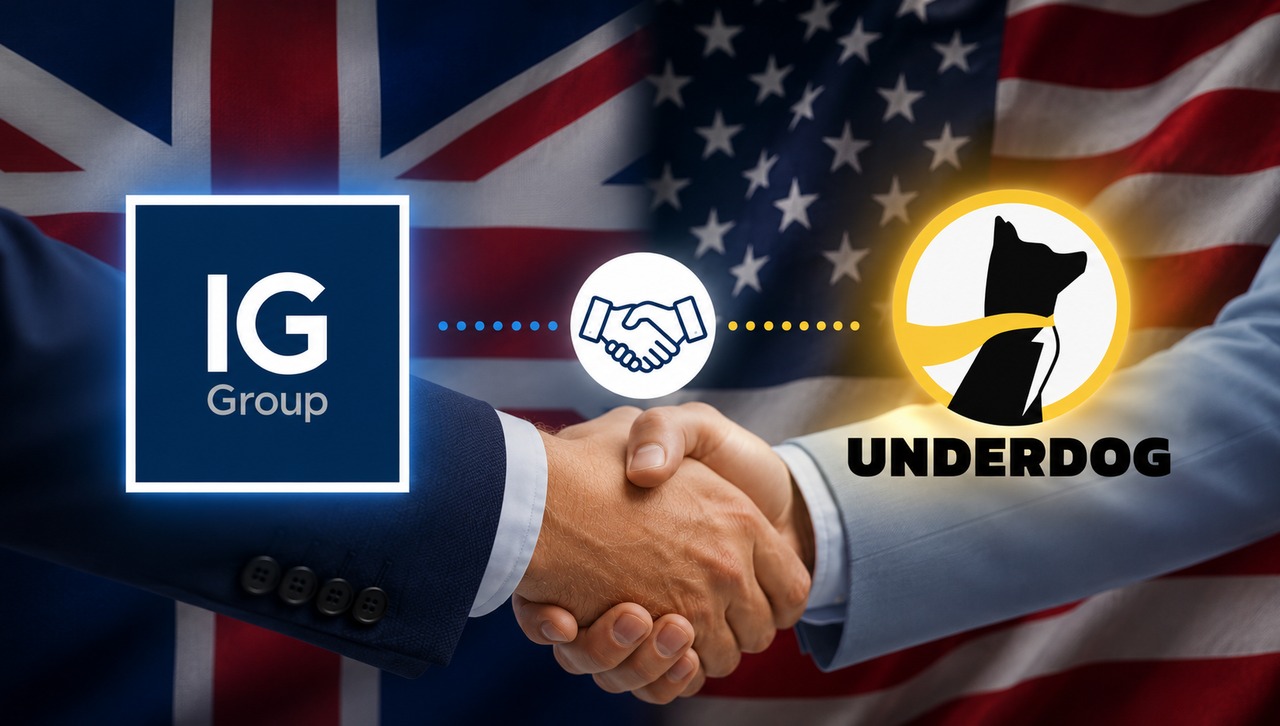
Celebrating just its sixth birthday this year, Underdog Fantasy received quite the gift when IG Group proposed a $1.3bn acquisition of the operator on July 30, a move to help “accelerate” the UK trading provider’s shift into US prediction markets. While Underdog will still remain as a commercially standalone business – with its own brand, management team and operational platform – the transaction marks a significant milestone for the formerly standalone daily fantasy sports (DFS) operator.
What it also represents, though, is just how opportunistic the prediction markets scene is viewed by organizations both in the US and across the pond. With Underdog having become the third-largest US prediction markets venue by regulated notional volume flow, the investment from IG Group comes as little surprise for an entity looking to break into “one of the most significant opportunities across trading and entertainment,” according to CEO Breon Corcoran.
As the initial shock of the acquisition begins to dissipate, the industry will be forced to ponder if the IG Group-Underdog deal is a one-off transaction or a sign of how fellow organizations may plan to enter the prediction markets space.
Could this merger be a UK investment catalyst?
At first glance, this acquisition represents a huge swing on the long-term economic stability and growth of the prediction market sector in the US. As one of the UK’s most well-recognized regulated trading operators, a $1.3bn investment from IG Group is highly unlikely to be a gamble, but rather a more calculated prediction (pun intended) as to the direction of travel across the pond.
But then again, what is the difference between a gamble and a prediction?
That, of course, is the question everyone across the global industry has been asking for almost two years – and this acquisition only serves to blur the lines further, rather than offering anything in the way of clarity.
The UK’s Gambling Commission has made its stance on the sector clear – it defines them as gambling products under the 2005 Gambling Act. Nevertheless, prediction markets are supposedly under the sole regulatory jurisdiction of the Commodity Futures Trading Commission in the US – and that model certainly isn’t working.
With Underdog set to grow its offering under IG Group as well, the distance between FanDuel, DraftKings and fellow prediction market competition seems set to only extend farther in the near future
Indeed, the continued convergence of these products in the US raises difficult questions over where that regulatory boundary should sit if similar products emerge in Britain.
This merger, however, evidently seeks to expand IG Group’s presence in the US market – whilst also highlighting that it is now not just gambling operators such as FanDuel or DraftKings that see the value in prediction markets, but mainstream financial firms, too.
Make no mistake, IG’s investment into the space represents the entry of an established capital markets company that has sniffed out a significant commercial opportunity. It will bring long-standing trading, technology and investment expertise to the table. This, integrated with Underdog’s pre-existing sports-focused player base and market knowledge, highlights the obvious synergies between the pair.
That being said, the market doesn’t quite seem to agree, as IG Group’s share price has dropped by over 14% in the 24 hours since the announcement of the merger, with its market capitalization dipping in tandem to £4.82bn ($6.49bn).
On a separate note, this strategic decision could also represent something of a beacon to other major players in the UK market that investment into US prediction space could pay dividends long-term – acting as a catalyst for similar deals from firms looking to extend their own reach over the Atlantic.
Hypothetical digressions aside, the timing of this merger is undeniably fascinating. As some states such as New York and Nevada continue to tear at the throat of the predictions sector, others such as North Carolina and (somewhat surprisingly) New Jersey have quietly softened on the practice. All the while, those huge unregulated gambling economies such as California and Texas continue to take the ‘sit back and watch’ approach – much to the disappointment of many Tribal entities across the US.
Is Underdog set to challenge Kalshi for the prediction market mantle?
Underdog took its first steps toward becoming a notable player in prediction markets after launching the product through its own federally regulated exchange, completing a shift away from relying exclusively on third-party venues for the contracts offered through its app.
Having previously served as an intermediary for exchanges such as Crypto.com and Kalshi, Underdog will instead look to challenge both operators for a greater slice of the US prediction markets pie. Now backed by IG Group’s billion-dollar-plus support, it appears Underdog is well-positioned to take a leading stance across sports betting’s latest innovation.
As the initial shock of the acquisition begins to dissipate, the industry will be forced to ponder if the IG Group-Underdog deal is a one-off transaction or a sign of how fellow organizations may plan to enter the prediction markets space
As Kalshi, Polymarket and the CFTC continue to fight lawmakers on both the state and federal scale, IG Group may also view Underdog as a way of tip-toeing around the efforts made to restrict event contract trading since 2025. Given the operator is currently accessible in nearly every US jurisdiction, there could be a simpler means of entry for Underdog rather than what its prediction market counterparts have been forced to endure.
But will Underdog ever achieve the same goliath-type control in prediction markets that FanDuel and DraftKings have maintained for sports betting?
It’s difficult to imagine Kalshi falling off the prediction markets podium anytime in the near future, although the legal understanding of what is a “swap” or “trade” appears to change with each passing day in the US. Ultimately, the industry may also become wide enough that Underdog can return the value IG Group has placed upon the operator even while fellow competition continues to grow as well.
Underdog has plenty of motivation to further enhance its prediction market and sports betting businesses, as the operator must deliver an EBITDA of at least $400m in 2028 and $700m in 2029 to receive the maximum payout from its transaction with IG Group. Still, going from having to establish operations during the Covid-19 pandemic to its most recent valuation marks an impressive tale of sports betting triumph, and one with a true underdog story (we can all make puns).
Perhaps most telling is how the previously mentioned sports betting goliaths will respond to IG Group’s acquisition of Underdog, as it would be difficult to describe FanDuel and DraftKings’ first foray into prediction markets as anything less than disappointing up to this point.
Are FanDuel, DraftKings set to fall further behind in predictions race?
Representing late entries into the prediction markets contest, it’s certainly understandable as to why FanDuel and DraftKings have yet to replicate its sports betting success for event contract trading operations. This doesn’t necessarily mean its competitors have slowed, however, as evidenced by Underdog’s new financial backing.
If anything, the space has grown to bring forth even greater opposition, as FanDuel’s parent company – Flutter Entertainment – is joined by IG Group in undergoing trans-Atlantic prediction market efforts.
Indeed, the continued convergence of these products in the US raises difficult questions over where that regulatory boundary should sit if similar products emerge in Britain
On May 6, FanDuel CEO Amy Howe was removed from her position after serving with the operator for over five years, with Flutter’s stock having fallen nearly 60% over the past full-year period. As part of a Q1 earnings call, Flutter CEO Peter Jackson stated “I don’t believe there’s anything we point to and think we’ve fallen behind,” but also highlighted a failure to “operate its generosity playbook” and “execute our digital strategy well” during the quarter.
DraftKings also launched a proprietary prediction markets exchange in June, DKeX, and recently surpassed approximately $3.4bn in annualized consumer volume on its DraftKings Predictions product. While Co-Founder and CEO Jason Robins expects to “emerge as the leader” in US prediction market activity, the operator has yet to catch-up to the type of figures Kalshi, Robinhood and Polymarket have become accustomed to.
With Underdog set to grow its offering under IG Group as well, the distance between FanDuel, DraftKings and fellow prediction market competition seems set to only extend farther in the near future. It remains to be seen if additional financial support will arrive for FanDuel and DraftKings’ prediction market ventures, but it's clear the industry has no qualms of leaving both behind as event contract trading continues to generate intrigue on a global scale.
Underdog appointed Nick Lundgren as its new Chief Legal Officer on May 8, less than one month after stepping down from his roles as both Crypto.com Chief Legal Officer and OG.com CEO