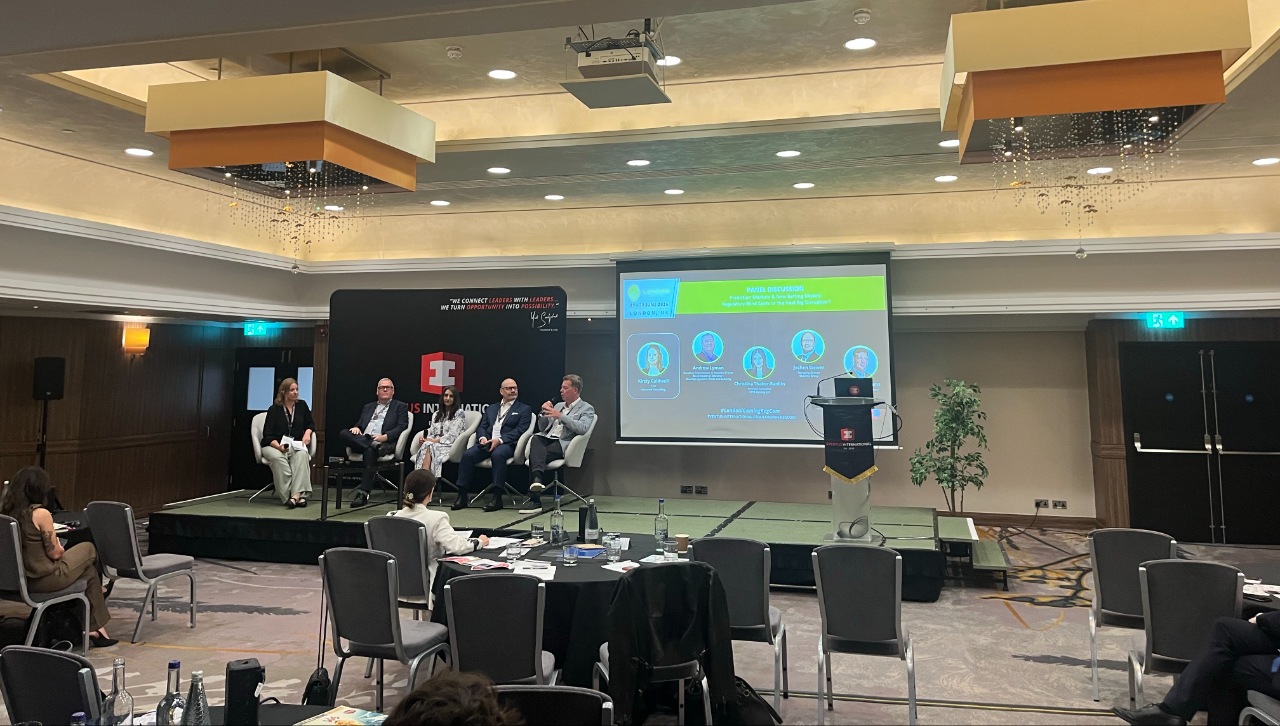
As the London iGaming REGCOM 2026 progressed into the afternoon, the prediction market discussion inevitably arrived, this time with a particular focus on their potential across the pond. Elsewhere, this expert panel also contributed their respective viewpoints on what the industry could look like in 10 years time, providing fascinating insights into innovation and growing ethical concerns.
Predictions and the Atlantic gap
Caldwell opens the discussion by posing the question of whether prediction markets will cross over effectively - or in any way - from the US to European market.
Williams outlines that he does not believe they will, mainly because the US gaming landscape is nowhere near as mature, which somewhat eliminates the novelty aspect - particularly applicable in states where gambling is still unregulated.
Lyman discussed ADI Predictstreet - which he licensed as the Gibraltar Gambling Commissioner - which only covers football markets. He explains they were happy to be classified as a betting intermediary. He explained that he believes it is not hard to regulate prediction markets once they are classified - the difficulty is classification, as many of them don’t want to be pinned down as gambling operators or financial services.
Building on this point, Thakor-Rankin believes we could have ‘predicted’ what was coming with prediction markets because of the nature of sports betting markets in the US, particularly when considering the market for micro betting and the desire from the younger generation to trade services and via crypto. She also outlined that insider trading is a huge risk, that combines with any regulatory risks affiliated with traditional sports betting in the prediction market space.
I do not think there will be a singular dominant brand of product in the gambling industry
Not as ‘new’ as we thought?
Emphasising the point that there have been recent indicators of revolutionary innovation in gambling, Lyman also drew comparisons between prediction markets and sweepstakes. He stated that sweepstakes satisfy consumer demand for slots with extras added, underlining that while prediction markets are taking their thunder, it shows how difficult it can be to combat something when there is an undeniable demand.
Outlining his demands as a regulator for the Gibraltan jurisdiction to combat insider trading, he stated that there is already an integrity model from regulators in Europe, so the operators must simply have robust AML and affiliated controls that can be tailored and monitored across differing markets. He continued by outlining that EU regulators must also have robust ethical safeguards - including no markets on death and so on - working alongside proper insider trading integrity controls to ensure a sustainable ecosystem before they could theoretically facilitate prediction markets.
Chiming in, Thakor-Rankin highlighted the issue of money laundering. Conceptually, she explained that she holds a ‘gut instinct’ that if there can be financial integrity issues related to prediction markets, AML failings can never be far away. The addition of this to an already strained financial ecosystem within gambling is, indeed, a troubling concept.
Biewer shifted the conversation to regulatory loopholes in the European market, explaining that there are crypto operators utilising loopholes in jurisdictions with outdated financial regulatory controls across Europe.
He emphasised that there are many regions that do not have the facilities to properly regulate the modern and rapidly evolving payment sector within the context of gambling. He stated that new Austrian regulations will take a sharper focus on crypto, however he has heard German regulators say they will not advance in this area because “they do not understand how.”
This point echoes discourse around regulators in the US market, namely the Commodity Futures Trading Commission, which is facing intense scrutiny from many in Congress who believe they do not actually know how to effectively regulate what are now widely recognised to be gambling products.
Expert predictions: What’s on the horizon?
Concluding, Caldwell posed the panel the question of which gambling products will be most popular in 10 years' time and how regulations will have to change to accommodate them.
The younger generation do not believe animals are for sport
Lyman stated that prediction markets won’t drive the demise of good sports betting sites, but rather platforms that are not easy to access and use: “I don’t think there will be a singular dominant brand of product in the gambling industry, I think there will be a wider range of options.”
Thakor-Rankin stated that in even 10 months' time prediction markets will have started to dissemble as it is a “mess with the modelling.” She thinks that further down the line horseracing will have dwindled massively: “The younger generation do not believe animals are for sport.” AI, she believes, will drive statistical betting in a way that cannot yet be realised.
Biewer stated that regulations in Europe are losing more and more ground to the black market, he thinks that long-term there must be a “massive amendment” in regulations - and that gaming, gambling and entertainment will become the same thing, which could spark a new breed of addiction for the younger generation.
Williams’ personal view is that over the next 10 years it is how we are betting will change more than what we are betting on. Voice activation, Telegram betting, Meta glasses and many additional innovations will evolve gambling in the same way they are more broadly evolving media consumption. The question, he outlined, then becomes; how do you regulate these kinds of products?
ADI Predictstreet became on of the first formally regulated prediction market operators in Europe after gaining a license in Gibraltar